

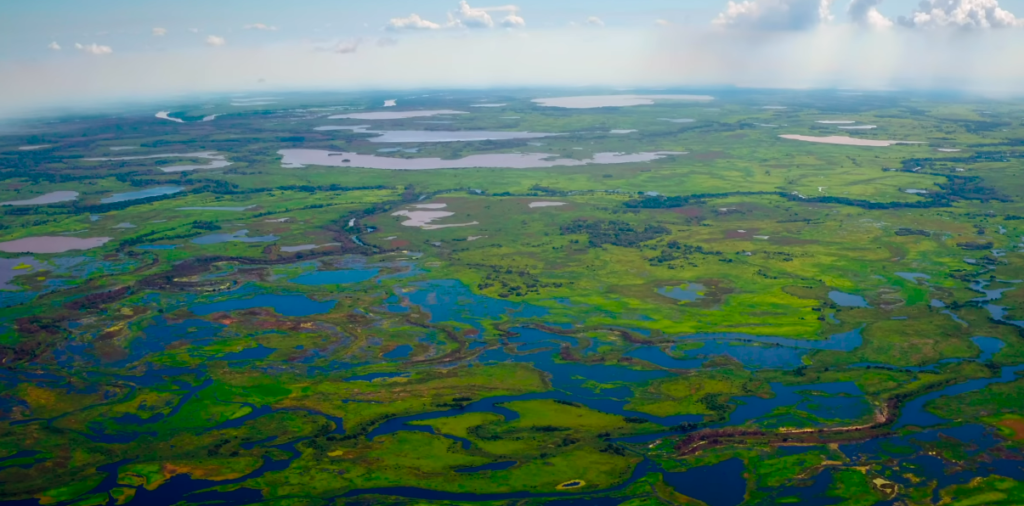
It doesn’t appear that the Pantanal should burn. For the majority of the year, it is a glistening patchwork of grass and water, with flooded plains extending toward a horizon only occasionally interrupted by wooden cattle fences and palm trees. Lazily, herons rise from marshes. In the mud, jaguars leave silent footprints. The smell of slow-moving rivers and damp earth fills the air. However, something seems strange lately. The soil fissures are growing, and the water that formerly characterized this terrain is retreating.
It’s hard to ignore the alarming rate at which Brazil’s Pantanal wetlands are drying up. Water surface coverage in 2023 was the lowest since regular satellite monitoring started in the mid-1980s, falling 61 percent below the historical average. There have been reports of water levels in some areas being two meters below normal. It’s difficult to ignore the quiet when you’re standing beside what was once a shallow lagoon but is now just a muddy depression. fewer birds. fewer insects. A dryness that doesn’t feel right.
There are instant repercussions. More than 980% more fires occurred in 2024 than the year before. More than 627,000 hectares had burned by the middle of the year, threatening to eclipse even the devastating 2020 season, when almost 30% of the entire Pantanal was charred. Smoke turned distant skylines gray as it drifted across cities. The transition to fire seems almost cruelly ironic for a location that is recognized as the largest tropical wetland in the world.
| Category | Details |
|---|---|
| Ecosystem | Pantanal Wetlands |
| Location | Brazil (also extends into Bolivia & Paraguay) |
| Size | ~150,000 square kilometers (world’s largest tropical wetland) |
| Key Species | Jaguar, Caiman, Hyacinth Macaw |
| 2023 Water Loss | 61% below historical average |
| 2024 Fire Increase | Over 980% surge compared to previous year |
| Historic Fire Season | 2020 fires burned nearly 30% of region |
| Current Water Levels | Approximately 2 meters below normal |
| Official Environmental Data | https://www.gov.br/mma |
| Wetlands Research & Advocacy | https://www.wetlands.org |
Climate change may be intensifying what may have been cyclical drought in the past. According to researchers, these extreme dry conditions are now 40 percent more intense and several times more likely due to human-induced warming. There have always been wet and dry seasons in the Pantanal. Its biodiversity was defined by that rhythm. However, the dry season now lasts longer, extending into months when rains used to replenish.
An additional layer of stress is caused by deforestation in nearby biomes, such as the Amazon and the Cerrado. The area depends on airborne moisture that travels through forests and falls as rain, which scientists sometimes refer to as “flying rivers.” The atmospheric moisture cycle deteriorates when those forests are cut down. Although the extent of that damage is still unknown, the pattern is concerning. Researchers are discussing a study that links deforestation to worsening drought.
The ecological cost is enormous. The endangered hyacinth macaw, which flashes cobalt wings across the sky, caimans lounging in river shallows, and one of the highest concentrations of jaguars on Earth can all be found in the Pantanal. An estimated 17 million vertebrates perished in the 2020 fires. Long after the fire has subsided, the image of burned wildlife—blackened tree trunks, scorched turtle shells—remains.
The change is also felt in nearby communities. As rivers get smaller, fishing families report fewer catches. After generations of living alongside seasonal floods, cattle ranchers now have to deal with dry pastureland rather than predictable cycles. Something fundamental appears to be shifting. One wonders how many more dry seasons ranch hands can withstand as they fix fences along dusty ground that was once submerged.
In a drying wetland, the fires themselves exhibit distinct behaviors. The peat-rich soil of the Pantanal can smolder for days underground before suddenly resurfacing. Firefighters, who frequently operate in intense heat, talk about battling seemingly uncontrollable flames. The image of the soggy earth becoming flammable is eerie.
During times of high fire activity, some officials have proclaimed states of emergency. More protection and restoration work is being called for by international organizations. More than 70% of the world’s wetlands have vanished in the last century, according to wetlands advocacy groups. Once thought to be resilient, the Pantanal now seems vulnerable in unexpected ways.
This is part of a larger pattern. As temperatures rise, droughts are occurring more frequently and with greater severity worldwide. The duration of wildfire seasons is increasing. Given that, the Pantanal crisis seems less singular and more admonishing. What implications does this have for smaller ecosystems if the largest tropical wetland in the world can dry up to this degree?
Nevertheless, the Pantanal story still includes resiliency. Grasslands and fish populations were restored in previous years when floodwaters returned following periods of extreme drought. There is a memory in nature. However, it’s unclear if recovery windows are getting shorter given the frequency and intensity of recent dry spells.
Standing on cracked earth where water once shimmered makes it difficult not to feel uneasy. The abundance of life, water, and space has always been what defines the Pantanal. That impression changes when you see it burn and thin. As though the scenery is holding its breath, there is a subdued tension in the air.
Rainfall patterns, upstream forest preservation, and global climate trends—which sometimes seem out of the control of those closest to the flames—will determine whether the Pantanal can regain its equilibrium. It is evident that the drying has become more noticeable. It can be felt in the smoke that floats across the horizon, measured in meters, and seen from satellites.
Disclaimer
Nothing published on Creative Learning Guild — including news articles, legal news, lawsuit summaries, settlement guides, legal analysis, financial commentary, expert opinion, educational content, or any other material — constitutes legal advice, financial advice, investment advice, or professional counsel of any kind. All content on this website is provided strictly for informational, educational, and news reporting purposes only. Consult your legal or financial advisor before taking any step.
