

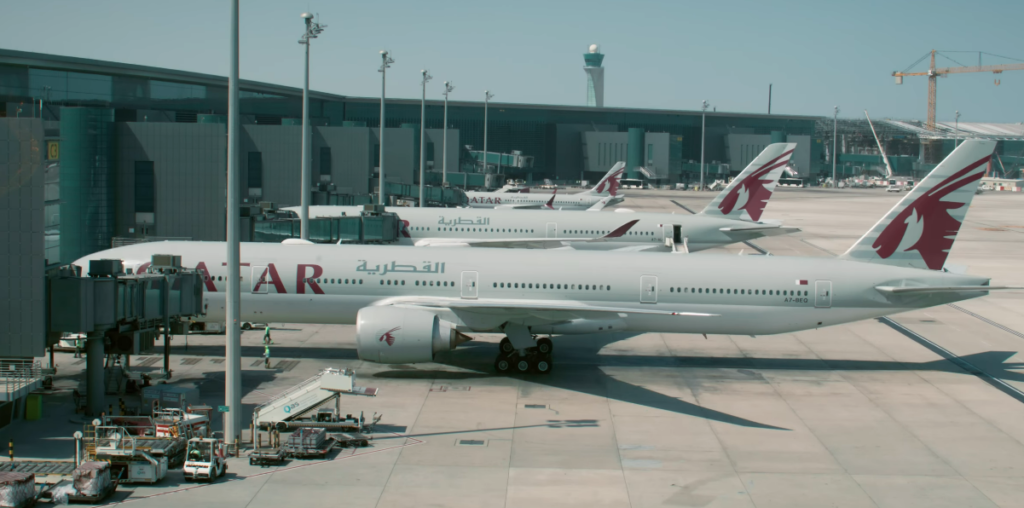
Before many travelers had even arrived at the airport, the phrase “Qatar Airways flights cancelled” started to trend. The familiar and dreaded red label “cancelled” was flickering on the departure boards inside Hamad International Airport by early afternoon. A few passengers gazed at the screens as though the letters might move on their own. They didn’t.
Following the closure of Qatari airspace due to an increase in military strikes throughout the region, the airline confirmed a temporary suspension of flights to and from Doha. The disruption was not unique. Radar maps revealed aircraft veering awkwardly around the region like cautious drivers navigating a blocked highway, and the skies over Iran, Iraq, Bahrain, Kuwait, and the United Arab Emirates were also becoming thinner.
Normally humming with quiet efficiency, Hamad International felt oddly empty. Stores were open. Coffee makers hissed. However, the departure gates that normally let travelers into Sydney, Bangkok, Johannesburg, and London were only partially occupied. Modern airports seem to be built to conceal stress, but even in the smallest details—hurried phone calls, airline employees speaking in low tones, and families huddled around charging stations—the tension was evident.
Initially predicting a limited restart later in the evening, Qatar Airways stated that operations would resume as soon as airspace reopened. Whether that timeline will hold is still up in the air. After planes and crews are displaced, the repercussions can continue for days, aviation analysts have cautioned. It is not possible for planes stuck in Cairo or Athens to teleport back to Doha.
| Category | Details |
|---|---|
| Airline | Qatar Airways Group |
| Founded | 1993 |
| Headquarters | Doha, Qatar |
| Hub Airport | Hamad International Airport (DOH) |
| CEO | Engr. Badr Mohammed Al-Meer |
| Fleet Size | 200+ aircraft |
| Alliance | Oneworld |
| Reason for Cancellation | Temporary closure of Qatari airspace due to regional conflict |
| Official Travel Alerts | https://www.qatarairways.com/en/travel-alerts.html |
| Civil Aviation Authority (Qatar) | https://www.caa.gov.qa |
Geography is what makes this disruption more significant than a typical weather delay. At the intersection of international aviation, Doha and Dubai direct traffic from Europe to Asia through waves of connecting flights that are precisely timed. The effects of Qatar Airways ceasing operations extend well beyond the Gulf. Business travelers connecting from Manchester to Mumbai, vacationers returning from the Maldives, and students flying from Paris to Australia all abruptly stopped.
It’s difficult to ignore how reliant on a small number of transit hubs the modern world has become as you watch this unfold.
On their way back from Southeast Asia, a British couple got stuck in the middle of their connection. Their luggage was in the system when their subsequent flight to Heathrow was canceled. They weren’t upset. Simply exhausted. Outrage didn’t feel as telling as that quiet weariness.
Approximately 50% of flights to Qatar were canceled during the first closure window, according to aviation data firm Cirium. Approximately 24% of services in the wider Middle East were discontinued. Although those figures may seem clinical, they represent thousands of travelers looking for lodging and rerouting via hubs in Europe, Riyadh, or Muscat.
Additionally, there is a financial component. Qatar Airways is a significant cargo carrier in addition to being a passenger airline. Every day, cargo traveling to Asia and Africa passes through Doha. Supply chain disruptions cause delays for electronics, perishable goods, and pharmaceuticals. Investors appear to think that earnings projections might need to be modified if closures take longer than a few days.
However, airlines have become used to unpredictability. Travel time between Europe and Asia increased by hours as a result of carriers redrawing flight routes due to the Russia-Ukraine war. The price of fuel increased. Flight durations increased. And planes continued to fly. Here, immediacy makes a difference. Within hours of receiving a missile alert, hundreds of flights are grounded as airspace is immediately closed.
Residents of Doha’s shopping center district reported hearing thuds in the distance as projectiles were intercepted by defensive systems. Although the public was reassured by authorities, the psychological effects were evident. People kept checking their phones. Future departures were reexamined by travelers.
It’s possible that Qatar Airways will resume a large portion of its schedule within 48 hours of the airspace fully reopening. In order to help impacted passengers, the airline has sent out more ground crew and provided options for refunds and rebooking. Experience, however, indicates that recovery will be uneven. Simple solutions are complicated by crew duty limits, aircraft rotations, and maintenance windows.
This has a wider implication that aviation executives hardly ever discuss in public. Because it provides effective, central positioning between continents, the Middle East has become essential for global routing. However, risk is also concentrated by that centrality. Ten years ago, few could have predicted how a regional conflict could impede travel from east to west.
The absence was more audible than announcements as I stood close to Gate C23, where a Sydney flight would typically start boarding at midnight. With their hands folded, the gate agents waited. Other routes were shown on the screens. A few travelers departed for hotels in the area. Others sat, as though remaining near the gate would bring clarity.
How long airlines will remain cautious due to elevated tensions is still unknown. Carriers have already been advised by European regulators to stay out of the impacted airspace. Timetables across continents are altered by rerouting around Saudi Arabia or the Caucasus, which adds hours and fuel burn.
Nevertheless, aviation has a certain quiet resilience. Frequently, aircraft that are grounded today leave tomorrow. Anecdotes are disruptions. Empty gates are forgotten.
However, “Qatar Airways flights cancelled” is more than just a headline for the time being. It serves as a reminder that the delicate geopolitical balances are what allow the thin blue lines on a flight map to function as invisible highways in the sky. The world seems smaller and more uncertain when those balances change, even for a brief moment.
Disclaimer
Nothing published on Creative Learning Guild — including news articles, legal news, lawsuit summaries, settlement guides, legal analysis, financial commentary, expert opinion, educational content, or any other material — constitutes legal advice, financial advice, investment advice, or professional counsel of any kind. All content on this website is provided strictly for informational, educational, and news reporting purposes only. Consult your legal or financial advisor before taking any step.
