

The stock of CRWV has been hovering on the brink of extremes. One day, it seems invincible, riding the wave of artificial intelligence alongside Microsoft and Nvidia. The next day, it’s plummeting by almost 20% in a single session, depleting its market value by billions before lunch.
CoreWeave, Inc., the company that created the ticker, reported $1.57 billion in revenue for the fourth quarter, an increase of about 110% from the previous year. Normally, such growth would cause euphoria. Rather, after closing close to $97, shares fell precipitously to about $79.56. Investors focused on growing losses and a lower-than-expected revenue outlook.
It’s possible that the true issue was expectations rather than performance.
| Company Name | CoreWeave, Inc. |
|---|---|
| Stock Ticker | CRWV (NASDAQ) |
| Founded | 2017 |
| Headquarters | Livingston, New Jersey, USA |
| CEO | Michael Intrator |
| Employees | 881 (2024) |
| Market Cap | ~$41.4 Billion |
| 52-Week Range | $33.52 – $187.00 |
| Latest Price | $79.56 (Feb 27 Close) |
| 2024 Revenue | $1.92 Billion |
| Core Business | GPU-accelerated cloud infrastructure for AI |
| Investor Relations | https://investors.coreweave.com/overview |
| Nasdaq Profile | https://www.nasdaq.com/market-activity/stocks/crwv |
A recent afternoon saw trading screens turn red as over 67 million shares were exchanged, which is significantly more than the usual amount. Portfolio managers in Midtown Manhattan debated whether the revenue miss was symptomatic or temporary while scanning earnings transcripts. The story of AI infrastructure still has a strong sense of impact. However, the weight of capital expenditures can cause stories to sag.
One of the most well-known GPU cloud providers is CoreWeave, which rents compute power to AI model developers and constructs data centers crammed with Nvidia chips. The demand is apparent. According to reports, the backlog increased to almost $67 billion. The length of contracts is increasing. From hundreds of megawatts to gigawatts, power capacity is increasing.
Profitability is still elusive, though.
The adjusted loss per share reported by the company fell short of consensus projections. The amount of debt has surpassed $21 billion. It is anticipated that capital expenditures will more than triple from their current levels and reach as high as $30 billion to $35 billion in the upcoming year. The management maintains that this rapid expansion is required to meet customer demand. Investors appear less confident.
It seems as though the stock of CRWV now represents a larger fear of AI spending. The message over the last two years has been straightforward: because AI demand is unending, buy the infrastructure providers. Nvidia took off. Then came software names. Following its 2025 IPO, CoreWeave briefly reached a 52-week high of $187.
It’s difficult to avoid wondering if the market is readjusting as you watch the shares now hover closer to $80.
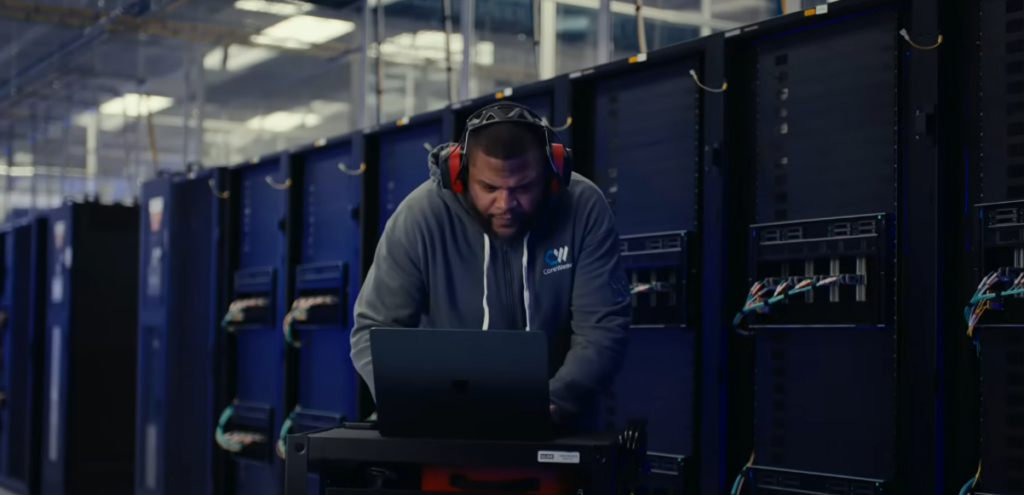
Rows of servers in a New Jersey data center are constantly humming, kept cool by humming transformers and strong ventilation systems. As they move between racks, technicians keep an eye on GPU usage and power loads. The operation’s physical scope is astounding, with an intensity that borders on industrial. There is no sense of speculation. It has a tangible feel.
However, the present is rarely the focus of finance. Leverage and timing are key.
Because CRWV’s debt-to-equity ratio is higher than 2.6, analysts are concerned about growing interest costs. The quick and current ratios of the business are still tight. Every quarterly call is plagued by execution risk, especially with regard to bringing new data centers online without delays. Although class action lawsuits alleging disclosure deficiencies are not unusual in high-volatility growth names, there have even been legal overhangs.
It appears that investors think the backlog warrants the expenditure. Or some do, anyway. Others are questioning whether it makes sense to increase capital expenditures in a market that might cool.
Customers are “desperate” for infrastructure, according to CEO Michael Intrator, who has publicly defended the approach, saying the company would rather suffer short-term margin pain than lose long-term contracts. That belief may persuade. It may also be dangerous.
Whether the demand for AI will continue on its current course or level off is still up in the air. Hyperscalers such as Google Cloud and Amazon Web Services are making significant investments in their own GPU capacity. The launch of an object storage service by CoreWeave indicates that the company wishes to expand its reach beyond computation and engage in more direct competition.
But skepticism is reflected in the stock. Continued losses are highlighted by a price-to-earnings ratio that stays negative. The market cap is still above $40 billion even after the decline, indicating that it will continue to grow rapidly.
As we watch this develop, it seems as though CRWV stock has turned into a gauge for the AI infrastructure market as a whole. It rallies strongly when there is a lot of enthusiasm. It drops as fast when worries about debt and spending arise.
Markets don’t remember things for long. If margins stabilize and revenue guidance improves in six months, today’s selloff might appear to have been an overreaction. The situation may become more complex if interest rates rise or AI capital expenditures decline.
The stock of CRWV is currently at a turning point, supported by large contracts, under pressure from significant spending, and caught between caution and optimism. The servers are still operational. Models are still being trained on the GPUs. The demand is still evident, at least for the time being.
Disclaimer
Nothing published on Creative Learning Guild — including news articles, legal news, lawsuit summaries, settlement guides, legal analysis, financial commentary, expert opinion, educational content, or any other material — constitutes legal advice, financial advice, investment advice, or professional counsel of any kind. All content on this website is provided strictly for informational, educational, and news reporting purposes only. Consult your legal or financial advisor before taking any step.
