

When someone first introduced the concept of a “blue ocean event,” it sounded almost abstract—a neat line drawn at one million square kilometers of sea ice, an academic threshold. The phrase, however, assumes a different meaning when one is standing on the deck of an Arctic research vessel in late summer and observing broken floes drifting past like melting porcelain. It’s more than just a figure. In front of your eyes, the landscape is becoming thinner.
Sea ice has been steadily retreating from the Arctic Ocean for decades; this retreat has been evident in satellite imagery since the late 1970s. The first summer day without ice, however, might come before 2030, possibly as early as 2027, according to new research published in Nature Communications. Even scientists used to pessimistic forecasts find that timeline shocking.
Perhaps the models are finally catching up to the real world. For years, the rate at which Arctic sea ice would disappear was underestimated in many climate simulations. While previous models predicted a decline of about 2.5 percent per decade, observations showed a decline of about 8 percent. That gap has lingered like an uncomfortable footnote in climate science—raising questions about whether the system is more sensitive than expected.
| Category | Details |
|---|---|
| Region | Arctic Ocean |
| Key Study | Nature Communications (2024 study on first ice-free day) |
| Climate Authority | National Oceanic and Atmospheric Administration |
| Research Institution | National Snow and Ice Data Center |
| Ice-Free Threshold | Below 1 million square kilometers of sea ice |
| Earliest Projection | Potential first ice-free day by 2027 |
| References | NOAA Climate.gov • National Snow and Ice Data Center |
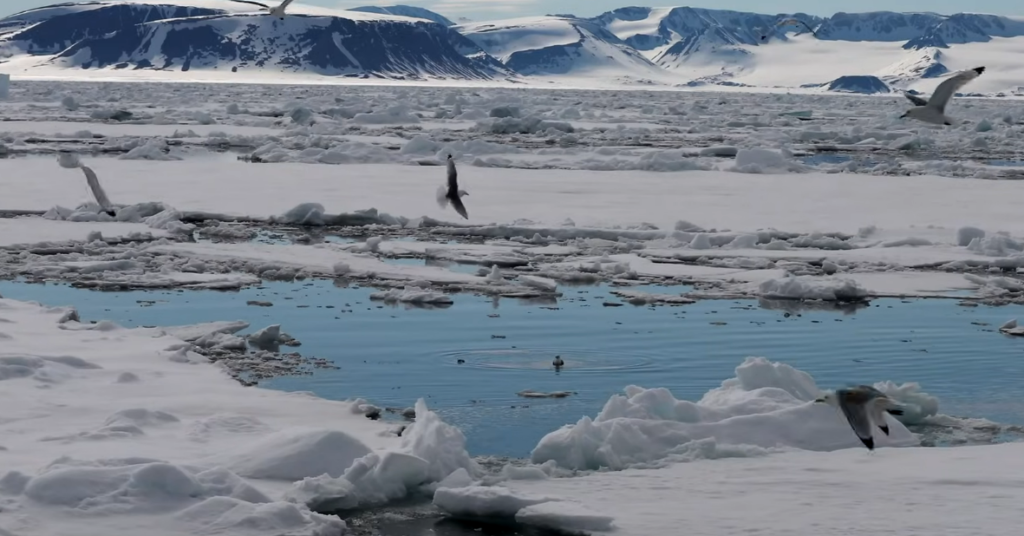
However, the new research focuses on daily thresholds rather than monthly averages. The Arctic does not turn into a warm water bath on a “ice-free day.” With thicker ice clinging to northern Greenland and portions of the Canadian Archipelago, it means that the sea ice extent dips below one million square kilometers, making the majority of shipping routes technically navigable. Yes, symbolic. However, symbolism is important.
There’s a sense that we’re watching the Arctic cross psychological boundaries faster than political ones.
The mechanics are surprisingly easy. Arctic amplification is the process by which the darker ocean absorbs more sunlight as sea ice recedes, intensifying warming. The remaining ice is thinned by the additional heat, preparing it for a quick melt in warm years. Add a stubborn high-pressure system trapping warm air over the region, or a powerful August storm fracturing already fragile ice, and the transition can accelerate dramatically.
This is essentially rolling the dice for the climate, according to scientists, who refer to it as internal variability. According to some simulations, under various emission scenarios, the first day without ice will occur in three to six years. It’s a disturbing detail. It suggests that while even small mitigation measures could affect the frequency of subsequent crossings of that threshold, they might not be able to stop the initial crossing.
It’s difficult to ignore how thin the multiyear ice has gotten as you watch this play out. It used to be resilient, thick, and ridged, but it now covers a lot less ground than it did in the 1980s. In the winter, younger ice forms, which melts more readily in the summer. Storms that might once have left the pack intact now shatter it, speeding dissolution.
The wider ramifications extend well beyond the Arctic Circle. Heatwaves in Europe, North America, and Asia are influenced by storm tracks and atmospheric circulation patterns that are altered by less summer sea ice. Although the precise nature of those links is still unknown, there is mounting evidence that complex ripples from Arctic changes extend southward.
Then there are temptations related to money. Shorter transatlantic routes between Asia and Europe are of interest to shipping companies. Investors appear to think that new maritime routes could bypass conventional routes by thousands of miles. However, those same waters continue to be unstable due to erratic weather patterns and drifting ice remnants. The Arctic is not becoming a cruise route to the Mediterranean. Less frozen, but scarcely stable, it is turning into something unfamiliar.
Indigenous communities have already experienced what headlines frame as future events. Hunting routes and coastal protection have been disrupted by winters in parts of the northern Bering Sea with little sea ice. Season by season, food security changes subtly. In contrast to the lived reality of thinner ice and erratic freeze-ups, the milestone of a “ice-free day” may seem academic to those who live there.
Policymakers are frustrated by the uncertainty surrounding timing, which frequently spans a 20-year window. Researchers advise against obsessing over a single year. The first day without ice could come sooner or later depending on weather patterns like heat domes or lingering high-pressure systems. A few cool summers could delay it. It could come suddenly from a series of warm winters.
However, the long-term trend indicates one course. In recent decades, the Arctic has warmed about four times faster than the global average. Even if emissions decline sharply, some degree of further sea ice loss appears locked in. It does not imply that action is pointless. Summers without ice would probably become less frequent and longer if greenhouse gas emissions were reduced.
It’s hard to measure, but there’s a sense that humanity is on the verge of a significant turning point. For previous generations of explorers who fought against unbreakable ice, an open-water North Pole in September would have been unthinkable. It now falls within the range of likely short-term results.
The fact that the data now sounds so commonplace is perhaps the most depressing feature. percentages, thresholds, and charts. However, every line on a graph depicts a changing physical reality: polar bears swimming farther, coastlines absorbing waves that were previously dampened by frozen buffers, and walruses hauling out on crowded beaches rather than stable ice.
Disclaimer
Nothing published on Creative Learning Guild — including news articles, legal news, lawsuit summaries, settlement guides, legal analysis, financial commentary, expert opinion, educational content, or any other material — constitutes legal advice, financial advice, investment advice, or professional counsel of any kind. All content on this website is provided strictly for informational, educational, and news reporting purposes only. Consult your legal or financial advisor before taking any step.
