

The sounds of the ice in western Greenland on some summer days seem almost out of place. There were softer sounds—water trickling, dripping, and sliding across surfaces that were once permanently frozen—instead of the deep cracking that one might anticipate from glaciers. Researchers have reported seeing meltwater pooling in shallow blue ponds near the ice sheet’s edge, reflecting the sky with a spooky calm. It’s difficult to ignore how unremarkable it appears. Normal, and incorrect.
The rate of change has become hard to ignore for scientists who have studied Greenland for decades. When it first surfaced in satellite data, even seasoned researchers found it hard to believe that the ice sheet was melting roughly seven times faster than it had in the 1990s. At first, some people thought it was a mistake, a brief variation, or maybe an odd weather pattern that would go away on its own.
It didn’t.
It’s hard to imagine without using abstraction how much ice Greenland lost in a single year in 2019—roughly 532 gigatonnes. In locations where summer used to hardly soften the snow, researchers working in remote monitoring stations reported seeing temperature readings rise and occasionally hover above freezing. These moments seem to stick in people’s memories not because they were dramatic but rather because they seemed subtly irrevocable.
| Key Information | Details |
|---|---|
| Location | Greenland Ice Sheet, Arctic Region |
| Ice Sheet Size | Covers ~80% of Greenland |
| Ice Loss Increase | Melting 7× faster than 1990s |
| Record Melt Year | 2019 lost ~532 gigatonnes of ice |
| Potential Sea Level Rise | Up to 7 meters if fully melted |
| Key Research Sources | NASA, Columbia Climate School, UCAR |
| Monitoring Methods | Satellite observations, ice cores, field measurements |
| Scientific Concern | Possible irreversible melting threshold |
| Reference | NASA Jet Propulsion Laboratory |
| Additional Reference | Columbia Climate School |
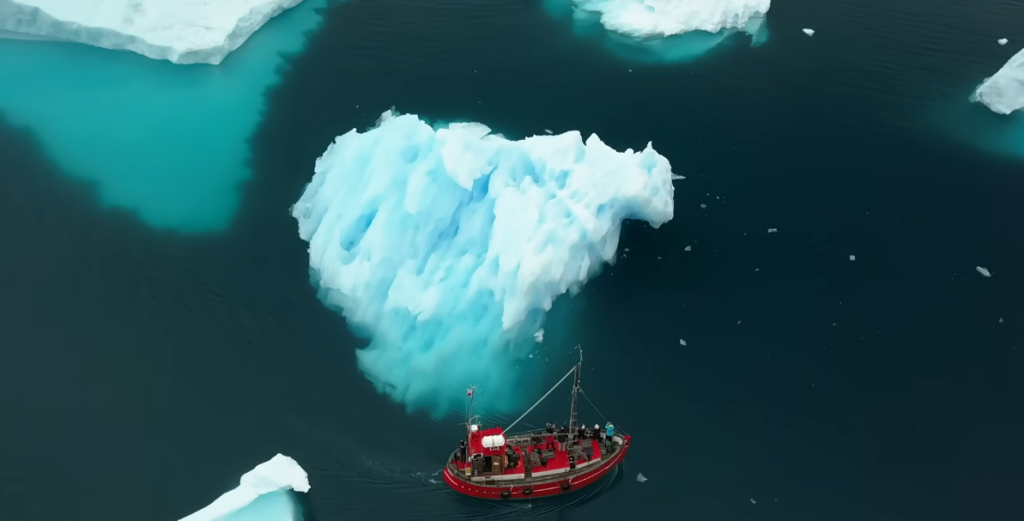
Many scientists were taken aback not only by the extent of the loss but also by how closely it matched worst-case scenarios that were previously anticipated for much later in the century. Those possibilities had always seemed far-fetched and hypothetical. Some researchers are speaking more cautiously than before after witnessing them unfold in real time, decades ahead of schedule.
It’s possible that Greenland has entered a previously unanticipated phase.
The actual ice sheet rises slowly in white slopes toward the interior as it extends endlessly across the horizon. It still seems permanent, almost unconcerned, from a distance. However, satellite data shows that the edges are gradually becoming thinner, with glaciers retreating inland and losing ground each year.
The losses that initially went unnoticed have been among the most concerning. Smaller glaciers that are dispersed along Greenland’s coastline have been melting more quickly than anticipated, which has increased sea levels more than previous models had predicted. These glaciers weren’t the huge ones that catch the eye in pictures. They were ignored and more subdued. One gets the impression from seeing this happen that the system is more brittle than anyone wanted to acknowledge.
Greenland is a stable archive that preserves climate history in frozen layers that date back hundreds of thousands of years, according to researchers who drilled ice cores decades ago. The surface above those layers is changing more quickly than the past would indicate, but those layers still exist.
Scientists now make more frequent adjustments to equipment at field camps, recalibrating instruments made for unpredictable conditions. minor modifications. minor adjustments. Each one suggests a more significant change.
How near a tipping point Greenland may be is still up for debate. If temperatures stop increasing, some scientists think the ice sheet might stabilize. Others fear that even if warming slows, some losses cannot be undone.
Which perspective will turn out to be accurate is still up in the air.
The extent of Greenland’s melting is what makes it so disturbing. Sea levels would rise sharply if the entire ice sheet vanished, changing coastlines all over the world. Today’s cities that seem permanent, like New York, Mumbai, and Amsterdam, would have to deal with unimaginable realities. On the ice itself, however, those repercussions seem far away. The surface is still huge, silent, and invisible. That comparison may be deceptive.
Natural cycles of growth and retreat have always occurred in Greenland. However, the pace now seems different, taking place in a single human lifetime. Previously measuring change in decades, veteran researchers now monitor it annually.
When they talk about it, there’s a subtle change in tone.
Do not panic. More akin to incredulity.
Disclaimer
Nothing published on Creative Learning Guild — including news articles, legal news, lawsuit summaries, settlement guides, legal analysis, financial commentary, expert opinion, educational content, or any other material — constitutes legal advice, financial advice, investment advice, or professional counsel of any kind. All content on this website is provided strictly for informational, educational, and news reporting purposes only. Consult your legal or financial advisor before taking any step.
