

The Milky Way stretches across the sky like a faint bruise on a clear night far from city lights. Sagittarius A*, our galaxy’s invisible anchor, is located somewhere in that hazy band, hidden behind distance and dust. Astronomers have been talking about it with a certain quiet assurance for decades. an extremely massive black hole. In the dark, four million suns were crushed. Some physicists are hesitant, though, except now.
There is a chance that Sagittarius A* is not even a black hole. Einstein’s equations have ruled with almost religious authority in some academic hallways, and that statement still sounds like heresy. However, a growing number of scientists are investigating a more exotic possibility: that dark matter, more especially fermionic dark matter, rather than a singularity, forms the Milky Way’s dense, quantum-supported core.
There is more than just an academic distinction. The universe’s emotional texture is altered.
Astronomers have been studying stars close to the galactic center for years at observatories in Chile and Hawaii. These stars are tiny points of light that follow tight, frantic orbits. Specifically, S2 is a star that completes its orbit around the center in a mere sixteen years, demonstrating tremendous speed. It feels personal to watch those data plots change over time, much like watching insects fly around a flame.
| Item | Details |
|---|---|
| Topic | Fermionic dark matter theory explaining the Milky Way’s central object |
| Key Location | Galactic Center, Sagittarius A* region |
| Main Scientific Proposal | Dense fermionic dark matter core could mimic a supermassive black hole |
| Key Scientists | Dr. Carlos Argüelles and international astrophysics collaborators |
| Observational Evidence | Stellar orbits, GAIA mission data, and Event Horizon Telescope shadow observations |
| Particle Type | Fermions (hypothetical particles like sterile neutrinos, mass ~10–100 keV) |
| Reference Links | ScienceDaily – Dark matter masquerading as a black hole • Universe Journal – Fermionic Dark Matter Review |
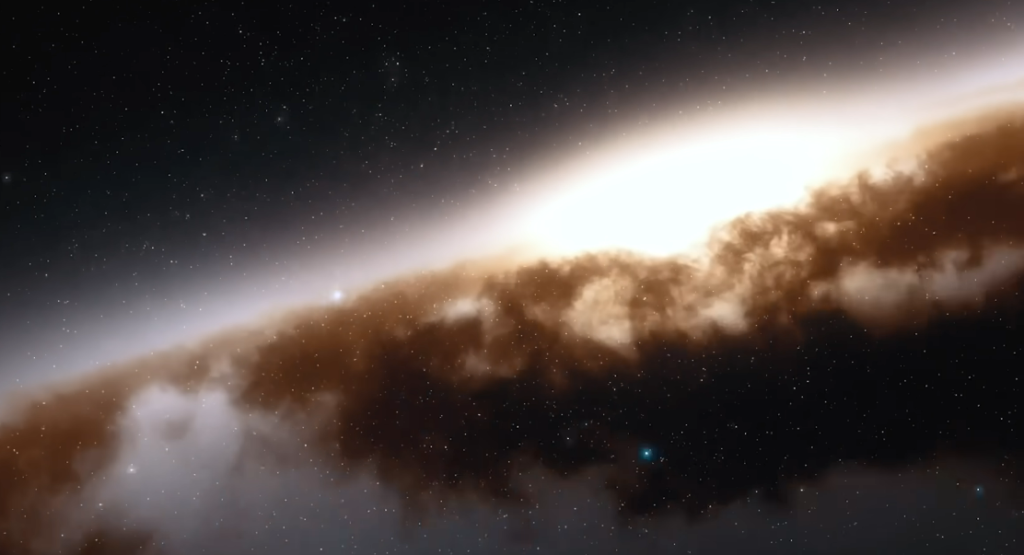
In the presence of intense gravity, those orbits behave precisely as predicted. However, gravity isn’t enough to show what causes it.
For the majority of scientists, the explanation was straightforward: black hole. Long before these objects were seen, Einstein’s general theory of relativity predicted them. His formulas explained how space is bent by matter and how, above a certain density, collapse is unavoidable. Every test to date, including the well-known shadow image taken in 2022, has shown that the theory is sound.
The new fermionic theory, however, has a stubbornly alluring quality.
Because of quantum mechanics—more especially, the Pauli exclusion principle—fermionic particles resist compression rather than matter collapsing infinitely inward. Because of their refusal to share a quantum state, these particles exert a sort of pressure that keeps things from collapsing completely. It isn’t theatrical. It’s silent opposition. An extremely compact core that isn’t a black hole would be the end result.
Crucially, it would appear nearly identical from a distance.
That idea has a disconcerting quality. For many years, astronomers thought they were staring into a chasm where the laws of physics itself would collapse. It could be something else now, a weird invisible sphere of particles that follow laws Einstein never really understood.
New information from the GAIA mission of the European Space Agency fueled the argument. Through the remarkably accurate mapping of star motions throughout the galaxy, GAIA was able to uncover minute patterns in the rotation of the Milky Way. A fermionic dark matter halo that radiates outward and is smoothly joined to a dense core seems to be consistent with these patterns.
That explanation feels so elegant that it’s difficult to ignore it. A black hole and a dark matter halo are two distinct entities that are replaced by a single, continuous galaxy.
As this theory develops, a sense of déjà vu is experienced. Even Einstein rejected Newton’s theory. He substituted relativity and curvature for absolutes and certainty, respectively. Physicists are now challenging Einstein in a similar manner, not out of disdain but out of interest.
Naturally, there is still skepticism.
In the image of Sagittarius A* taken by the Event Horizon Telescope, a shadow appears precisely where a black hole should be. Although fermionic models can replicate that shadow and bend light similarly, imitation is not evidence. Future observations may reveal subtle differences and the object’s true nature, but this is still uncertain.
After all, things rarely go as planned in science.
Some astronomers privately acknowledge that the concept makes them uneasy. As emblems of cosmic mystery, black holes have evolved into cultural icons. Changing them out for something more subdued, something more particle-like, seems almost counterintuitive. Human expectations, however, have never piqued the universe’s interest.
It is not that the fermionic theory contradicts Einstein that makes it so convincing. The reason for this is that it expands his legacy into new areas. Although his equations still explain gravity, it may have a more bizarre origin than anyone had thought.
In silent offices with half-erased equations and chalkboards, physicists keep improving their models by contrasting data point by data point with predictions. There isn’t any big announcement. Just gradual accumulation. Possibility and doubt coexisted.
Disclaimer
Nothing published on Creative Learning Guild — including news articles, legal news, lawsuit summaries, settlement guides, legal analysis, financial commentary, expert opinion, educational content, or any other material — constitutes legal advice, financial advice, investment advice, or professional counsel of any kind. All content on this website is provided strictly for informational, educational, and news reporting purposes only. Consult your legal or financial advisor before taking any step.
