

A map of human emotions wouldn’t typically start with rubidium atoms and a laser beam. However, scientists at the nexus of quantum physics and neuroscience have made that improbable connection remarkably fruitful. Researchers have begun to track how our emotional responses are physically encoded throughout the brain—and how they reflect what we observe in others—by utilizing the concepts of quantum sensing.
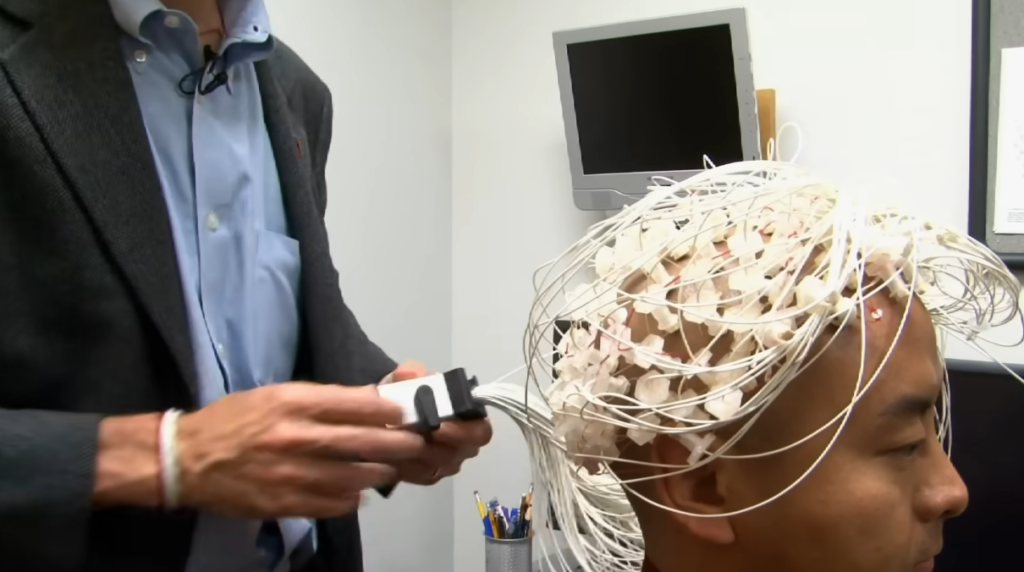
Quantum sensors, especially those that use optically pumped magnetometers, have emerged as remarkably useful instruments for recording minute magnetic fluctuations generated by the brain. In contrast to conventional brain imaging methods, which frequently depend on heavy, cold superconductors, these sensors are incredibly clear, portable, and nimble. Their exceptional sensitivity in measuring magnetism allows researchers to see how emotions develop as structured, spatial, and traceable patterns rather than as purely abstract experiences.
The mapping of emotional resonance in the visual cortex has yielded the most fascinating finding to yet. Eight different maps that function similarly to the somatosensory cortex have been found by scientists. They adhere to the same head-to-toe arrangement that is commonly connected to touch. However, because these maps are based on visual input, it is evident that merely witnessing someone else display joy or anguish can cause our own brains to produce physical representations of those emotions, as though we were internally reproducing them.
Although this type of embodied empathy has long been assumed, it has never before been explained in such vivid neuronal detail. While using quantum sensors to capture participants’ brain activity, researchers showed them scenes from emotionally charged movies to study these impacts. The brain did more than simply register the action when viewers saw someone clutch a hot cup, grimace in annoyance, or flinch in pain; it also physically responded with signals that were spatially organized.
| Topic | Details |
|---|---|
| Core Technology | Quantum sensors using optically pumped magnetometers (OPMs) and atomic-light interaction |
| Key Research Institutions | University of Birmingham, Netherlands Institute for Neuroscience |
| Main Discovery | Quantum sensors detect magnetic signatures of neural activity linked to emotional states |
| Brain Areas Involved | Visual cortex, somatosensory cortex, amygdala |
| Scientific Breakthrough | Mapped body-like “empathy” maps in the visual cortex using emotional response data |
| Application Potential | AI emotion modeling, diagnostics for autism/depression, next-gen brain-computer interfaces |
| Tools Used | TMS (Transcranial Magnetic Stimulation), functional imaging, quantum field detectors |
| Future Implications | Emotionally responsive AI, improved neurotherapies, real-time emotional state decoding |
I was reminded of a day last year when I saw my niece fall off a swing during that scene. Before I knew she had fallen to the ground, my shoulder stiffened. The visual cortex now has a shape—a physical map—etched into it for that silent jolt of shared emotion.
Every map seems to have a specialty. Some are calibrated to identify specific body parts, while others evaluate emotional tone or positioning. Different maps light up depending on our focus, be it hands, posture, or gaze. We can transform what we perceive into potential emotions thanks to this system. Amazingly, it’s all taking place in milliseconds.
These discoveries are not just intriguing from a scientific standpoint, but they are especially novel in the way they relate machine learning to human perception. We may be able to create robots that can not only identify sentiment but also interpret it with real-time nuance if AI systems can be trained to model emotional states using data from these maps. For therapeutic bots, next-generation assistants, and even creative tools that require emotional context to react effectively, that might be extremely effective.
The medical applications of AI are particularly exciting. This discovery could result in better diagnosis for those who have trouble processing emotions, such as those with autism or specific mood disorders. Quantum-based scanning could help clinicians create much more individualized therapies by revealing the points at which emotional decoding fails.
Combining these sensors with transcranial magnetic stimulation (TMS) is one significant advancement. TMS has historically stimulated parts of the brain without providing obvious feedback, making it a bit blind in its application. Researchers can now see what occurs in other areas in real time using quantum sensors, establishing a feedback loop that improves the procedure. This strategy may significantly enhance the treatment of neuropsychiatric disorders that impair emotional control, such as depression and obsessive-compulsive disorder.
These sensors’ capacity to integrate with different modalities is what gives them their extraordinary versatility. Teams are already working on dual systems that detect blood flow and brain activity concurrently by combining quantum sensors with technologies like near-infrared spectroscopy. More precise brain diagnostics are promised by this hybridization, particularly for injuries or minute neurological changes that traditional methods could overlook.
These findings are fundamentally changing our understanding of emotion. It has long been believed that feelings are transient, internal phenomena that are impossible to fully witness. However, we are discovering that emotion has a sort of geography that is recorded, mapped, and retrievable as a result of quantum instruments that are exposing their structure.
Beyond medicine, such realization is significant. Emotional transparency in AI is becoming a major issue in talks of tech ethics. The distinction between real and artificial empathy may become hazy if machines start to mimic emotion using brain maps similar to ours. Though it also raises concerns about emotional privacy and the veracity of digital compassion, there is hope in this—systems that comprehend us better might assist us more naturally.
However, the mood among researchers is still very positive. Mimicry or reducing human emotion to numbers is not the aim. Rather, it’s to gain a deeper understanding of our own inner landscapes and possibly apply that knowledge to promote improved mental health, more emotionally sensitive technologies, and closer human connections.
These scientists are mapping more than just emotions when they map the invisible. They are redefining what is possible when emotion, accuracy, and quantum physics come together—not as theoretical concepts, but as useful instruments that have the capacity to alter our perceptions of one another and ourselves.
Disclaimer
Nothing published on Creative Learning Guild — including news articles, legal news, lawsuit summaries, settlement guides, legal analysis, financial commentary, expert opinion, educational content, or any other material — constitutes legal advice, financial advice, investment advice, or professional counsel of any kind. All content on this website is provided strictly for informational, educational, and news reporting purposes only. Consult your legal or financial advisor before taking any step.
