

Just in front of the boat, a dolphin broke the surface, holding a shell in its mouth like a valuable token. It swallowed the fish that fell out after hovering for a beat and shaking the shell briefly. It was a fleeting but clearly deliberate moment. For the researchers observing from above, it was just another documented case of “shelling,” a foraging activity that has subtly changed the way scientists see learning in wild animals.
Even if the use of tools is excellent, it isn’t what makes this trick particularly inventive. It’s the rate at which the behavior spreads, not across generations but across society. Dolphins in Shark Bay are not merely learning skills from their moms, according to recent studies on the creatures. They are observing their pals. Then they are also doing it.
Researchers discovered that over half of the dolphins using the shelling technique most likely learnt it from their peers after observing their behavior over an 11-year period. Although 57% may seem like a little amount, it’s quite powerful when it comes to animal learning. In non-human species, the majority of foraging behaviors are vertically transmitted from parent to child. Peer-to-peer, or horizontal, learning is still uncommon, particularly outside of primate communities.
| Key Finding | Detail |
|---|---|
| Species Studied | Bottlenose dolphins in Shark Bay, Australia |
| Behavior Observed | “Shelling” – trapping fish in shells and shaking them out to eat |
| Learning Type | Horizontal (peer-to-peer), not just vertical (mother-to-offspring) |
| Cultural Transmission Rate | 57% learned the skill from peers rather than their mothers |
| Significance | Shows cultural learning and intelligence previously linked to primates |
| Environmental Adaptation | Skill adoption rose after 2011 marine heatwave disrupted ecosystems |
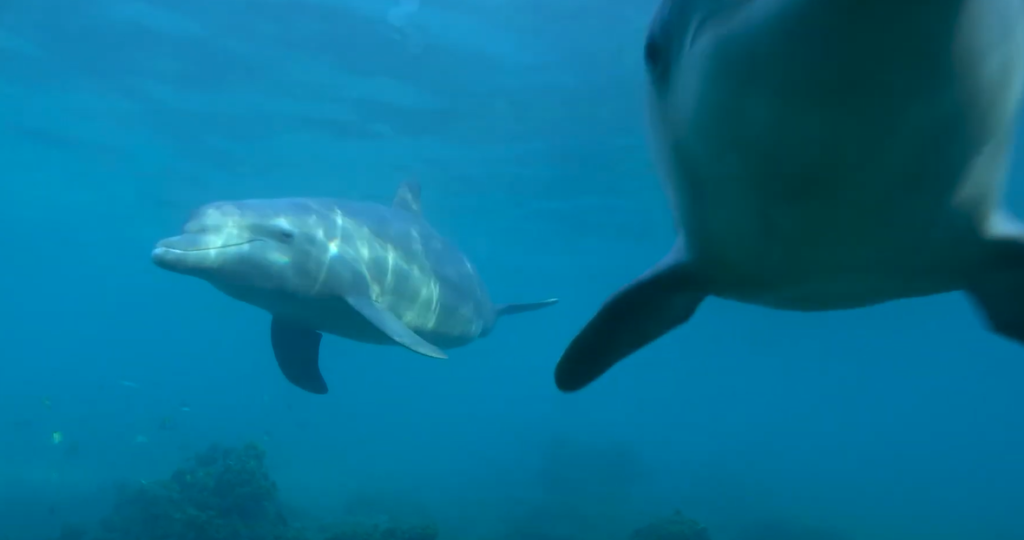
Dolphins are actually one of a very few number of animals that have shown this type of cultural transmission, along with chimps and other bird species. Additionally, they are reacting to changing environmental circumstances in real-time. Things get really intriguing at that point.
Shark Bay’s environment underwent a dramatic transformation in 2011 following a major marine heatwave. Finding prey became more difficult. The well-known hunting spots become less trustworthy. Shelling habits became increasingly common among dolphins that were unrelated at that time. What may have begun as the improvisation of a single dolphin swiftly evolved into a collective tactic—a sort of crowdsourced adaptation.
Researchers monitored the connections and feeding behaviors of over a thousand dolphins by collecting data strategically. They tracked social relationships, including who spent time with whom and how closely, in addition to recording which dolphins were utilizing shells to catch fish. Rather than family links, these social ties turned out to be predictive. Dolphins who interacted with shellers developed into shellers themselves.
When I read that line, it stayed with me. Not relatives. companions.
Although humans are familiar with learning by association, it is especially remarkable to witness it in action in wild marine creatures. It alters our perception of intellect by emphasizing group knowledge as a means of survival rather than individual problem-solving.
Although it’s not the only instance, shelling is one of the more obvious examples of dolphin culture. Mothers typically teach their offspring additional activities, like burrowing through the seafloor and utilizing marine sponges to shield their snouts. Vertical learning is what that is. However, it appears that a maternal connection is not necessary for shelling. It transcends social categories. It moves by way of observation. Because of this, it can adapt more quickly than natural selection could on its own.
Some doubters contend that additional study is required to ascertain the true degree of independence of these learnt habits. Could this be caused by exposure to the environment rather than observation? Maybe. However, it becomes hard to overlook the trend when dolphins that spend time together begin to perform the same new trick.
Not only are these dolphins surviving, but they are adapting with a startlingly high level of sophistication. This type of learning could be especially helpful in light of the rapidly changing climate. A species may not survive if it is unable to quickly modify its behavior. However, the advantage for individuals who can share survival tactics within a generation is far more dynamic.
This discovery has begun to reverberate in the scientific discourse around animal culture in recent days. Humans have long held a limited notion of intelligence, which is frequently predicated on language, technology, or abstract reasoning. However, dolphins can show intelligence without creating devices or writing code. All they have to do is demonstrate their ability to quickly and purposefully observe, analyze, and apply new information.
The shelling trick itself is surprisingly easy. A dolphin carries a big, empty snail shell up the seafloor after chasing a fish into it. It jerks the shell at the surface, allowing the fish to fall into its mouth. It’s very effective, but it’s not very showy. And it only takes one person to witness it in action, give it a try, and repeat it if it works.
Knowledge becomes collective from that moment.
This indicates something both humbling and affirming about dolphin civilizations. Unlike dogs or elephants, they are not merely gregarious. They are social and cultural. They model, imitate, and improve rather than just react. That capacity makes them highly adaptable in an ocean where survival is never assured.
For many years, we have projected human characteristics onto dolphins, frequently mistaking their amiable demeanor for intelligence. However, we are now starting to realize how keen they truly are thanks to study that is based on behavioral data rather than sentiment. And how delicate that edge can be.
The capacity to adapt behaviorally may determine which species flourish and which fail as the ocean changes more quickly than in the past. Dolphins seem to be one of the species that adapts through one another rather than simply changing over time.
They are therefore a case study in learning that is both quick and subtly profound.
Disclaimer
Nothing published on Creative Learning Guild — including news articles, legal news, lawsuit summaries, settlement guides, legal analysis, financial commentary, expert opinion, educational content, or any other material — constitutes legal advice, financial advice, investment advice, or professional counsel of any kind. All content on this website is provided strictly for informational, educational, and news reporting purposes only. Consult your legal or financial advisor before taking any step.
