

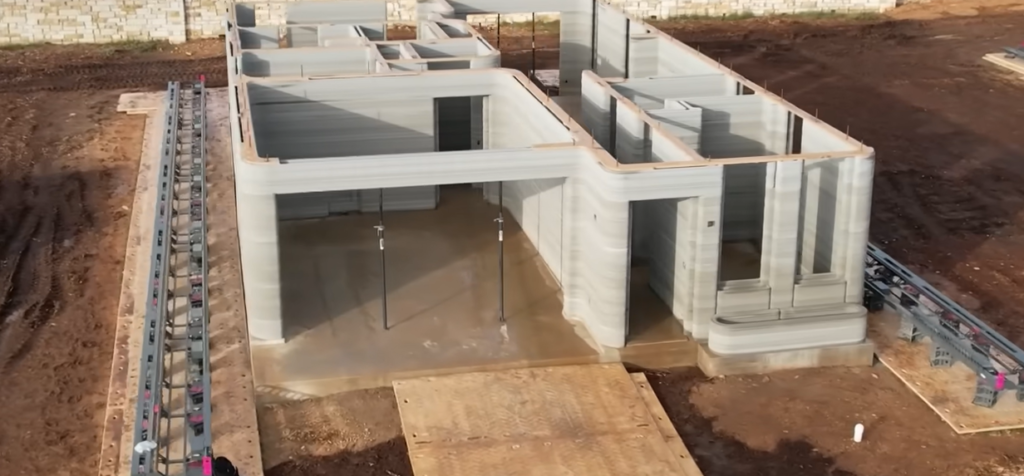
The silence isn’t the first thing you notice. It’s the lack of mess. No brick pallets. No tangled rebar. The smooth motion of a printer arm extruding concrete layers resembles a pastry bag on a baking show. It is, however, constructing a two-bedroom house in less than three days.
The norms governing residential construction are starting to change as a result of these dwellings, which are laser-printed layer by layer. More than that, though, they’re changing the individuals who create it. Each print job is the result of a little but important labor shift that substitutes code-fluent minds for calloused hands.
It has nothing to do with losing a job. It’s about changing jobs. While traditional jobs like bricklaying and framing aren’t going away anytime soon, they are unquestionably changing. The workforce is evolving into a combination of operator, analyst, and technician, especially in pilot zones throughout Texas and parts of Europe.
Previously, a site manager oversaw inspections, weather delays, personnel, and deliveries. These days, that same duty includes printer route optimization, mix consistency calibration, and sensor data monitoring. Documentation moves from screen to machine with exceptional clarity. Sequence is now employed to produce what was once built by muscle.
This reroutes the human touch rather than eliminating it. Textures are still applied by finishing workers. Systems are still installed by plumbers and electricians. However, even they are adapting, frequently using revised designs to take into account the distinctive wall shapes of printed shells.
| Feature | Detail |
|---|---|
| Technology | 3D concrete printing (aka laser printing) |
| Key Impact | Automates traditional construction labor |
| Workforce Changes | Reduces manual labor; creates new tech-based roles |
| Notable Benefits | Lower costs, faster builds, less waste, increased safety |
| Emerging Job Types | CAD designers, robotics technicians, material scientists |
| Efficiency Gains | 20–40% labor savings; homes built in days, not months |
| Major Players | ICON (U.S.), COBOD (Denmark), Apis Cor (U.S.), WASP (Italy) |
| Source Link | Stanford Report on 3D Printing |
Last year, I met a father-son team who used to frame houses full-time while working on a project south of Austin. The son had returned to school to become a CAD modeler. The semi-retired parent described it as “both surreal and oddly hopeful” to watch his son develop in an hour what he used to build in a week. Our current state of straddling tradition and change was encapsulated in that contradiction.
Before the first concrete line is laid, these companies are reducing construction waste and optimizing design iterations by utilizing AI-powered modeling. By doing this, efficiency is not only promised but also achieved. Previously months-long projects now take less than a week to complete. Labor expenses decrease. From one house to another, the build quality becomes quite comparable.
This isn’t a ruse. These strategies provide a mechanism to expand access to shelter in nations experiencing housing challenges, such as Angola or portions of India. Because rural Texas is an ideal training ground for Martian bases, U.S. businesses like ICON have teamed up with NASA to investigate off-planet uses.
Here on Earth, however, the most noticeable change is a workplace with fewer accidents, less delays, and more predictable schedules. Workplace accidents have drastically decreased, according to safety records from ongoing experimental initiatives.
Institutions are catching up at the same time. Introductory courses in robotics maintenance and 3D construction are increasingly offered by technical schools. Apprenticeships are being revised to incorporate both hammering and digital modeling. Within three weeks of its opening, a community college in Arizona announced that their 3D concrete printing course was completely booked.
The general public’s perception is still evolving. Many people believe printed homes are boxy, brittle, or transient. However, improvements in mix design have made these buildings incredibly resilient—often more resilient to heat fluctuations or seismic shifts than conventional constructions. A project in Italy barely cracked after surviving a simulated earthquake.
The way that design thinking is developing as well as how homes are constructed is what makes this change so revolutionary. Curves, domes, and biomorphic designs that were once thought to be prohibitively expensive are now designed by architects. Whether the machine prints a Fibonacci spiral or a straight line is irrelevant to it. Neighborhood aesthetics are altered as a result.
The question for employees is: do you learn to use the printer or do you reject it? Do you grasp the code or do you hold on to the hammer? Making this choice is difficult, particularly for older generations. However, the shift feels incredibly natural to younger craftsmen who were raised with screens and design tools.
Automation isn’t the only issue here. It aims to increase access to high-quality, reasonably priced homes while creating opportunities for a new type of skilled workforce. Long thought to be physically taxing and weather-bound, construction is evolving into an area of creativity, accuracy, and innovation.
Unlike hand-laid bricks, a printed wall does not convey a narrative. However, the person who programs it does. And that change—quiet, nuanced, and intentional—is already changing lives, classrooms, and skylines.
This change won’t happen all at once, just as the printing head draws layer after layer. However, it’s developing. And it’s growing quickly.
Disclaimer
Nothing published on Creative Learning Guild — including news articles, legal news, lawsuit summaries, settlement guides, legal analysis, financial commentary, expert opinion, educational content, or any other material — constitutes legal advice, financial advice, investment advice, or professional counsel of any kind. All content on this website is provided strictly for informational, educational, and news reporting purposes only. Consult your legal or financial advisor before taking any step.
