

When I first saw the prototype, it looked like a shiny contact lens, but it was more extraterrestrial—domed, translucent, and speckled with tiny holes. It saw, even if it didn’t glow or blink. What surprised me most was how simple its design was. This camera, which was inspired by the eye of a dragonfly, surveyed space without the use of spinning motors or conventional glass lenses. Rather, it depended on a hemispherical shell with dozens of pinholes spread across it, each of which served as a minimal sensor with maximum awareness.
The most nimble flier in nature is remarkably comparable to what researchers at the Hong Kong University of Science and Technology have accomplished. They have created a camera that can cover a 220-degree field of vision, respond fast to motion, and perform remarkably well in low light by carefully imitating compound eyes. In the case of engineers creating VR and autonomous gadgets, that is not only brilliant, but also really helpful.
These systems use nanowires to absorb and translate light with impressive sensitivity through small overlapping photodetectors embedded in 3D-printed domes. Not a lens. No heavy glass. Just a series of tunnels that guide light, carved by the pattern of nature. The invention is quite effective in addition to being beautiful. The mechanism becomes more reliable when there are fewer moving parts. It accomplishes situational awareness from wider perspectives, which is very useful for mobile robotics or spatial computing.
| Key Detail | Description |
|---|---|
| Technology | Insect-inspired tiny cameras |
| Design Inspiration | Compound eyes of insects like dragonflies and bees |
| Field of View | Up to 220 degrees with overlapping lenses |
| Key Material | Perovskite nanowires |
| Lead Research Institution | Hong Kong University of Science and Technology |
| Primary Application | Robotics, drones, VR, autonomous systems |
| Notable Feature | High-speed imaging in low-light, low weight, no complex lens systems |
| Research Publication | Science Robotics (DOI: 10.1126/scirobotics.adi8666) |
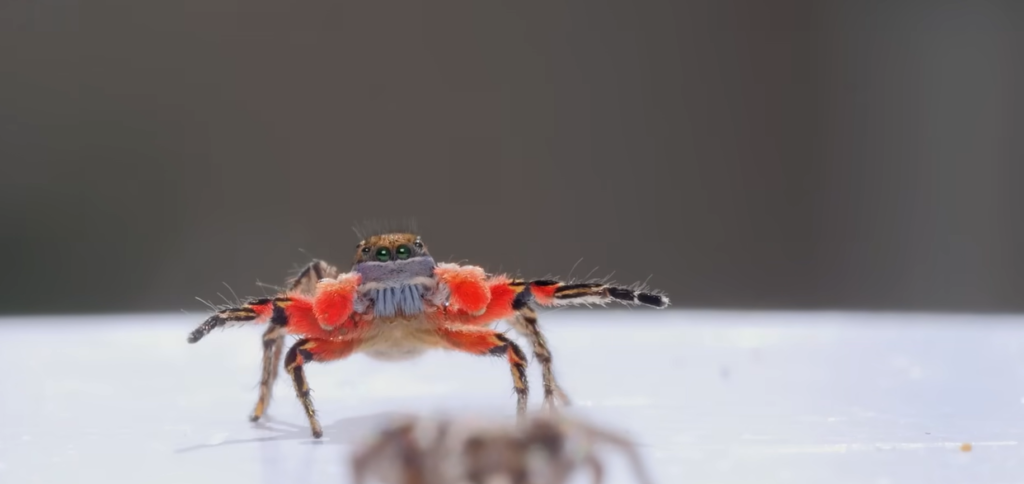
Conventional VR headsets attempt to fool your brain into thinking they can sense depth, but they frequently have trouble with narrow sightlines and skewed fields. Designers might at last produce hardware that truly reacts like a living eye—quick, sweeping, and dynamically reactive—by incorporating this insect-inspired technology. It’s simple to envision this being integrated into immersive training headgear or drone swarms, revolutionizing performance without adding bulk.
One of the researchers demonstrated how they patched together a panoramic image in real time by holding up two tiny domes, one angled sideways and the other facing forward. I was amazed at how well the drone controlled its flight as I watched it follow a moving target across an open lab area. No interruptions. Without hesitation. It responded with a confidence that was almost instinctive. This fluidity, which was fueled by extensive peripheral data, represented a much enhanced type of machine vision.
The scientists increased light reactivity by utilizing perovskite nanowires, which were previously only used in solar breakthroughs. These nanowires provide clear images with less energy consumption and perform remarkably well in low light. For battery-dependent devices, where every milliwatt matters, that is a blessing. In actuality, energy requirements were greatly decreased without compromising field performance when compared to conventional lens-based systems.
The implications are especially fascinating for medium-sized robotics companies. Faster development processes and increased design flexibility are the results of lightweight components that operate without recalibration. Compact VR setups that finally capture subtle body movements without the need for six independent cameras in a studio could be used in educational applications. The advantages are not just technical but also financial and ecological. Longer life cycles, fewer resources, and fewer parts.
Early adopters have recently begun discreetly testing versions of this technology in immersive installations, wearable computing, and even surgical robotics. A Munich team is investigating the potential of compound-eye vision to provide safer navigation for minimally invasive treatments. To lessen blind spots during pipeline monitoring, a Canadian business is also putting similar domes onto industrial inspection machines.
Several businesses have started licensing the basic design architecture through strategic alliances. Studying the camera’s performance under stress, vibration, and temperature fluctuations is more important than mass production just yet. According to early reports, it is incredibly resilient. The structure’s ability to withstand continuous motion, despite its simplicity, makes it ideal for outdoor applications such as search-and-rescue drones.
The way this camera reimagines what vision technology should be is particularly encouraging. We have been investing in more delicate optics for decades because to our obsession with megapixels and sharpness. But in this case, reactivity and coverage take precedence above clarity. A wide-angle, quick-reaction perspective is significantly more useful than precise detail for some tasks, such as spotting unexpected activity or traversing a congested area.
I couldn’t help but reminisce about my early days spent chasing fireflies. Their erratic yet accurate zigzag flight patterns were captivating. Here, that same vitality is captured by deciphering the firefly’s vision and movement rather than by reproducing its illumination. This isn’t about mass-producing insects; rather, it’s about identifying and carefully utilizing their performance benefits.
This move toward nature-guided technology may change how visual systems are developed in the years to come. We may increasingly embrace designs that mirror what evolution has already mastered, rather than relying on gear that is piled with lenses and heavy on glass. These dome cameras will probably be further improved by engineers, who will also streamline production, make them smaller, and integrate them with AI-powered systems for in-the-moment scene analysis.
In the end, this is more than a tale about a new camera. It’s a tale about reconsidering our preconceptions. About realizing that often the most intelligent solutions are already escaping our notice—surviving, buzzing, and dashing. And now, maybe, leading machines into the next frontier of seeing.
