

It’s difficult to argue with a certain type of phone. It’s the item that, after a week of real use, makes you question why you’d spend twice as much on something else, but it’s not the most thrilling thing in the room or the one that people line up around the block to take pictures of. Announced in March 2026, the Samsung Galaxy A57 5G appears to be vying for that title.
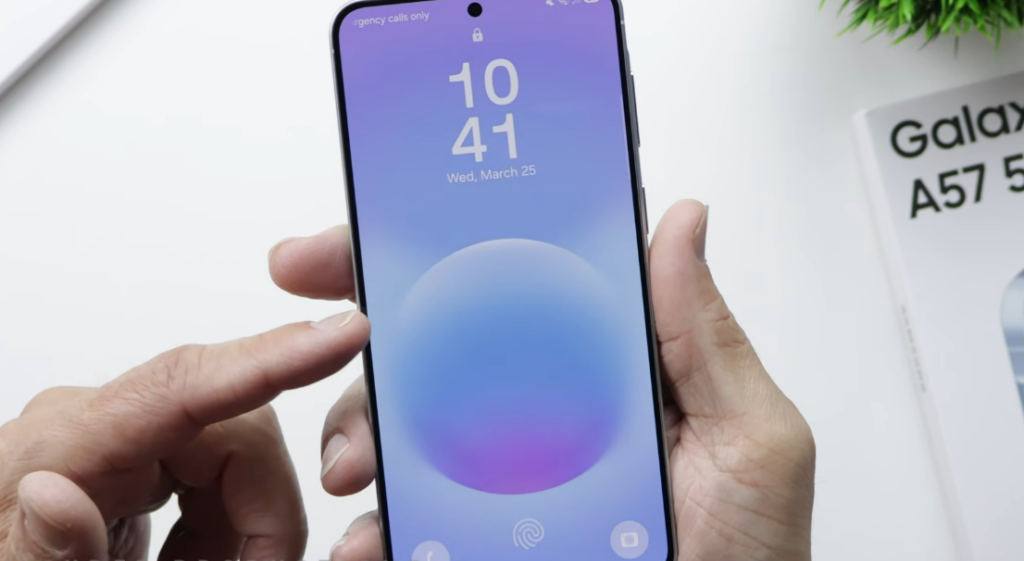
Alongside its smaller sibling, the A37, Samsung unveiled the A57, continuing the progress the company has been making in its mid-range lineup for a number of years. The A57 weighs 179 grams and is 6.9 mm thin, which may not seem like much until you hold it and realize that most phones in this price range still feel like they were made to be heavy. It appears more like a flagship than a low-cost phone to the untrained eye due to the slimmer bezel surrounding the display and the glossy translucent camera bump. First impressions are important, but whether they hold up under closer examination is a different matter.
The majority of the significant internal changes are found in the transition from the Exynos 1580 in last year’s A56 to the more recent Exynos 1680. Neural processing, which manages AI-related camera work, object recognition, and real-time image enhancement, has increased by up to 42%, while CPU and GPU performance has increased by about 12.5% and 13.8%, respectively. It’s important to focus on that final figure. On paper, the A57’s camera configuration is nearly the same as that of its predecessor: a 50MP primary sensor with optical image stabilization, a 12MP ultra-wide, a 5MP macro, and a 12MP front camera. However, shot-to-shot processing time has decreased to about 230 ms from 300 ms on the A56, and the larger pixel sensor design and improved ISP have significantly improved low-light video through what Samsung refers to as Nightography. It’s the kind of enhancement that is evident when you take a picture in a dimly lit restaurant but doesn’t show up well in spec comparisons.
Samsung Galaxy A57 5G — Key Specifications & Information
| Category | Details |
|---|---|
| Device Name | Samsung Galaxy A57 5G |
| Announced | March 2026 |
| Display | 6.7-inch FHD+ Super AMOLED+, 120Hz, up to 1900 nits |
| Processor | Exynos 1680 (Octa-core) |
| RAM / Storage | 8GB / 12GB RAM; 128GB / 256GB / 512GB storage |
| Main Camera | 50MP OIS + 12MP Ultra-Wide + 5MP Macro |
| Front Camera | 12MP with Super HDR |
| Battery | 5,000mAh with 45W Super Fast Charging 2.0 |
| Water Resistance | IP68 |
| Build | Gorilla Glass Victus+, Metal Frame, 6.9mm thin, 179g |
| OS | Android 16 / One UI 8.5 |
| Software Support | 6 OS upgrades + 6 years of security updates |
| Connectivity | 5G, Wi-Fi 6E |
| Starting Price | $549.99 (8GB + 128GB) |
| Colors | Awesome Navy, Awesome Gray, Awesome Icyblue, Awesome Lilac |
| Availability | April 9 (US), April 10 (UK and select markets) |
| Official Page | Samsung Galaxy A57 5G |
| Full Specs | GSMArena — Galaxy A57 5G |
Even though the term “AI” has lost most of its meaning due to overuse, the camera software’s AI features are still worth mentioning. Object Eraser, which eliminates unwanted background elements from photos, and Best Face, which allows users to select the most attractive expression from a collection of group shots, are genuinely helpful rather than flashy. Edit Suggestion automatically evaluates images and suggests certain enhancements, such as background blur, reflection removal, and resolution remastering. Samsung appears to recognize that these tools may be more important to some users than megapixel counts.
The battery situation is one area where Samsung made a thoughtful decision worth examining. According to Samsung’s own statistics, the A57’s 5,000mAh battery with 45W wired fast charging can reach 60% capacity in roughly 30 minutes. Wireless charging is missing. Given that some competing devices in the sub-$600 range have begun to include it, that is a noticeable omission at this price point. Although it’s still unclear if Samsung is intentionally delaying wireless charging or just making room for other cost savings, consumers switching from devices that support it might notice the discrepancy.
With the A57, Samsung is making a truly noteworthy software commitment. From a device starting at $549.99, the promise of six years of Android OS upgrades and six years of security patches significantly alters the value calculation. The guarantee that a phone won’t fall off the software support cliff halfway through its useful life is important for consumers who typically keep their phones for three or four years. With its Pixel line, Google made a similar pledge, and Samsung seems to have realized that long-term support is becoming more important than just a technical detail when making a purchase.
The A57 is located in a neighborhood that is genuinely competitive. At $499 and $599, respectively, the Google Pixel 10A and the iPhone 17E will draw consumers who have a strong sense of brand loyalty. Leading with tangible hardware appears to be Samsung’s response. Even though the price tag is technically mid-range, features like the thinner build, the metal frame, the Gorilla Glass Victus+ on the front and back, and the IP68 water resistance justify a premium feel. Another improvement over the A56’s Wi-Fi 6 is Wi-Fi 6E support, which gives users access to the less crowded 6GHz band. This can result in significantly faster and more reliable connections in crowded areas like airports, shopping centers, and events.
On April 9, the A57 will arrive in the United States. Initially, it will only be available in Navy Blue for the American market; Gray, Icyblue, and Lilac will be fully available in other regions. Samsung’s decision to offer color options to markets that may be less commercially decisive while giving the US the most conservative choice is somewhat ironic. Samsung hasn’t made a strong effort to defend the $50 price increase over the A56, which is represented by the starting price of $549.99. Whether or not buyers were already considering the A-series will likely determine whether or not that increase feels justified. The A57 is probably a significant improvement for those who are used to older devices. It’s more difficult for those upgrading from the previous year’s model to convince themselves.
