

Amidst the vast quiet of the UAE’s Martian-like landscapes, an extraordinary event is taking place. As they train for missions that could eventually span the solar system, humans are being trained not only for survival but also for self-mastery in a new analog ecosystem. It’s not about the show. It all comes down to being prepared.
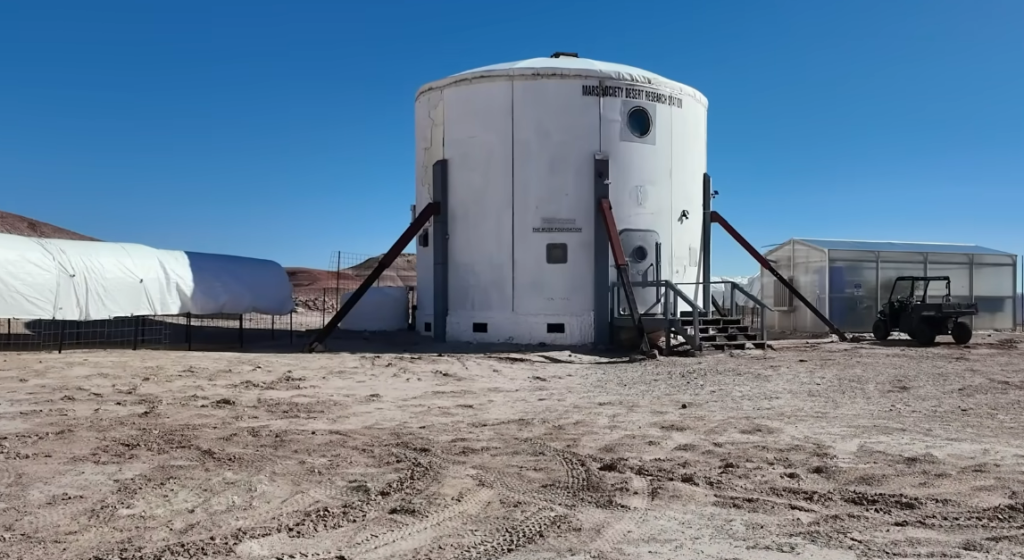
The habitat was built as part of the ambitious Mars 2117 program and is located inside what is referred to as Mars Science City. Although sci-fi aspirations may be evoked by the name, the design decisions show a purposeful, engineering-first approach. All of the sleeping pods, surfaces, and corridors are controlled environments, and every test replicates the monotony and difficulty of deep space isolation.
Through partnerships with Russian analog teams and NASA, the UAE has incorporated international best practices into a regional training center. Years of analog research have already been conducted by Russia’s SIRIUS program and NASA’s HERA program, and the UAE is learning from taking part. One of the first analog astronauts, Emirati pilot Dr. Shareef Al Romaithi, spent 45 days in a meticulously planned simulation conducted by NASA. Under time pressure and sleep limits, his mission involved lengthy cognitive load testing, VR-based exploration, and fake communication delays. It was surprisingly taxing.
The UAE has changed its role from one of observer to one of contributor through strategic partnerships. Data collecting for mission design is what this is, not only training for experience. Sleep disturbances, heart rate variations, and psychological strain from captivity are all recorded, examined, and fed back into mission planning. These are rehearsal exercises that have actual physiological effects; they are not theoretical exercises.
| Item | Description |
|---|---|
| Announcement | UAE launches Mars-Analog Habitat for astronaut training |
| Project Lead | Mohammed Bin Rashid Space Centre (MBRSC) |
| Program Name | UAE Analog Programme (part of Mars 2117 vision) |
| Purpose | Train astronauts for Mars-like conditions and long-duration missions |
| Habitat Location | UAE (Mars Science City project, with simulations also in the US & Russia) |
| International Partners | NASA (HERA facility), Russian Institute for Biomedical Problems (SIRIUS) |
| Key Features | VR Marswalks, communication delay scenarios, health and stress monitoring |
| Duration of Simulations | From 45 days up to 8 months |
| Research Areas | Mental health, isolation, cardiovascular response, team dynamics |
| Notable Trainee | Dr. Shareef Al Romaithi (UAE pilot and mission analog astronaut) |
Analog research has been used by space agencies to gradually push the boundaries of human endurance over the last ten years. The UAE’s entry, however, is especially creative. It has not only embraced simulation but also ingrained it into the academic architecture of the area. Custom monitoring methods and experiment designs are being implemented in the environment by research organizations such as AUS and MBRU. A notable improvement in the quality of experimentation has been brought about by this cross-pollination, where universities meet mission control.
Recently, the focus has shifted to creating long-duration simulations, some of which might go on for up to eight months. That timeline is similar to the anticipated round-trip to Mars. Without immediate assistance, participants must manage resource scarcity, work within strict task structures, and settle disputes. The 20-minute communication delay that simulated Mars-Earth transmissions during one such exercise created a subtle but growing stress. Teams were hesitant. A few people didn’t communicate well. Some adjusted.
The real training is in that stress, which the simulation amplify but which is based on very real human dynamics. It’s more than just planting a flag or operating a rover. It’s about managing boredom, irritation, and interpersonal drift since a broken team cannot be fixed by technology.
The United Arab Emirates has made significant progress in moving away from symbolic milestones and toward functional infrastructure by utilizing analog missions. It makes headlines when a probe is sent to Mars. Developing a training program for human spaceflight requires dedication. This project feels like an anchor—something stable to build from.
This gives younger generations visibility, which is especially good for the area. Foreign space programs are no longer merely watched passively by students. They now form a part of simulation designs, lab builds, and research teams. Additionally, when Mars Science City expands, the amount of data produced locally will only rise.
I remember reading about a test that used virtual reality to help pilot drones over terrain similar to Mars. It appeared to be a tech demo at first. But the importance became clear after a few minutes of navigational mistakes brought on by delays. It had less to do with the drone and more to do with how people adjust to flawed systems—how we become intuitive when accurate instruments fail.
In the next stages, extended simulations will investigate modular architecture, waste recycling, and sustainable life-support—all while undergoing the stress of confinement. In order to build resilient ecosystems, engineers and physicians will collaborate. They will be miniature cities with their own micro-economies, energy loops, and hierarchies for solving problems, rather than merely being sealed boxes.
In the long-term human exploration context, such training is not only essential, but urgent. Analog habitats allow us to practice all the possible outcomes before sending a crew into space. The UAE is setting itself up to be a knowledge producer on future missions rather than only a passenger.
They’re not just dreaming of Mars with this program; they’re measuring it, practicing for it, and getting ready to survive it. Furthermore, that silent preparation might end up being more valuable than any flag planted or selfie taken and sent back to Earth.
