

There is a real sense of urgency in the shipyards of Ulsan and Yeongam, a frenetic energy that feels less like building and more like a space race. South Korea, a nation that has historically dominated the global shipbuilding sector, is not happy to just ride the wave of present orders. Rather, the next one is being intentionally engineered. The recent launch of the Hydro Zenith was a declaration of intent rather than merely the christening of another vessel. As the globe grapples with maritime decarbonization, Seoul has decided that the future of shipping will be written in hydrogen, and they aim to hold the pen.
The Hydro Zenith, built by the eco-friendly ship specialist Vinssen, is a practical proof-of-concept in a field typically criticized for heavy dependence on theoretical models. Powered by a hybrid system of 100 kW hydrogen fuel cells and lithium-ion batteries, it moves over the water with an eerie stillness, devoid of the diesel chug that has defined maritime travel for a century. But this small vessel is simply the opening gambit in a much wider tactic known as the “Super-Gap.”
Here, the ambition is astounding. For the purpose of developing large-scale liquid hydrogen transporters, the South Korean government has set out almost $40 million. This isn’t just about developing ships that run on hydrogen; it’s about building ships that can deliver the fuel of the future across oceans. By 2027, they hope to launch a 2,300 cubic meter demonstration vessel, and by 2040, they hope to scale up to enormous 160,000 cubic meter commercial carriers. To put that in context, they are effectively seeking to accomplish for hydrogen what the LNG carrier business did for natural gas—create a worldwide supply chain from scratch.
Key Factual Context: South Korea’s Hydrogen Maritime Strategy
| Feature | Details |
| Flagship Vessel | Hydro Zenith (Launched Dec 2025/Jan 2026); first hydrogen fuel cell-powered ship. |
| Strategic Goal | “K-Shipbuilding Super Gap Vision 2040” aimed at dominating green maritime tech. |
| Investment Scale | ₩55.5 billion ($39.2M) for large-scale liquid hydrogen carrier development. |
| Key Partners | Vinssen, HD Korea Shipbuilding, Hanwha Ocean, Samsung Heavy Industries. |
| Infrastructure | Developing 2,300 cbm demonstration vessel by 2027; 160,000 cbm commercial vessels by 2040. |
| Reference | Safety4Sea: Korea’s first hydrogen fuel cell vessel |
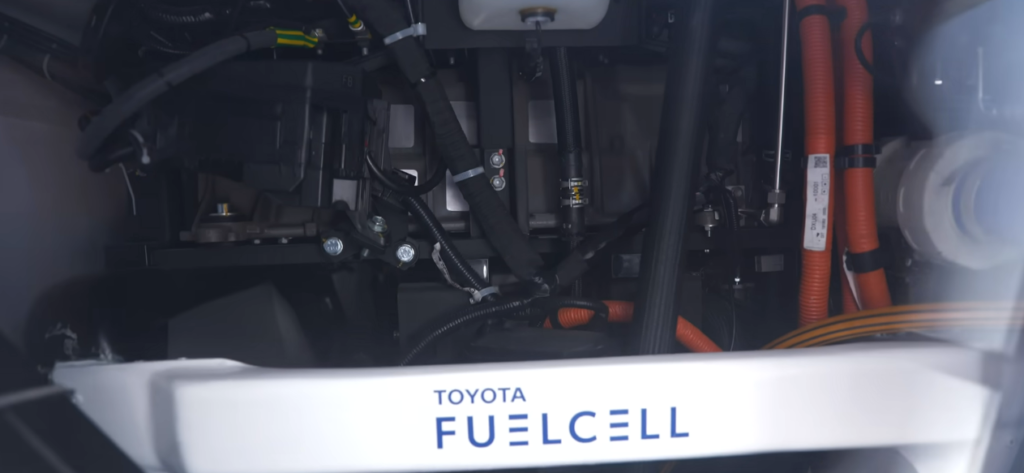
When I recently viewed a video of the Hydro Zenith testing, I was struck not by the technology but by how completely conventional it was—a high-tech ship functioning in ordinary waters, demonstrating that the future isn’t science fiction but rather engineering.
Physics is the problem, of course. It is necessary to keep liquefied hydrogen at minus 253 degrees Celsius, which is comparable to a warm bath. This calls for cutting-edge insulation technologies and cryogenic tanks that push the limits of materials science. By cooperating with academic institutions like Pusan National University and the “Big Three” shipbuilders—HD Korea Shipbuilding, Hanwha Ocean, and Samsung Heavy Industries—the government is developing a national consortium aimed to solve these difficulties before anybody else does.
This is a traditional “state-led capitalism” strategy that South Korea has mastered. By constructing a legislative framework—the so-called “Hydrogen Law”—they have removed the legal gray areas that sometimes block innovation. This allows enterprises to test, fail, and iterate faster than their competitors in Europe or Japan. As a result, a multi-source test ship that can test batteries and MW-class fuel cells at the same time was launched in late 2024, transforming the ocean into a floating laboratory.
The consequences for the global maritime industry are substantial. As the International Maritime Organization (IMO) tightens emissions standards, shipowners are looking for alternatives to heavy fuel oil. South Korea is positioning itself to be the principal vendor for that option. From the factories that produce hydrogen in their “Hydrogen Cities” to the ships that will transport the fuel to the rest of the world, they are offering an entire ecosystem rather than simply ships.
The high cost of green hydrogen and the present dearth of bunkering facilities may be cited by detractors, but Seoul appears to view these issues as speed bumps rather than obstacles based on the magnitude of the investment. They are hoping that the “first-mover advantage” in the hydrogen economy will secure their economic dominance for the next half-century.
In the end, the Hydro Zenith is more than just a boat. It is an indication that the long, gradual end of shipping powered by fossil fuels is coming to an end. South Korea has witnessed the horizon, which is silent, blue, and driven by the most prevalent element in the cosmos.
