

Even in 2026, there’s a certain theatrical quality to a new dinosaur. It wasn’t a quiet announcement when Spinosaurus mirabilis was revealed. For a brief moment, it made the Sahara seem like the center of the scientific universe, lit up museum newsletters, and rippled across social media feeds. As the reaction developed, it became clear that this was not just another fossil; rather, it was a challenge to a narrative that paleontologists believed they had almost completed.
One species, Spinosaurus aegyptiacus, was primarily associated with the name Spinosaurus for more than a century. That animal has long held an almost legendary status after being reconstructed from fragmentary remains discovered in North Africa in the early 20th century. backed by sail. Crocodile-snouted. It might be aquatic. Maybe not. It has been the focus of scholarly debates, documentaries, and even popular misrepresentations. However, discoveries of Spinosaurus mirabilis fossils in the central Sahara of Niger have compelled scientists to reevaluate some long-held beliefs.
| Category | Information |
|---|---|
| Scientific Name | Spinosaurus mirabilis |
| Classification | Theropod dinosaur (Spinosaurid) |
| Age | ~95 million years old (Late Cretaceous, Cenomanian) |
| Length (Estimated) | Up to 40–43 feet (12–13 meters) |
| Weight (Estimated) | 5–7 tons |
| Distinguishing Feature | Tall, scimitar-shaped cranial crest |
| Diet | Primarily fish |
| Habitat | Inland river systems of what is now Niger |
| Discovery Location | Jenguebi & Iguidi, Central Sahara, Niger |
| Lead Researcher | Paul Sereno |
| Published In | Science (2026) |
| Institution | University of Chicago |
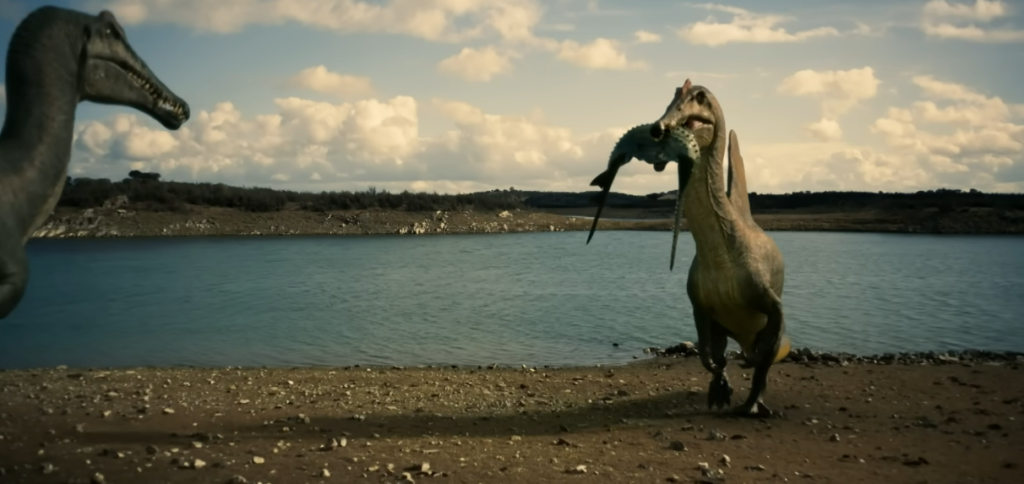
A story is told by the setting alone. The air is dry enough to cause lip chapping in a matter of minutes, and Jenguebi is now a sweep of stone and sand. However, this was river country 95 million years ago, with muddy banks, freshwater fish, and thick vegetation encroaching on both sides. Far from what would have been ancient coastlines, the fossils were discovered embedded in fluvial sediments. That is an important detail. It implies a life that is inland and involves wading instead of diving. And the crest comes next.
A tall, scimitar-shaped bony crest, more akin to a blade than a bump, rises sharply from the skull. The texture of the fossil indicates that it was formerly covered in keratin, possibly reaching even higher in life. It’s difficult not to picture it as a Cretaceous riverbank, glistening in the sunlight. The feature looks too ostentatious to be strictly utilitarian. Display seems plausible. Perhaps intimidation. Maybe attraction. The typical evolutionary blend of rivalry and beauty.
This crest might have changed the animal’s silhouette so drastically that competitors could identify one another from a distance. Birds constantly do this in contemporary ecosystems. It’s hard not to notice the comparison researchers have made when you see a heron standing still in shallow water, its neck coiled and its eyes fixed. The new species has been dubbed the “hell heron” by some, which is a ridiculous yet strangely plausible image.
The argument is strengthened by the teeth. They appear to be designed to grasp slick prey rather than ripping flesh from land animals because they are conical, interlocking, and resemble a fish trap. This does not imply that land-based food was disregarded by Spinosaurus mirabilis. However, the jaws’ architecture seems specialized. It has a sense of purpose.
The question of whether spinosaurs were primarily waders or strong swimmers has been debated in academic circles for many years. Reconstructed tails implied waterborne propulsion. Rebuttals cited problems with buoyancy and balance. Nuance is now added by this inland discovery. Whether spinosaurs hunted by diving or were just at ease in shallow water is still up for debate. However, the evidence from Niger points to an animal that stalks riverbanks rather than hunting in open waters.
The fact that the fossils found thus far are from subadult individuals is one detail that remains. Although the holotype specimen is about 26 feet long, estimates indicate that adults may have grown to a height of 40 feet or more. That is the length of a school bus. standing in Cretaceous water waist deep. observing.
Beyond the bones, a larger narrative is also being revealed. In Niger, the excavation required cooperation with local communities while negotiating the intense heat of the desert and potential security threats. Excavation windows were restricted by reported midday temperatures that approached 50°C (122°F). Sometimes fragment by fragment, fossils were carefully removed from brittle sandstone. Although these discoveries are romanticized, the reality is one of dust, exhaustion, and the protracted uncertainty of whether anything will be found during the next dig.
Perhaps more than the crest or habitat is what makes this new Spinosaurus discovery so fascinating. It serves as a reminder that surprises can still be found beneath seemingly lifeless sand in a field as ancient as paleontology. That demonstrates humility.
Now that Spinosaurus aegyptiacus and Spinosaurus mirabilis are two recognized species, scientists can start closely comparing evolutionary divergences. Did species recognition depend on crest size? Did distinct feeding strategies depend on inland habitats? Before climatic changes put an end to their existence, were spinosaurs experimenting with semi-aquatic lifestyles from an evolutionary perspective?
