

NASA solar flares have increased dramatically in recent days, dazzling social media feeds and scientific dashboards with incredibly vivid visuals. The Sun emitted four intense X-class flares within roughly twenty-four hours, showing that Solar Cycle 25 is not only active, but energetically moving toward its peak.
In essence, solar flares are magnetic explosions that release radiation at almost impossible speeds. When these bursts occur, they send electromagnetic waves rushing toward Earth at the speed of light, ionizing the upper atmosphere and altering radio frequencies with shockingly quick results.
On February 1 and 2, NASA’s Solar Dynamics Observatory captured extremely sharp photographs of solar flares, colorized in gold and red, displaying plasma heated to millions of degrees. The most powerful, rated X8.1, induced R3-level radio blackouts across eastern Australia and areas of the South Pacific, briefly halting shortwave communication systems.
To comprehend the scale, it helps to visualize the classification system as an energy ladder. A tenfold increase in intensity is represented by each letter: A, B, C, M, and X. An X-class flare is not simply stronger; it is much more intense than the M-class occurrences that already draw attention from forecasters.
| Event Dates | February 1–2, 2026 |
|---|---|
| Number of Major Flares | 4 (X1.0, X8.1, X2.8, X1.6) |
| Observing Mission | NASA Solar Dynamics Observatory |
| Main Impact Zones | South Pacific, Australia, New Zealand (radio blackouts) |
| Potential Effects | Radio disruption, geomagnetic storms, spacecraft risk |
| Active Sunspot | Region AR4366 (described as a “solar flare factory”) |
| CME Risk | Glancing blow to Earth possible around February 5 |
| Reference | https://science.nasa.gov/sun/solar-storms-and-flares |
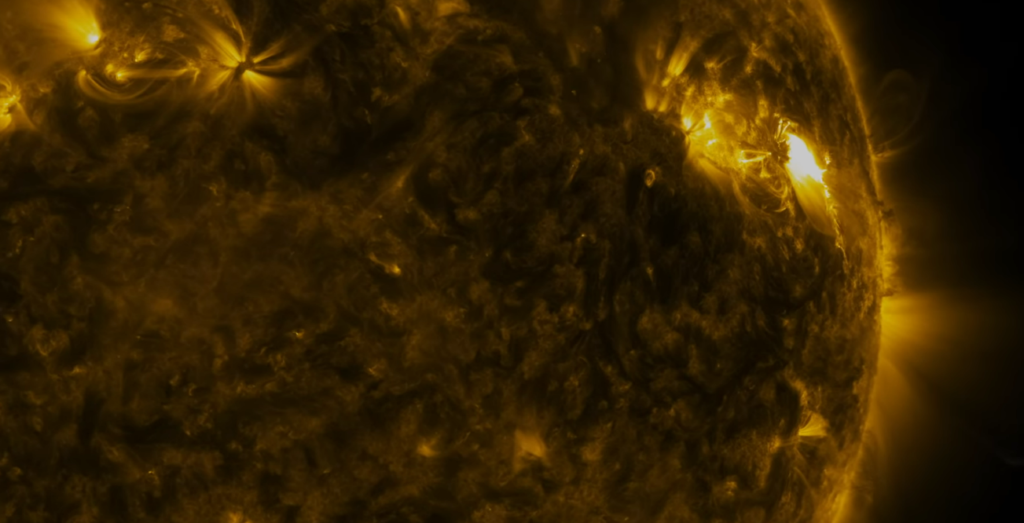
What makes this period particularly important is the behavior of sunspot AR4366. It has grown quickly and rotated into an Earth-facing orientation, releasing energy in rapid succession like a furnace door left open. Scientists have dubbed it, albeit informally, as a “solar flare factory,” and the moniker feels surprisingly accurate.
Researchers can calculate the likelihood of more eruptions by examining the magnetic field complexity in that area. Twisted magnetic lines, compressing and snapping back into alignment, function somewhat like overstretched elastic bands, releasing pent-up energy with explosive efficiency.
During one briefing I saw online, a heliophysicist detailed the sequence of events with extraordinarily clear precision, carefully noting how radiation from the X8.1 flare ionized air layers within minutes. I remember thinking how commonplace the remarkable can sound when described by someone who studies it daily.
Beyond radiation, scientists are closely following linked coronal mass ejections, or CMEs. These huge clouds of charged solar material travel more slowly than light yet carry actual plasma capable of interacting with Earth’s magnetic field. Early modeling predicts a likely glancing impact around February 5, which might enhance geomagnetic activity.
If that happens, auroras may become considerably more visible at higher latitudes. For skywatchers, such prospect feels extremely helpful, transforming a technical prognosis into a stunning spectacle of dazzling greens and purples.
Yet the practical stakes remain considerable. Radio communication might be obstructed. Signals for navigation could change. As they silently orbit above us, satellites are subjected to increased radiation exposure, which over time can deteriorate electronics.
However, for the past ten years, NASA’s monitoring system has proven astonishingly effective. By using numerous spacecraft—including the Solar Dynamics Observatory and the Parker Solar Probe—researchers now discover and study solar outbursts significantly faster than in prior cycles.
That speed matters. A faster detection window allows power grid operators to prepare, adjusting load distribution and securing transformers. Airlines can divert polar flights. Sensitive systems can be temporarily put into safe modes by satellite operators, lowering risk.
Over the past decade, forecasting approaches have considerably improved, merging complex models and real-time data. Solar activity is translated into actionable alarms by systems that are far faster and more highly efficient than those that used to process data over hours.
For astronauts, the ramifications are direct. High-energy radiation from X-class flares can offer substantial dangers, forcing astronauts aboard the International Space Station to shelter in shielded locations if necessary. These measures, improved by experience, have proven exceedingly reliable.
The broader picture, however, is positive. Solar maximum is a predicted part in the Sun’s roughly eleven-year cycle. Increased activity during this time is normal, not unusual. In that way, the flurry of NASA solar flares matches very comparable with historical trends reported in prior peaks.
For example, strong flares also congregated close to maximum during Solar Cycle 24, creating geomagnetic storms that tested grid resiliency and dazzled aurora chasers. This current cycle is significantly stronger than earlier estimates showed, however still within projected parameters.
By partnering with NOAA’s Space Weather Prediction Center, NASA operates as the scientific arm of a coordinated monitoring effort. Each satellite transmits data, each device adds a piece to a larger, continuously updating mosaic, and the process is similar to a swarm of bees exchanging signals.
That collaboration has been particularly inventive in how it integrates research and public communication. Alerts are shared fast, images are accessible, and data portals allow aficionados to watch solar indices in near real time.
In the context of technology dependency, this vigilance is vital. Our infrastructure—navigation networks, power grids, communication arrays—is interconnected and increasingly sensitive to electromagnetic disturbances. Preparing for solar volatility is not alarmist; it is prudent.
The development of mitigating methods is encouraging. Shielding has been increased by grid operators. Radiation-hardened components, which are incredibly resilient to increased exposure, are now incorporated into satellite designs. Monitoring algorithms, enhanced by machine learning, are becoming increasingly adaptable and precise.
It is anticipated that solar research will continue to grow in the upcoming years, expanding our knowledge of magnetic reconnection, the process that causes flares. By examining these eruptions attentively, scientists aim to anticipate not just when a flare will occur, but how intense it may be and whether it will fire a CME toward Earth.
Realizing that a star 93 million kilometers distant can suddenly disrupt our communications is humble. Yet there is also something soothing about watching a global network of experts respond with calm knowledge, assessing data and offering advise with measured assurance.
NASA solar flares, stunning as they appear in golden ultraviolet photographs, are reminders of both fragility and readiness. They highlight the precarious equilibrium between cosmic forces and human systems—forces that, despite their vastness, are becoming better understood via careful study and patient observation.
The Sun will keep flaring and pulsing. That much is certain.
What feels as obvious is that our potential to predict, comprehend, and respond to those pulses has never been stronger.
