

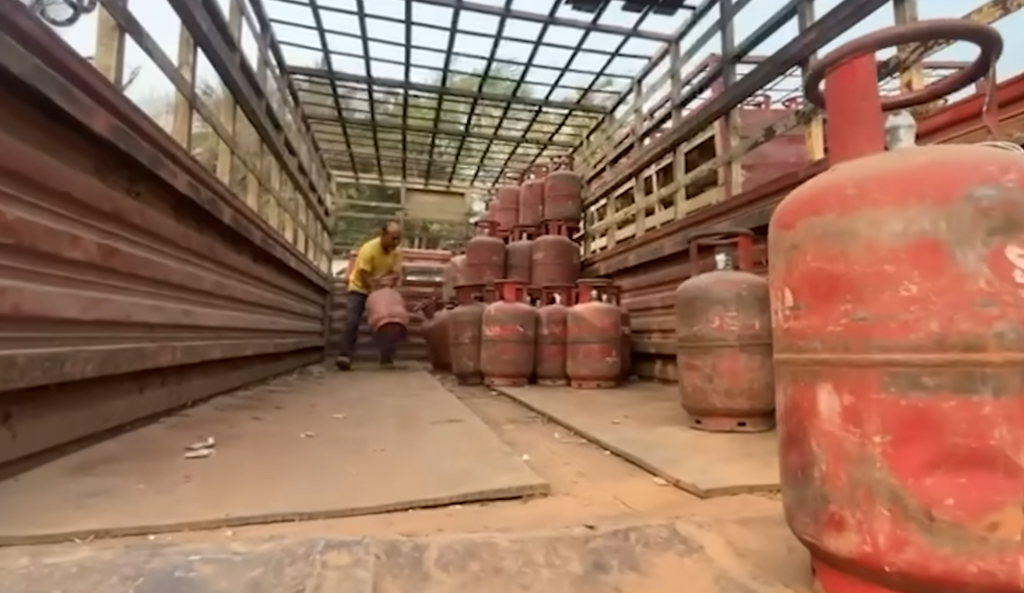
There’s something strange about any residential area in Hyderabad right now. There are gaps in the typical rhythm of everyday life, such as the faint hiss of a gas burner, the clinking of pots, and the smell of cooking wafting through open windows in the early evening. Cylinders in hand, people have been waiting in line outside some gas stations since the morning. By the third day, the lines had somewhat decreased, but the anxiety remained.
Despite the government’s strong preference for a different description, India is in the midst of what can legitimately be called an LPG crisis. The supply chain for liquefied petroleum gas has been severely strained since the Strait of Hormuz essentially closed in the weeks after the conflict in West Asia began on February 28, 2026. About 60% of India’s LPG imports are handled by the Strait; you can’t covertly reroute that amount with a few phone calls to other suppliers. Even though the extent of the disruption is being hotly contested in Delhi’s political circles, it is real.
In response, the government has taken both aggressive action against what it describes as intentional misinformation and sincere administrative action. With the issuance of an LPG Control Order by the Ministry of Petroleum and Natural Gas, domestic refinery production increased by 40%, reaching a daily output of 50 thousand metric tonnes (TMT) compared to a daily requirement of about 80 TMT. There are reportedly 22 LPG import terminals receiving assured cargo shipments from the US, Russia, and Australia, which is twice as many as there were in 2014. The ministry maintains that panic buying has been the main cause of apparent shortages rather than a real supply gap and that India is producing far more LPG than it currently needs to import. The argument is well-reasoned. The issue is that it looks awkward next to pictures of abandoned gas stations and closed community kitchens in states that have formally written to the Center asking for more funding.
India’s LPG Shortage Crisis — Key Facts & Information
| Category | Details |
|---|---|
| Crisis Trigger | Closure of the Strait of Hormuz due to West Asia conflict (Iran war, from Feb 28, 2026) |
| Impact on India | ~60% of India’s LPG imports routed through the Strait of Hormuz |
| Daily LPG Requirement | ~80 TMT (thousand metric tonnes) |
| Domestic Production (post-order) | 50 TMT/day (ramped up 40% via LPG Control Order) |
| Net Import Requirement | 30 TMT/day |
| Cylinder Deliveries per Day | Over 50 lakh cylinders |
| Strategic Reserve Cover | ~60 days (crude + products) |
| LPG Supply Cover | Approximately 1 month, with procurement ongoing |
| Alternative Fuel Push | Piped Natural Gas (PNG) — expanded from 25 lakh to 1.5 crore connections since 2014 |
| Emergency Sourcing | Argentina (50,000 tonnes Q1 2026), USA, Russia, Australia |
| Government Stance | No shortage; misinformation campaign alleged |
| Opposition Stance | Severe shortage acknowledged; foreign policy failures cited |
| Reference | PIB India — Official Government Statement |
| Reference | The Hindu — Fuel Crisis Live Updates |
On March 25, a community kitchen in Shillong’s Jhalupara Taxi Stand, which had been feeding daily wage earners, drivers, and the urban poor for 3,858 days in a row for just five rupees, quietly ceased operations. Panic buying is not what that is. The gas in that kitchen is running low. No press release can completely address the credibility issue caused by the contrast between official assurances and stories like this one, and it is particularly annoying to watch officials and opposition leaders quarrel over whose version of events is true while regular people wait outside agencies.
In all of this, Argentina has shown itself to be an unlikely ally. The South American nation supplied 50,000 tonnes of LPG to India in the first quarter of 2026, acting as a backup supplier over nearly 20,000 kilometers of ocean when the more well-known Gulf routes became unstable. Even though official statements stress stability, it’s a remarkable logistical turnabout that shows how seriously Indian oil companies are taking the situation. Iran has also allowed India to cross the Strait of Hormuz with China, Russia, and a few other countries that are considered “friendly.” Although it’s still unclear if this diplomatic opening will result in normalized supply flows in the near future, it is important.
The political consequences have been foreseeable and, in certain respects, instructive. The central government has been attacked by opposition leaders from the DMK, TMC, AAP, and Samajwadi Party in turn. Akhilesh Yadav came up with the term “Lapata Gas”—vanished gas—in a jab that was well received in Hindi heartland discussions. The BJP has retaliated, calling the criticism opportunistic and citing production figures and supply data. Everybody has a point. It’s possible that false information circulating on social media is exaggerating the crisis. It’s also possible that the government was slower to secure alternative supply lines than it should have been, given that the Strait of Hormuz has always been an obvious vulnerability for a country as import-dependent on LPG as India.
The push for piped natural gas seems both reasonable and hurried at the same time. PNG connections have grown from 25 lakh to over 1.5 crore since 2014, and domestically produced natural gas does reduce exposure to Gulf supply disruptions. But the government’s order — that LPG supply will be cut off for households that refuse to switch to PNG where it’s available — has an edge of compulsion to it that sits oddly alongside claims that there’s no shortage at all. Why is there pressure to switch if supplies are safe? The government hasn’t provided a clear response to this query.
There’s a feeling that India’s energy vulnerability, long discussed in policy papers and energy security conferences, has arrived in real and inconvenient form — not as a distant theoretical risk but as a queue outside a gas agency in Madhya Pradesh, a ₹5 canteen closed after a decade of service, and a hotel in Hosur reportedly trading biryani for LPG cylinders. Whether the crisis passes quickly or lingers will depend on how fast alternative supply chains stabilize. But the memory of these weeks — the queues, the scrambling, the political noise — will take longer to fade.
