

The question reverberated in living rooms and newsrooms for almost twenty-four hours: is the Iranian leader alive or dead?
Bombs in Tehran, the kind that rattle windows and send people running for stairwells, were the first to cause confusion. Later, smoke was seen curling above the Leadership House compound in satellite photos. However, Iranian officials remained silent during those initial hours. International leaders engaged in speculation. Social media was both sure of nothing and certain of everything. The denials followed. Then came the silence.
It’s difficult to ignore how regimes respond to uncertainty. As the rumors spread, state television in Tehran carried on with its regular programming. Diplomats waited, oil prices wavered upward, and markets in some parts of the region paused. In any case, investors appeared to think that confirmation would set off a bigger event.
| Category | Details |
|---|---|
| Full Name | Ali Khamenei |
| Born | April 19, 1939 |
| Position | Supreme Leader of the Islamic Republic of Iran (1989–2026) |
| Political Role | Head of State, Commander-in-Chief of Armed Forces |
| Office Location | Leadership House, Tehran |
| Confirmed By | Iranian State Media |
| Reported Date of Death | February 28, 2026 |
| International Coverage | https://www.bbc.com |
| Global News Reporting | https://www.reuters.com |
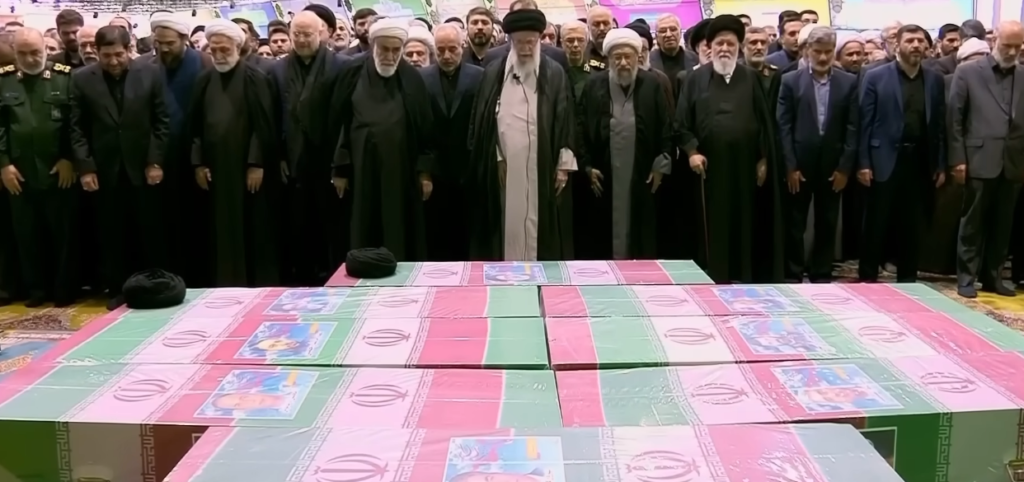
Early in the morning, the uncertainty vanished. The death of Ali Khamenei in US-Israeli strikes was confirmed by Iranian state media. His death was referred to as martyrdom by a solemn presenter, whose voice broke slightly. Within hours, black banners appeared in some Tehrani neighborhoods. In others, the night was filled with the soft crackle of fireworks.
One had the impression that history had changed course as they watched this play out.
After Ayatollah Khomeini’s death in 1989, Khamenei took over as ruler. He influenced Iran’s foreign disobedience and domestic crackdowns for 37 years, strengthening his hold during demonstrations and leading the nation through isolation, sanctions, and intermittent war. His power was structural rather than merely symbolic, and it was ingrained in the Revolutionary Guard, the legal system, and the administrative establishment.
The “dead or alive” question becomes more than morbid curiosity as a result. It had to do with continuity.
Crowds in black gathered outside Enqelab Square in Tehran, chanting well-known slogans and waving Iranian flags. Videos of young people honking car horns in a muted celebration, however, went viral not far away. Perhaps the conflicting responses tell us more about contemporary Iran than any official statement. The nation has seen numerous protest movements, internet outages, and economic hardship. Even though his death is seismic, it comes to a society that is already uneasy.
Power structures, however, rarely disappear overnight.
A successor must be chosen by the Assembly of Experts in accordance with Iran’s constitution. A temporary leadership council takes over interim authority. The transition seems orderly on paper. Under bombardment, transitions are actually unpredictable. Air defenses are still in place. Missiles are still flying across the sky. Whether internal factions will quickly align to maintain stability or compete quietly is still up in the air.
Implications for the region seem immediate. Iran has already struck back in the Gulf, focusing on locations connected to American military installations. Reports of explosions have come from Bahrain to Dubai. As naval ships shift positions, oil traders anxiously monitor the Strait of Hormuz, calculating risks in spreadsheets. There have been abrupt changes in leadership in the Middle East before. Few have taken place in the midst of such open conflict.
The symbolic dimension is another. Eliminating Iran’s top leader is being presented as a strategic necessity by Washington and Jerusalem. It is martyrdom and an excuse for escalation for Tehran’s establishment. Ordinary Iranians’ responses are more complex, influenced by fear, memory, and maybe a glimmer of cautious optimism.
It’s possible that the system a man created is not destroyed by his removal. Institutions typically outlast people, especially those that have been built over many years. There are still members of the Revolutionary Guard. The clerical network continues to operate. Bureaucracies still stamp documents and control traffic. However, an intangible has changed.
Families were seen packing their cars and driving north out of Tehran late Saturday night, with brake lights extending into the shadowy hills. Others waited for clarity in their apartments while watching state television. The strange mixture of anticipation and anxiety that hovers over cities during uncertain transitions was in the air.
Is the Iranian leader still alive? The response now seems clear-cut. The question of what form Iran will take next, however, may be more significant.
Seldom do regime changes go as planned by outside forces. There aren’t many clear examples in history. Iraq following Saddam. Libya following Gaddafi. Even the political issues in Venezuela remain unsolved. More can be destabilized than resolved by removing a leader.
Tehran announces mourning times and transitional procedures, projecting calm for the time being. Missiles are still in the air. Emergency meetings are organized by diplomats. Demonstrators assemble, some in mourning, others speculating about the future.
