

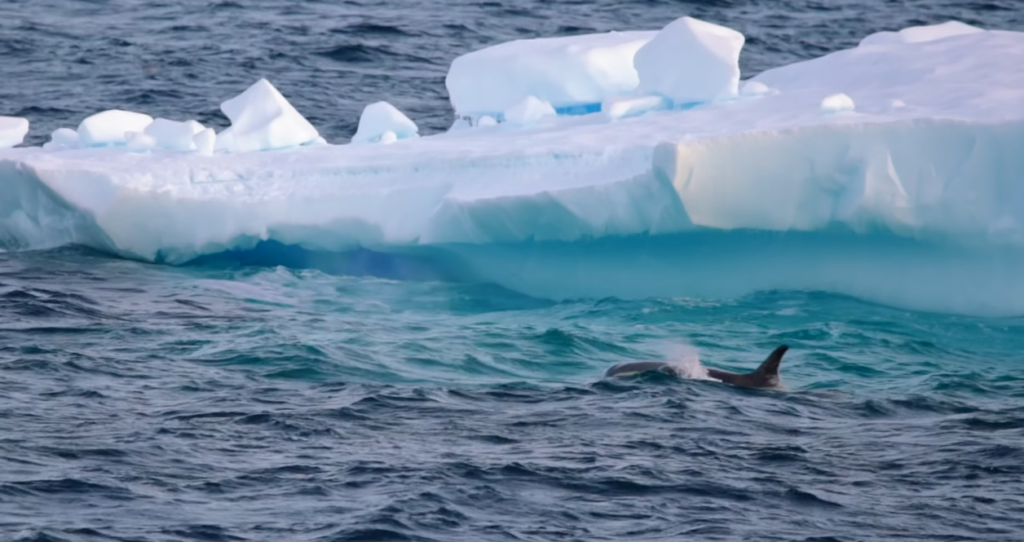
A slow-moving iceberg off the coast of West Antarctica seems unthreatening from afar. However, beneath its calm exterior lurks a mixture of sediment that is changing scientists’ perceptions of the Southern Ocean’s carbon absorption. For years, experts believed that glacial melt would help absorb more carbon from the atmosphere by feeding iron-hungry algae. However, recent study casts doubt on that reasoning and raises the possibility that the opposite may be true.
As the West Antarctic Ice Sheet continues to retreat, it loses huge quantities of iron-rich debris into the ocean. But instead of feeding the growth of algae and aiding carbon drawdown, the silt is proving significantly less effective. The explanation is fairly straightforward: the iron derived from these icebergs has already undergone extensive weathering. Its nutrients are trapped in forms that algae can hardly reach, making it chemically exhausted.
This creates a worrisome loop. Less carbon is drawn from the atmosphere when there is less algae. With more CO₂ staying over the water, warming continues. That heat melts additional ice, which dumps even more of the same useless iron into the water. The cycle continues—self-sustaining, quiet, and escalating.
| Aspect | Details |
|---|---|
| Focus Area | West Antarctic Ice Sheet (WAIS) and Southern Ocean |
| Primary Concern | Reduced ocean carbon uptake linked to iron-rich sediments from melting Antarctic ice |
| Key Discovery | Iceberg-delivered iron is chemically weathered and not bioavailable for algae growth |
| Feedback Mechanism | Less algae → less carbon absorbed → more warming → more ice melt → cycle continues |
| Long-Term Risk | Decline of Southern Ocean’s efficiency as a carbon sink could accelerate global warming |
| Supporting Research | Study published in Nature Geoscience (2026) led by Columbia Climate School |
| Data Source | Sediment cores, isotope analysis, glaciological models |
In the context of global warming, decreasing the Southern Ocean’s carbon sponge is extremely harmful. Currently, this region absorbs roughly 40% of the carbon dioxide that the oceans take in from human activity. If its efficiency diminishes, the atmosphere will sense the difference.
Through sediment core analysis conducted from three miles beneath the ocean’s surface, researchers revealed that this loop has existed previously. Despite significant iron influx from melting glaciers, algal development in the Southern Ocean has drastically decreased during warm times during the past 500,000 years. That input wasn’t the helpful airborne dust seen in other regions—it was silt scraped from ancient Antarctic rock, filled with minerals but not in the appropriate form.
The effect wasn’t confined to algae. When the ocean’s surface water acquired enormous amounts of meltwater, the layering of the ocean also began to shift. In principle, fresh melt should produce a surface layer that shields the ice shelves from deeper, warmer currents. Instead, researchers detected an increasing salinity in these surface waters, making them heavier and allowing warm water to rise more easily. That process leads to increased basal melting of ice shelves—an consequence that promotes sea-level rise and glacier instability.
Adding to the intricacy, the disturbance of ocean circulation has started slowing down the natural “conveyor belt” that helps mix surface and deep waters. Known as overturning circulation, this activity is vital to delivering nutrients and storing carbon long-term. As meltwater slows it down, nutrients become trapped below, unavailable to surface ecosystems, and carbon sequestration becomes considerably less efficient.
By studying the isotopic signatures of sinking particles, the research team could even quantify algae productivity during these important intervals. The findings were particularly clear: while more icebergs were migrating northward from West Antarctica, algae growth plummeted. That reduction closely mirrored past rises in atmospheric CO₂.
I remember a talk in 2023 with a marine chemist during a visit to the Alfred Wegener Institute. She described this process as a form of “false positive”—where more ice melt seems like a gift of nutrients, but turns out to be more bark than bite.
Further complicating issues is the old nature of the rock beneath the ice. Even when it is crushed up and transported to sea, the iron it contains is hardly soluble since a large portion of it is so ancient and chemically worn. The marine life that depends on it is unable to detect it since it is locked away.
However, there is a chance to reconsider how we observe and control ocean systems in the midst of all of this. Scientists are starting to map the chemistry of sediments transported by icebergs in real time by using deep-sea robots and new autonomous sensors. Early data already indicates techniques to predict ocean carbon efficiency under different warming scenarios.
By exploiting these knowledge, climate modeling can become substantially faster at identifying when and where these feedback loops may trigger again. This type of forecasting is especially helpful for international efforts to reduce emissions and save the ocean.
What sticks out most isn’t only the discovery, but the scale of its consequences. For a long time, we have relied on the Southern Ocean to quietly absorb extra carbon. Now, we recognize that even that process has its limits. And when one of Earth’s major natural systems begins to slow down, the margin for error elsewhere becomes razor thin.
Research institutes are reacting, which is encouraging. Through strategic partnerships between universities and government agencies, more coordinated efforts are emerging to investigate Antarctic geology and sediment flow. Funding has considerably improved for polar research vessels and core-sampling missions. These processes are extraordinarily effective at speeding up scientific discovery, even though they frequently take place behind the scenes.
The Southern Ocean may still be collecting carbon today, but its position as a dependable buffer is under review. The secret feedback loop between melting Antarctic ice and decreased carbon uptake is no longer a theory. It’s a signal. And like many signals in climate research, it arrived quietly—hidden beneath layers of ice, silt, and time.
But now we’re paying attention. And in comprehending this loop, we’re better prepared to respond—decisively, wisely, and with the humility that Earth’s most intricate processes deserve.
