

It’s a nearly imperceptible adjustment. Conversations slow, shadows intensify at odd angles, and the afternoon light softens as if the day itself is reevaluating its speed. With silent authority, a solar eclipse aligns celestial bodies in a sequence that is both mathematically exact and emotionally arousing. It does not make a loud announcement.
A solar eclipse is when the Moon passes between the Sun and the Earth, obstructing daylight with a shadow. The process is simple and is described in textbooks and briefings from space agencies using remarkably clear illustrations. But seeing it with your own eyes is anything but robotic. It has a sense of purpose.
There are three main categories. For a few minutes, the Sun completely vanishes during a total eclipse. a partial eclipse, in which only a section of the sky is blocked. Also known as a “ring of fire,” an annular eclipse occurs when the Moon seems somewhat smaller and surrounds the Sun with a bright halo.
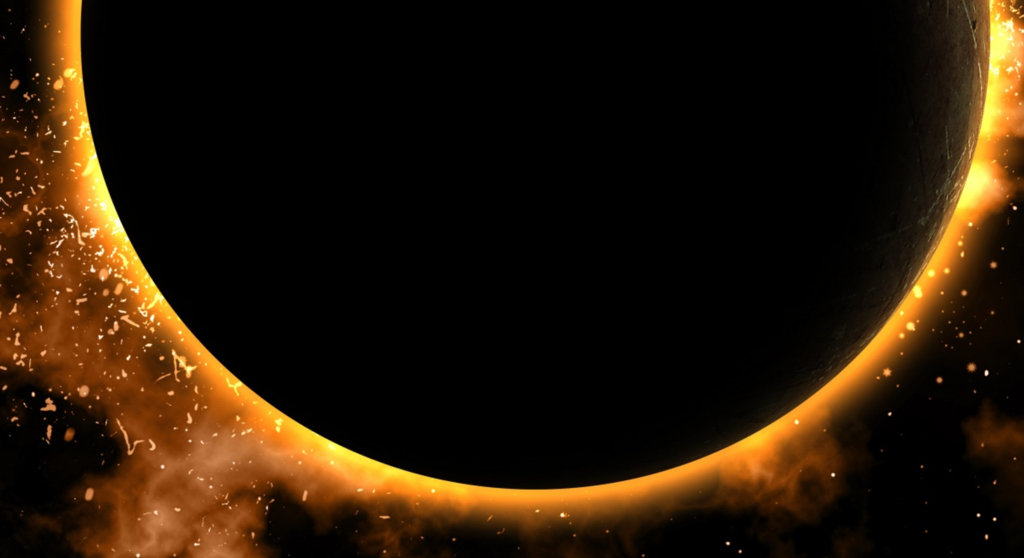
That halo commands attention in a very powerful way. The Sun changes into an almost architecturally symmetrical ring of brilliance suspended in an unexpectedly darkening sky. Daylight is significantly diminished, but never completely collapses as in totality, producing an atmosphere that seems to hover between afternoon and dusk.
Mostly over Antarctica, this annular eclipse will be seen on February 17, 2026. A unique alignment will be witnessed by researchers based on the frozen continent, and partial views will be visible throughout the Southern Hemisphere. Live streaming will be used by many viewers in other locations, who will follow the action via incredibly efficient digital updates and satellite feeds.
| Category | Details |
|---|---|
| Phenomenon | Solar Eclipse |
| Basic Definition | Occurs when the Moon passes between Earth and the Sun, blocking sunlight partially or completely |
| Main Types | Total, Partial, Annular (“Ring of Fire”) |
| Annular Eclipse | Moon appears slightly smaller, leaving a bright ring around the Sun |
| Frequency | Typically 2–5 solar eclipses per year somewhere on Earth |
| Upcoming Notable Event | Annular eclipse visible primarily over Antarctica (Feb. 17, 2026) |
| Safety Note | Requires certified solar viewing glasses for safe observation |
Though technology has greatly shortened the distance between people who are in the shadow and those who are watching from afar, eclipses do not disperse themselves equally.
Astronomical modeling has increased drastically in accuracy and speed over the last ten years. Scientists are able to forecast eclipse routes with remarkable accuracy years or even decades in advance. You may be sure that even the most spectacular sky event follows consistent gravitational choreography because of the predictability, which is quite dependable.
The feeling is not lessened, however, by being aware of the timetable.
When the Sun dwindled into a curving sliver, I remember standing on a rooftop during a prior partial eclipse, wearing cheap cardboard glasses and feeling a sense of anxiety. The city around me carried on as usual, with phones ringing and vehicles moving, yet there was a subtle sense of change. I was briefly struck by how brittle our everyday presumptions may be.
Total eclipses make the experience more intense. The full Moon obscures the Sun, exposing the solar corona, a thin layer of plasma that radiates outward in spectral threads. It becomes colder. The birds become quiet. Streetlights react to the drastically decreased illumination by flickering on too soon.
For scientific investigation, such brief darkness is especially useful. The corona is studied by astronomers who examine the magnetic fields and solar wind patterns that affect satellite systems and communication networks. Eclipses even measured the bending of starlight close to the Sun in previous decades, which helped validate Einstein’s general theory of relativity.
There aren’t many natural phenomena that so perfectly blend science and spectacle.
An annular eclipse conveys a distinct mood. The Sun is still partially visible, so the atmosphere is tense but not completely changed. Concentrated brilliance from the ring makes the Moon’s silhouette remarkably clear. The geometry behind it is remarkably apparent and exquisitely simple, despite the fact that observers frequently describe it as strange.
Safety has not changed. Irreversible eye damage can result from staring at the Sun without the proper eye protection. Public awareness initiatives consistently highlight this, simplifying guidelines and releasing spectators from preventable danger. When prepared, a potentially hazardous situation can be transformed into a safe, enjoyable event that is surprisingly inexpensive and incredibly successful.
Eclipse chasers are fully aware of this readiness. They pursue totality with a tenacity that verges on fanaticism, booking far-flung resorts, researching weather forecasts, and traveling across countries. Every eclipse, to them, is a watershed, a turning point in a life defined not just by years but also by shadows traversed.
Whatever their occupation or nationality, they are remarkably enthusiastic. When the sky changes, engineers, educators, and photographers stand shoulder to shoulder.
At one eclipse gathering, I observed strangers converting a parking lot into a makeshift observatory by trading safety glasses and comparing camera settings. The crowd erupted in spontaneous acclaim as completeness arrived. They didn’t practice it. Relief and admiration were expressed.
A solar eclipse is especially novel as a group event because it may attract attention without being amplified. Scripts, stages, and tickets are all absent. Just alignment, playing out above us with lightning-fast time.
Unstable civilizations have been eclipsed in the past. As the Sun darkens, monarchs consult priests, interpreting it as a warning or omen, according to ancient accounts. Science now gives perspective, but the emotional reaction is still there. The sky going dark in the middle of the afternoon can be unsettling, even with forecasts and livestreams.
Then, as quickly, the light comes back.
The shadow travels at an astounding rate across the surface of the Earth, sometimes surpassing thousands of kilometers per hour. The effects of totality last far longer, even though it just lasts a few minutes. Following this, people talk softer, as though they’re acclimating to a new scale.
Over the next few years, a number of significant eclipses will cover Europe, the Arctic, and portions of Asia. Each occurrence will be governed by very dependable gravitational principles, showing how celestial mechanics manages to withstand human disturbance below.
Something about that constancy is really promising.
Neither the Sun’s energy output nor Earth’s orbit are changed by a solar eclipse. It alters our view momentarily, serving as a reminder that alignment—rare, exact, and transient—can turn the ordinary into something surprisingly meaningful.
