

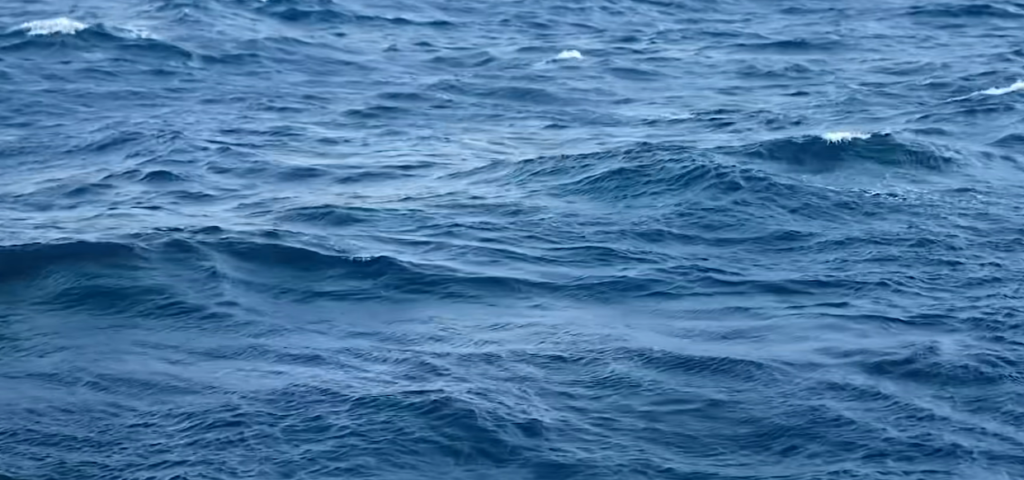
Observing the gray Atlantic heave and fold beneath low clouds while standing on a windswept beach in western Ireland makes it difficult to imagine that something delicate is beneath that agitated surface. Even the waves appear to be eternal and powerful. The ocean’s most vital circulation system, however, is deteriorating, according to scientists, and the change is so subtle that most people will never notice it.
At its most basic, the Atlantic Meridional Overturning Circulation is a planetary conveyor belt, even the name itself sounds heavy and mechanical. Warm water from the tropics moves northward, passing Florida and heading for Europe. A cycle that redistributes heat across half the world is completed there as it cools, sinks, and slides slowly back south in the shadowy depths.
It’s possible that Europe wouldn’t feel like Europe without it.
According to recent measurements, since the middle of the 20th century, the circulation has weakened by roughly 15%. The current may be slower now than it has been in over a thousand years, according to scientists examining sediment cores and temperature records. As they observe the graphs in research labs, some researchers describe a pattern that appears to be permanent.
It appears to be guided.
| Category | Details |
|---|---|
| System Name | Atlantic Meridional Overturning Circulation (AMOC) |
| Function | Transports warm surface water north and cold water south |
| Estimated Decline | About 15% weaker since the 1950s |
| Major Concern | Potential tipping point leading to collapse |
| Key Drivers | Melting Greenland ice, freshwater influx, warming oceans |
| Possible Effects | Cooling in Europe, sea-level rise, extreme weather shifts |
| Scientific Warning | 44 climate scientists issued formal warning in 2024 |
| Monitoring Organizations | NOAA, Woods Hole Oceanographic Institution |
| Official Reference 1 | https://www.noaa.gov |
| Official Reference 2 | https://www.whoi.edu |
It seems like this system, which was thought to be stable, is actually more brittle than anyone realized. The physics is straightforward enough: warm, fresh water sinks more readily than cold, salty water. However, as the ice in Greenland melts and freshwater floods the North Atlantic, the saltiness is lessened and the water becomes lighter. It can’t sink.
And all other things follow when sinking slows.
Although fishermen in coastal towns don’t specifically mention the AMOC, they have started to notice changes. Seasons seem a little strange. Some fish show up later than anticipated, or not at all. The ocean isn’t acting quite like it used to, according to these anecdotal, flawed observations that linger in conversations.
The frequency with which those minor observations occur first is difficult to ignore.
The slowdown itself is not as important to scientists as what will happen next. A tipping point, or a threshold beyond which recovery becomes challenging or impossible, may be reached by the system, according to some models. Whether that threshold is decades away or already in the near future is still up in the air.
All predictions are tinged with uncertainty.
Europe may have colder winters even as the rest of the world warms if the circulation continues to deteriorate. Sea levels in the eastern United States may increase more quickly. In areas that are already having difficulties, crops and water supplies may be impacted by changes in tropical rainfall patterns.
It is uncommon for climate change to occur in straight lines.
The slowness of its development is what makes this particularly unnerving. In contrast to wildfires or hurricanes, there isn’t a single catastrophe or dramatic moment to signal the change. Mile by mile, year after year, and measured in fractions of a degree and minute changes in density, the change takes place underwater.
The majority of people will never sense when it goes too far.
Instruments inside research ships that traverse the North Atlantic record temperature and salinity by descending thousands of meters into the frigid darkness. The crews move silently and intently while they watch screens flash with numbers that stand for motion that cannot be seen. It must be unsettling to know that those figures represent something that controls life on Earth.
An old thing.
There is also disagreement. Some experts predict that this century will see a weakening of the circulation but not its complete collapse. Others caution that historical climate records indicate that abrupt shutdowns have occurred in the past, leading to abrupt and dramatic changes in the climate.
At the same time, both possibilities are possible.
Despite the rise and fall of empires above it, the AMOC has always been there, flowing steadily. It influenced economies, weather patterns, agriculture, and coastlines. However, for the majority of human history, no one was aware of its existence.
Disclaimer
Nothing published on Creative Learning Guild — including news articles, legal news, lawsuit summaries, settlement guides, legal analysis, financial commentary, expert opinion, educational content, or any other material — constitutes legal advice, financial advice, investment advice, or professional counsel of any kind. All content on this website is provided strictly for informational, educational, and news reporting purposes only. Consult your legal or financial advisor before taking any step.
