

The glaciers still seem enormous high above Gilgit-Baltistan’s valleys. Their white surfaces, pressed hard against black rock, appear remarkably resilient from a distance. Year-over-year measurements, however, paint a more ambiguous picture.
Pakistan’s glaciers are melting at historic rates, and within the last 50 years, the rate has significantly increased. Many glaciers are retreating by roughly ten meters every year on average. Some areas close to Siachen are losing ice at rates that would have appeared implausible to researchers a generation ago, decreasing five or six times faster.
This change is not a unique environmental problem for a nation that has the highest concentration of glacier ice outside of the polar regions. It is closely related to agriculture, electrical generation, and water security. Nearly 90% of Pakistan’s agricultural activity is supported by the Indus River system, which is primarily fed by glacier runoff.
The rapid thinning of that ice reservoir has downstream effects.
| Item | Details |
|---|---|
| Estimated Number of Glaciers | 7,000–13,000 across Karakoram, Himalaya, Hindu Kush |
| Retreat Rate | Average ~10 meters per year; some glaciers losing 50–60 meters annually |
| Ice Significance | Largest glacial concentration outside polar regions |
| Water Dependence | Indus River basin supports ~90% of agriculture |
| Hydropower Share | Around 29% of national electricity generation |
| Risk Factors | Glacial lake outburst floods (GLOFs), flash floods, water scarcity |
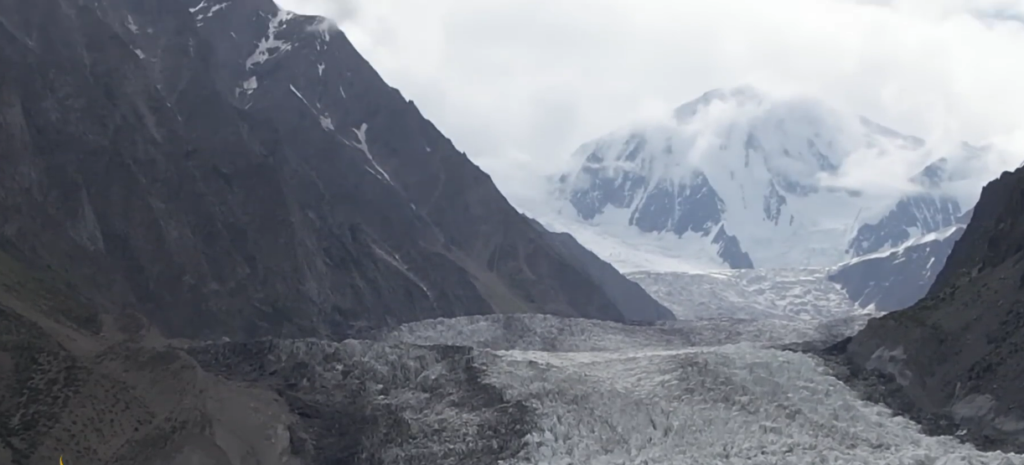
The creation of thousands of new glacial lakes has been verified by field surveys and satellite photos during the last ten years. These lakes are especially susceptible to abrupt collapse since they are gathered behind shaky debris ridges. The ensuing torrents, when they erupt, surge through narrow valleys, wiping away homes, bridges, and orchards with frightening ferocity.
Before a wall of water stormed downhill, a villager from a nearby village once described hearing rocks clatter. His family eventually gained more ground. Their animals didn’t.
The physics underlying this acceleration is particularly evident in the context of global warming. Summer melt seasons are prolonged by warmer temperatures. Darker rock surfaces become visible when ice thins, absorbing more heat and hastening melting. The intricacy and scope of this feedback loop, which develops silently at great altitude, are especially inventive.
First, quick melting can cause river flows to rise, giving the appearance of plenty. The reservoirs fill very fast. Streams are more powerful. However, the buffer that supports dry-season flows gradually diminishes as glacier mass decreases. Water availability fluctuates, going from a consistent supply to unpredictable fluctuations.
I recall thinking how incredibly dependable that flow appeared to be in the last of the light as I stood close to the Baltoro Glacier at sunset and watched meltwater chisel its way through pebbles.
Such dependability is essential for hydropower, which provides around 29% of Pakistan’s electricity. Energy planning and dam operations are made more difficult by fluctuating flows. In order to achieve noticeably quicker response times during surges, planners are now attempting to predict seasonal extremes by utilizing sophisticated hydrological models.
The equation is further complicated by air pollution. Industrial emissions and cross-border transportation of black carbon particles cause them to accumulate on the surfaces of glaciers. Darker ice melts faster because it absorbs more sunlight. The interconnectedness of atmospheric systems is highlighted by some studies that indicate a significant portion of this deposited carbon originates outside of Pakistan’s mountainous regions.
However, it is impossible to overlook local environmental influences. Natural barriers against runoff have significantly decreased as a result of forest loss. Slopes that once absorbed rainfall gradually have been degraded by a discernible drop in tree cover between 2001 and 2024. Without roots to stabilize the soil, meltwater and monsoon rains move much more quickly downhill, increasing the danger of flooding.
Flash floods are becoming more frequent in Gilgit-Baltistan and Khyber Pakhtunkhwa communities. Particularly at risk are roads built across delicate terrain. Even while it is good for the economy, growing tourism has brought infrastructure to formerly underpopulated places.
Air traffic into mountain airports, according to some officials, only slightly adds to localized warming. Others argue that regional emissions are still negligible when compared to global sources. The argument goes on, but the ice keeps melting.
The difference between local memories and contemporary trends is especially noticeable. Elders frequently remember that fresh snowfall would start to consolidate and glacier melting would slow by mid-August. Melt now stretches farther into fall. Seasonal indicators have changed.
According to projections, almost 60% of the current glacier volume may disappear by the end of this century if warming keeps up its current rate. That estimate is depressing, but it also makes clear how urgent action is.
Although Pakistan contributes very little to global greenhouse gas emissions, it is heavily exposed to the effects of climate change. Calls for more robust international collaboration have been spurred by this disparity. Countries can lessen the heat impact on high-altitude ice by enlarging the use of renewable energy sources and fortifying regional emission reduction pledges.
Adaptation efforts are encouragingly gaining momentum. Pakistan has constructed early-warning systems in high-risk areas and extended glacier monitoring networks through strategic cooperation with foreign organizations. These systems, which combine ground sensors and satellite data, are increasingly successful in identifying rising water levels and sending out timely alerts.
Reforming water management is equally important. Authorities can mitigate seasonal unpredictability by building more storage reservoirs and updating irrigation channels. Water wastage in agriculture can be greatly decreased using drip irrigation, which is incredibly effective and surprisingly inexpensive when scaled appropriately.
Research on native customs like glacier grafting could be especially creative in the years to come. In order to preserve ice at higher elevations, local communities have long experimented with methods that involve compacting snow and rerouting meltwater. Combining scientific modeling with such traditional knowledge could result in flexible solutions.
Initiatives for reforestation also show potential. Restoring tree cover in catchments that are at risk can decrease flow and drastically lessen soil erosion. When backed by open governance, well-planned forest management that strikes a balance between conservation and local lives may be incredibly resilient.
Above the Indus, the glaciers serve as more than just picturesque scenery. They are essential parts of Pakistan’s economic and ecological framework. Their fast retreat necessitates preparation for the future, grounded research, and concerted action.
