

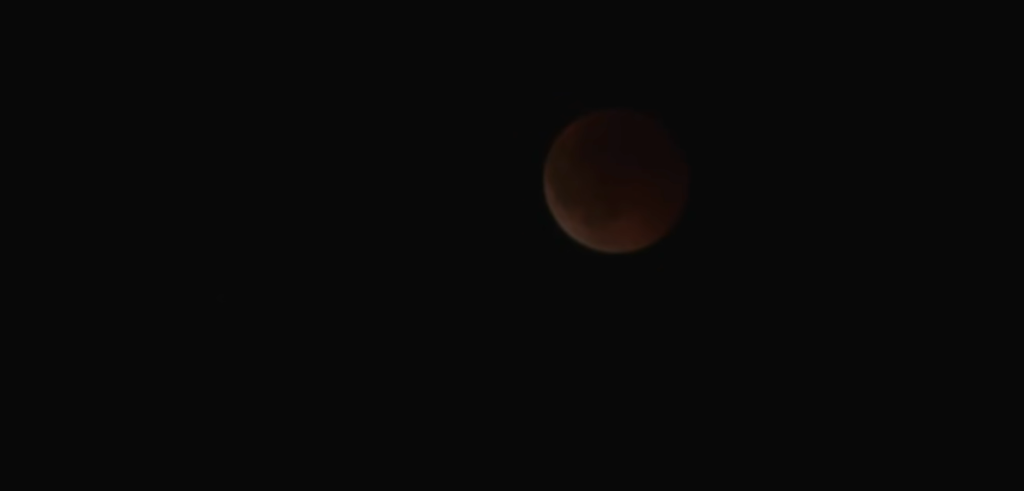
Setting an alarm for 4:30 in the morning just to see the moon change color has a subtly dramatic quality. Much of North America will do just that on March 3. Before dawn, the so-called Blood Moon, a total lunar eclipse, will come into view. It will darken, turn red, and then fade as the sun starts to rise.
Perhaps this one feels different because of the timing. Totality in the eastern United States starts at 6:04 a.m. EST, just before sunrise. The moon glows copper in the west while the sky softens to pale orange in the east, creating an odd handoff. When the eclipsed moon and the rising sun are both visible at the same time, meteorologists refer to this as a “selenelion.” Despite the fact that physics is still completely predictable, there is a feeling that nature is defying its own laws.
When Earth passes directly between the sun and the full moon, the umbra, the moon’s darkest shadow, is cast across the lunar surface, causing a total lunar eclipse. When sunlight bends toward the moon through Earth’s atmosphere during totality, shorter blue wavelengths are scattered and reds and oranges take center stage. This is the same cause of amber sunsets. Scale makes a difference. The lens is the entire planet.
There is no rush for safety glasses like there would be during a solar eclipse. No anxious looks. You are free to look up. Lunar eclipses may feel more communal because of their accessibility. Silently, apartment balconies fill up. Wearing slippers and sweatshirts, the neighbors go outside. There are phones. The tripods click open.
| Category | Information |
|---|---|
| Event Type | Total Lunar Eclipse (“Blood Moon”) |
| Date | March 3, 2026 |
| Totality Duration | 58 minutes 19 seconds |
| Totality (Eastern Time) | 6:04 a.m. – 7:03 a.m. EST |
| Maximum Eclipse | 6:33 a.m. EST |
| Best Visibility | Western North America, Pacific region |
| Visible Regions | North America, East Asia, Australia, New Zealand |
| Not Visible | Most of Europe and Africa |
| Next Total Lunar Eclipse | December 31, 2028 / January 1, 2029 |
| Scientific Explanation | Earth passes between Sun and Moon, casting umbral shadow |
For official viewing details and timing tools:
But geography is important. Because the moon will be higher in the sky during totality, Western North America will have the best view. The eclipse will take place under completely dark skies in states like Arizona and California. The moon will be fading into the brightening dawn while hovering low on the western horizon in Cleveland or New York. Whether that twilight will soften the rich red tones or create drama through color layering is still unknown.
Naturally, weather continues to be the wild card. Cloud cover is possible in early March, particularly in the Midwest and Northeast. Forecasts change quickly, but historical climate data points to clearer skies in the Southwest. It’s difficult to overlook how eclipse watchers turn into amateur weather forecasters, updating radar maps days ahead of time as though they were monitoring a storm.
Although totality, the main event, lasts less than an hour, the eclipse will last more than five hours from penumbral start to finish. Compared to a total solar eclipse, when seconds seem like heartbeats, that window is generous. Now is the time to play around with the camera settings, take a step back from the viewfinder, and just observe.
The following photography advice is already widely shared online: manual focus, exposure bracketing, and ISO adjustments. Once useless for night sky photography, smartphones can now capture surprisingly good wide-angle images. It’s possible that contextual scenes—the red orb hovering over rooftops, above desert ridges, or faintly reflected in a silent lake—will produce more captivating photos than close-ups of the moon itself.
The term “blood moon” has a slight dramatic connotation in culture. It is framed by astrologers as a pivotal moment. Karmic shifts are hinted at in social media posts. The scientific rationale is simple, but the emotional resonance endures. Something beyond explanation is evoked when one observes a familiar celestial object change color.
Additionally, until the end of 2028, this eclipse on March 3 will be the final total lunar eclipse. It has some weight because of that gap. People believe that if they miss it, they will have to wait almost three years for another opportunity. Although lunar cycles are not measured by investors, attention does follow scarcity. There is a sense of urgency created by the phrase “last one for a while.”
However, from a cosmic perspective, lunar eclipses are not uncommon. Astronomers have calculated them down to the second, decades in advance, and they are a part of predictable cycles. Standing outside before dawn, breathing in the cool air, and watching the Earth’s shadow move across the moon is a unique experience. It’s a perspective inversion. For the first time, the planet we are standing on is shown in outline, albeit indirectly.
That thought has a reassuring quality. The moon is not burning or bleeding when it glows red. Every sunrise and sunset that occurs simultaneously around the Earth’s edge is caused by sunlight. One color is the result of billions of horizons.
One gets the impression that the sky is momentarily slowing down as you watch this happen. There aren’t many cars at that hour. The streetlights go out. As it emerges from shadow, the moon dims, deepens in color, and then starts to brighten once more. EST, totality ends at 7:03 a.m. The day continues.
