

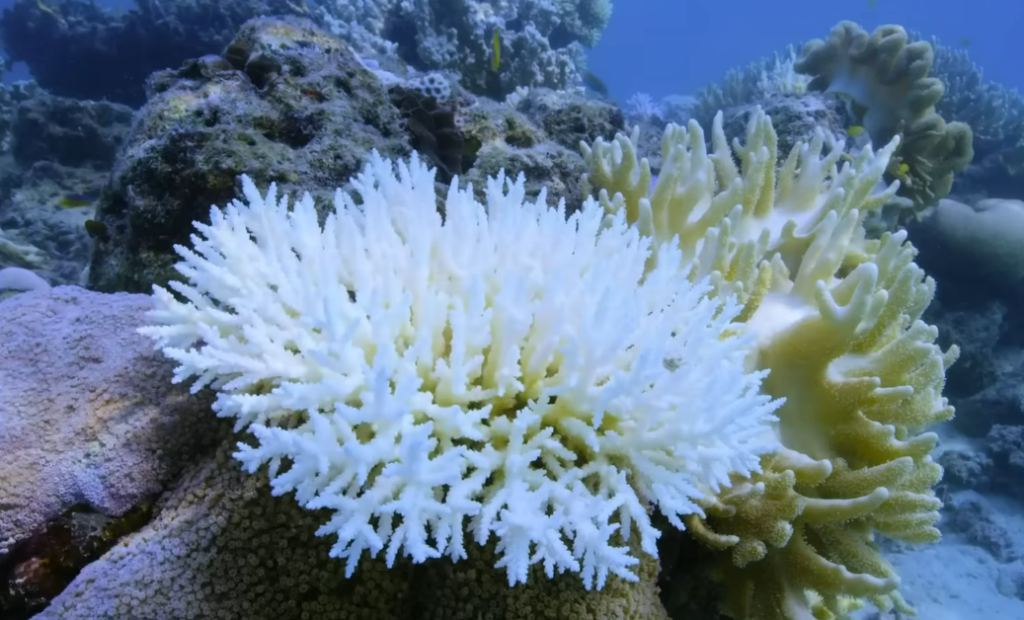
The water near One Tree Island, on the southern edge of the Great Barrier Reef, continues to appear flawless. Shimmering in the bright Australian sun, it was clear, almost like glass. Beneath that surface, however, the reef reveals a different story: patches of bone-white coral stretch across the seabed, resembling an overnight-emptied city. Here, coral bleaching has previously occurred. For decades, scientists have been recording it. However, the events of 2024 and 2025 have a different, almost heavier tone. It’s possible that the frequency of the damage is changing as well as its magnitude. Things that used to seem uncommon are beginning to recur with unsettling regularity.
About 40 to 50 percent of the bleached corals in the reef’s monitored southern sections did not recover. They passed away. Certain species experienced losses that were on the verge of complete collapse, particularly the fragile, plate-like Acropora corals. When divers touch what appears to be coral, it crumbles into powdery pieces and drifts away with the current.
The disappearance of color is unsettling in some way. Reefs in good health are noisy and visually rich, with fish darting through coral branches and electric blues and yellows. On the other hand, bleached reefs feel peaceful. Not exactly silent, but muted. Even though it’s happening gradually, there’s a feeling that something fundamental is slipping as you watch this develop.
The reason is not enigmatic. The temperature of the ocean has risen to such an extent that coral is no longer able to survive. Corals under heat stress are forced to expel the algae that inhabit them—the very organisms that give them color and, more significantly, vitality. The coral starves in the absence of that collaboration. At times, slowly. Not all the time.
| Category | Details |
|---|---|
| Topic | Coral Bleaching Crisis in Australia |
| Location | Great Barrier Reef, Queensland |
| Reef Size | ~344,400 sq km |
| Marine Life | 1,500+ fish species, 400+ coral species |
| 2024–2025 Impact | ~60% reefs affected |
| Mortality Rate | ~40–50% in key southern regions |
| Key Cause | Marine heatwaves, climate change |
| Emerging Threats | Coral disease, repeated bleaching cycles |
| Reference Links | Australian Institute of Marine Science • NOAA Coral Reef Watch |
The timing is what gives this moment its unique feel. Long recovery periods are no longer used for mass bleaching. According to some researchers, it’s starting to resemble a biennial pattern. Another hit every few years. The reef’s ability to rebuild itself under such pressure is still unknown.
Diving in the early 2000s, when bleaching events were severe but followed by noticeable recovery, is a memory that older marine biologists frequently revisit. fresh coral growth. Fish populations are rebounding. a belief that the system could recover despite its vulnerability. Now, that memory seems a little far away.
Severe damage has begun to appear in areas of the southern reef that were previously thought to be relatively sheltered. Scientists seem to be most troubled by that particular detail. These locations were supposed to serve as safe havens and strongholds. It begs the question of whether any portion of the reef is still protected from rising temperatures given how widely they bleach.
Then there is illness. Corals that have been weakened by heat are more susceptible, and diseases like black band disease have started to spread throughout colonies that are already under stress. It’s a compounding effect, with structural collapse coming after illness and bleaching. a series of events rather than a single one.
Every day, tour boats still show up, their engines running while guests with masks and snorkels look over the side. Some arrive anticipating the colorful reef they’ve seen in documentaries. Others, possibly more conscious, appear to look for life amid the lifeless patches. When they first see the whitened coral, it’s difficult to ignore their hesitation.
With millions of tourists each year, the reef continues to be economically significant to Australia’s tourism identity. Beneath that, though, a subtle tension is developing. Local communities, operators, and guides are all adjusting, changing routes, and controlling expectations. Even if only slightly, there’s a feeling that the narrative they’re presenting to visitors is evolving.
Coral reefs, which support a remarkable variety of life, are frequently referred to as the “rainforests of the sea” on a global scale. However, after years of repetition, that phrase now has a different meaning. It is possible for rainforests to burn. Reefs are bleachable. Under prolonged stress, both systems, which were previously believed to be robust, show their limitations.
It’s also difficult to overlook the larger context. This bleaching incident is not unique. Reefs in dozens of nations are under comparable stress, which is part of a worldwide trend. The ocean is warming because it retains heat that takes a long time to release. And season after season, that stored heat keeps coming back.
It’s simple to feel a disconnect between what’s visible and what’s going on below when standing on a boat deck and gazing out over the vast expanse of blue. The ocean doesn’t make a big deal out of its changes. It shifts silently, building up tension and coming out at times like this.
It is difficult to shake the impression that the reef is about to enter a new stage. Not gone, not yet, but changed in a way that might not be entirely undone. Future generations might still be able to see the Great Barrier Reef, but perhaps not in the same way.
