

Even seasoned glaciologists stopped when they first saw satellite images of Hektoria Glacier retreating 8 kilometers in just two months. Not because the ice in Antarctica hasn’t been melting. It has. However, this was different—sudden, nearly violent. There was no backward movement of the glacier. It broke.
The clarity of the images taken from orbit is unnerving, and Antarctica is breaking more quickly than scientists had anticipated. Fractures can be seen from space as ragged lines of ink across white fields. Some slowly enlarge. In what appears to be a geological heartbeat, others split open.
The vastness of Antarctica produced a sort of psychological distance for many years. It seemed unyielding. distant. shielded from its own chill. However, it is difficult to ignore the acceleration when viewing time-lapse sequences stitched from satellite footage. From below, ice shelves are getting thinner. Melting water filling crevasses. Floating slabs breaking into iceberg armadas.
| Category | Details |
|---|---|
| Region | Antarctica (West & East Antarctic Ice Sheets) |
| Key Glacier | Hektoria Glacier, Antarctic Peninsula |
| Major Threat | Accelerated ice shelf collapse and grounding line retreat |
| Ice Loss Trend | Ice loss rate multiplied sixfold over 30 years (by 2020) |
| Critical Mechanisms | Hydrofracturing, ocean erosion, buoyancy-driven calving |
| Sea Level Risk | Antarctic Ice Sheet holds ~90% of Earth’s freshwater |
| Reference Institutions | NASA Climate, Science (AAAS) |
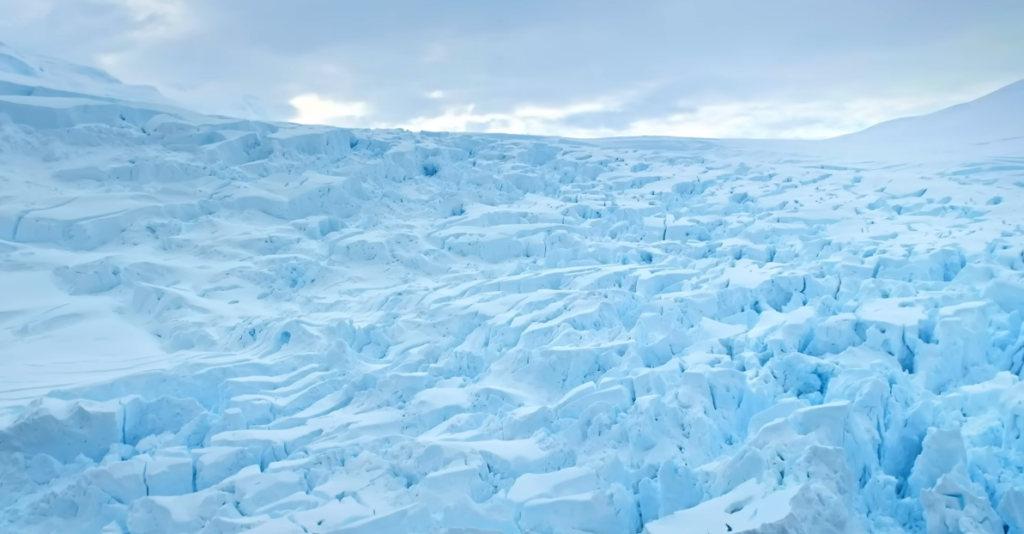
Part of the story involves hydrofracturing. Shallow blue lakes are formed by surface meltwater when warmer air settles over the Antarctic Peninsula. In photographs, the water appears placid, almost picturesque. However, it pushes cracks wider as it drains into them, breaking apart centuries-old ice. It’s possible that these surface lakes, which are tiny by themselves, are repeatedly driving wedges into ice that is already weak.
Meanwhile, the warming of the ocean is occurring from below. Floating ice shelves are thinned invisibly by warmer currents that slide underneath them. The term “ocean forcing,” which researchers use to describe it, barely describes the physical reality: water quietly eroding ice, lifting it from bedrock, and destabilizing the grounding line, that fragile anchor point where glacier meets land.
The protective buttress disappeared in 2022 when Hektoria lost its floating ice. Surprisingly, satellite altimetry showed that a whole area of thinning ice lifted afloat nearly simultaneously. Then came buoyancy-driven calving. Over 16 months, the glacier receded 25 kilometers. Within two months, eight of those kilometers vanished. It’s not an incremental pace. It is explosive.
Scientists seemed to have anticipated retreat, but not this rapid alignment of forces.
The “frontier of dramatic ice loss” has long been used to describe West Antarctica. There, glaciers are particularly vulnerable once warm water seeps in because they are situated atop marine basins that dip below sea level. Often referred to as the “Doomsday Glacier,” Thwaites Glacier looms large in any meaningful conversation about climate change. However, it’s becoming more and more obvious that East Antarctica, which was previously thought to be stable and even expanding, is also exhibiting signs of vulnerability.
There is enough ice in East Antarctica’s Totten Glacier to cause sea levels to rise by more than three meters. Reports often mention that figure, but it’s difficult to ignore the enormity when you’re looking at a satellite-rendered map of its catchment basin. In less than ten years, scientists have recorded ice surface height drops in Wilkes Land of almost three meters. These aren’t merely aesthetic adjustments.
However, the data may be confusing. Short-term ice gains between 2021 and 2023 were recently recorded by NASA satellites, primarily as a result of more snowfall. Some onlookers took that as confirmation. Plotting the longer trend, however, shows a steeper downward slope, with a brief upward blip interspersed with two decades of continuous mass loss. It’s similar to witnessing a ski jumper briefly soar before gravity returns.
Whether these short-term gains have any lasting significance is still up in the air. The majority of glaciologists appear doubtful.
Perhaps the speed of the melting is more unsettling than the melting itself. Over the last 30 years, Antarctica’s ice loss has increased sixfold. In 2023, sea ice extent reached all-time lows. Previously slowed by dense sea ice, storm waves now strike glacier fronts head-on. Hektoria’s glacier was exposed to open water as it was thinning from below thanks to the waves’ assistance in breaking through protective sea ice.
It feels strangely intimate to watch this unfold through satellite imagery. Thin ice is marked by surface depressions. Every year, you notice cracks getting longer. You witness floating shelves breaking apart and moving northward like tabular icebergs. Despite being quantifiable in meters and kilometers, the changes emotionally resonate as instability, which is more visceral.
The issue of modeling is another. Current ice-sheet projections make an effort to model snowfall variability, melt rates, and grounding-line retreat. However, it is hard to predict buoyancy-driven calving events, which involve entire regions popping afloat and breaking apart. Some researchers now acknowledge that the most unlikely scenarios might turn out to be more likely than previously believed.
When reading these figures, it’s difficult to avoid thinking of coastlines. Roughly 90% of the freshwater on Earth is found in the Antarctic Ice Sheet. Maps are altered when even a small portion of that enters the ocean. Cities that seem stable and permanent on political maps, like Miami, Jakarta, and Alexandria, are actually only a few feet above high tide. Storm surges are exacerbated by a slight rise. Geography is completely redrawn by a multi-meter rise.
Nevertheless, Antarctica is still far away and unreal in day-to-day existence. There are no daily weather segments on the evening news, and there are no traffic cameras. Only satellites are silently circling and recording every pixel of change.
The continent, which was once thought to be frozen in time, seems to be showing its true dynamic nature. cracks getting bigger. Retraction of grounding lines. Lifting, snapping, drifting away, ice plains.
