

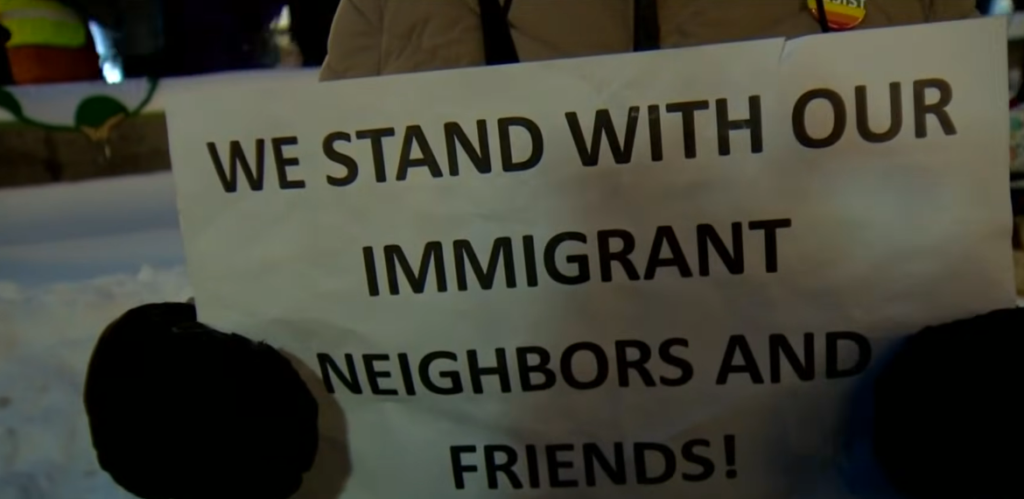
Six ICE vehicles blocked traffic on Michigan Avenue in Ypsilanti, Michigan, at nine in the morning on April 10, 2026, in front of the Art of Africa Hair Braiding storefront and the Encuentro Latino Restaurant. There was a man being held. There was Beth Bashert, the mayor of Ypsilanti from 2018 to 2020. She saw an ICE car and followed it with others, arriving in time to see the stop take place. They blew whistles. They gave a honk. They yelled. It took fifteen minutes instead of the usual five. The man’s car was left unlocked on the street with the keys inside when it was all over. “I am just an activated citizen that cares very deeply that my neighbors are being harmed, and families are being torn apart,” she said after Bashert and a few others secured it and brought it back to his house.
The arrest took place the day after the U.S. Department of Justice filed a federal lawsuit against Washtenaw County, which includes Ann Arbor and Ypsilanti, for three local policies that federal officials claim illegally interfere with immigration enforcement. USA v. Washtenaw County, which was filed on April 10 in the Eastern District of Michigan, names the county’s Board of Commissioners, Sheriff Alyshia Dyer and her office, and Prosecuting Attorney Eli Savit and his office as defendants. The government is requesting that U.S. District Judge Robert White order county officials to assist federal immigration operations and permanently block all three policies. In the last year, the DOJ has filed fifteen lawsuits of this type, including ones that target New York, Minnesota, Los Angeles, Boston, and New Jersey. The pattern is obvious: instead of negotiating around sanctuary policies, the Trump administration has chosen to litigate its way through them.
Key Information: USA v. Washtenaw County
| Field | Details |
|---|---|
| Case Name | USA v. Washtenaw County |
| Filed | April 10, 2026 — U.S. District Court, Eastern District of Michigan |
| Assigned Judge | U.S. District Judge Robert White |
| Plaintiff | U.S. Department of Justice (Trump Administration) |
| Defendants | Washtenaw County; Washtenaw County Board of Commissioners; Sheriff Alyshia M. Dyer; Washtenaw County Sheriff’s Office; Prosecuting Attorney Eli Savit; Office of the Prosecuting Attorney |
| Acting Attorney General | Todd Blanche |
| Associate Attorney General | Stanley Woodward |
| Series Context | 15th in a series of DOJ sanctuary city lawsuits (also targeting NY, MN, LA, Boston, NJ) |
| Three Challenged Policies | (1) Sheriff’s General Order 1.14 (Jan. 30, 2025): bars cooperation with ICE, no detention on immigration detainers alone; (2) Prosecutor’s Office Policy 2021-12 (Feb. 24, 2021): minimize immigration consequences in proceedings; (3) Board Resolution 26-015 (Jan. 21, 2026): bars ICE from county property without warrant; prohibits face coverings by ICE agents |
| Legal Basis | Supremacy Clause violation; obstruction of federal immigration enforcement |
| Relief Requested | Permanent injunction blocking county policies; compel cooperation with federal immigration officials |
| Notable ICE Incident | April 10, 2026 — man detained on Michigan Avenue in Ypsilanti near Encuentro Latino Restaurant; community members intervened, extending 5-minute operation to 15 minutes |
| Community Response | Former Ypsilanti Mayor Beth Bashert and activists followed ICE vehicles and staged protest at scene |
The three policies in question are sufficiently specific to be both comprehensible and debatable. The first is Sheriff’s General Order 1.14, which was issued on January 30, 2025. It tells Sheriff’s Office staff not to use county resources for federal immigration matters, not to ask people about their immigration status while conducting law enforcement operations, and not to detain people based only on an ICE detainer unless a federal magistrate or judge has signed the detainer. The second is Prosecutor’s Office Policy 2021-12, which was signed in February 2021 and instructs prosecutors to reduce collateral immigration consequences while the case is pending. Board of Commissioners Resolution 26-015, which was adopted on January 21, 2026, is the third and has drawn the harshest federal language. It prohibits ICE from entering county-owned properties without a warrant or court order and opposes the use of face coverings by ICE agents during operations.
According to the DOJ’s complaint, these policies are an attempt to “obstruct federal law enforcement and celebrate thwarting the constitutional obligation of the President of the United States.” It makes reference to the Constitution’s Supremacy Clause, which states that federal law supersedes conflicting state and local laws. Todd Blanche, the acting attorney general, put it this way: “Counties may not deliberately interfere with our efforts to remove illegal aliens and arrest criminals.” The complaint goes further, claiming that county policies have led to the release of individuals with severe criminal records who would have otherwise been placed in ICE custody, including those convicted of sexual assault and crimes against children.
At the time of filing, Washtenaw County officials had not yet addressed the complaint, and none of the defendants were readily available for comment. Based on its previous public statements and the policies themselves, the county believes that local law enforcement should not be forced to participate in federal immigration operations and that when county agencies act as extensions of ICE, community trust is harmed, especially in immigrant communities. For many years, prosecuting attorney Savit has been active in Michigan’s immigration affairs, joining groups of local government representatives from over 140 jurisdictions in their opposition to federal immigration enforcement tactics. Washtenaw County appears to have anticipated this lawsuit and has been planning its legal and political response for some time.
This case’s underlying constitutional argument is genuinely debatable. According to the complaint, the federal government believes that the county’s refusal to respect ICE detainers is unconstitutional interference with federal authority because of the Supremacy Clause. The anti-commandeering doctrine, which was established in earlier Supreme Court cases and maintains that the federal government cannot compel state or local officials to carry out or enforce federal programs, is likely the county’s counterargument. Local governments cannot be forced to actively support federal immigration enforcement, even if they are unable to actively obstruct it, according to court rulings. The Eastern District of Michigan will need to decide which side of that line Washtenaw County’s particular policies fall on. That’s not an easy question, and each of the three contested policies may have a different response.
It’s difficult to ignore how the Michigan Avenue arrest, which occurred the morning after the lawsuit was filed in a county that the federal government had recently publicly accused of protecting dangerous individuals, resulted in something more obvious than the typical administrative back and forth. blowing a whistle outside a Latin eatery. Instead of five minutes, it was fifteen. a community taking immediate action on the same constitutional issue that is being heard in federal court. The court case will proceed according to its own timetable. However, the argument that took place on Michigan Avenue on a Friday morning in April is unique in that it was not presented in a brief but rather on the sidewalk.
