

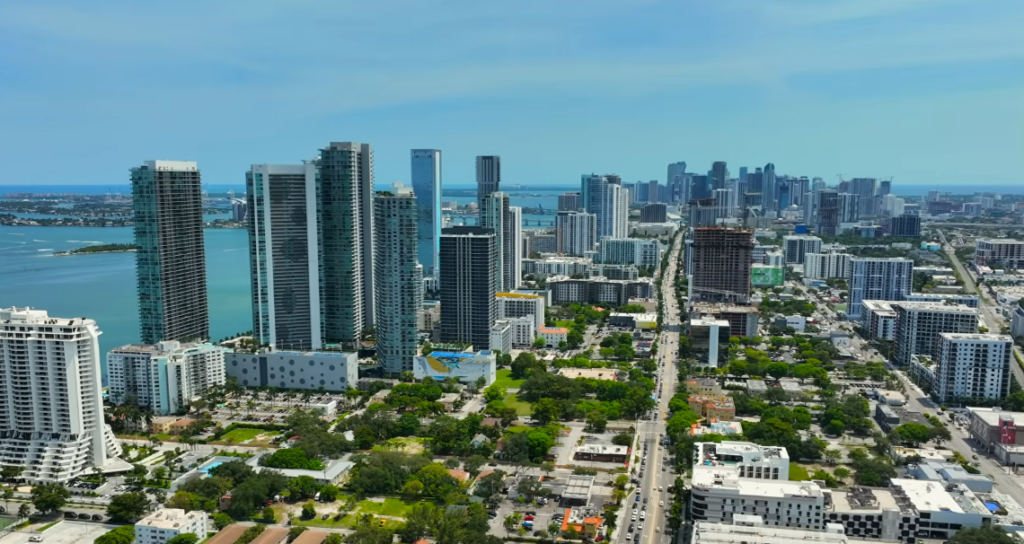
The skyline is not what you see when you first arrive in Miami. The light that bounces off the water is what gives everything a sense of permanence. Real estate signs stand boldly in front of buildings that appear a bit too close to the edge at high tide, condo towers shine, and palm trees lean slightly toward the ocean.
The contradiction is difficult to ignore.
Miami’s real estate market is still booming, with wealth coming in from California, New York, and other places, prices rising, and luxury condos selling. However, something more subdued is changing beneath that momentum. The ground is literally losing its certainty.
The market seems to be starting to bargain with reality.
Developers are still constructing glass towers with expansive views of the Atlantic along the waterfront. Buyers frequently pass by flood maps that seem far away, almost theoretical, as they stroll through showrooms, picturing sunsets and tax benefits. For many of them, lifestyle may still be more important than long-term risk. However, the narrative begins to twist a few miles inland.
Cranes now hover over construction sites that would have gone unnoticed decades ago in areas like Liberty City and Little Haiti, where the streets are slightly higher above sea level. These places weren’t always appealing. They are now. They sit a few feet higher, not because of beaches or nightlife. Elevation has evolved into a form of money.
| Category | Details |
|---|---|
| Location | Miami, Florida, USA |
| Market Status | High demand with rising climate-related risks |
| Key Issue | Sea-level rise and chronic flooding |
| Insurance Costs | ~$4,200+ annually (well above US average) |
| Trend | “Climate gentrification” toward higher ground |
| High-Risk Outlook | Up to 60% of Miami-Dade at risk of flooding by 2060 |
| Market Signal | Slower appreciation in low-lying areas |
| Social Impact | Displacement of low-income residents |
| Reference 1 | CNBC – Climate Gentrification in Miami |
| Reference 2 | Pulitzer Center – Climate and Housing |
Climate gentrification is a common term for this subtle, slow, but noticeable change. Sensing long-term risk along the coast, wealthier buyers relocate inland, raising prices in formerly lower-class neighborhoods. As this happens, it seems that climate change is changing more than just geography. Who gets to stay is being reshaped.
And who doesn’t?
A stroll through Overtown reveals some of the narrative. Fresh glass balconies represent a different kind of future, while older houses sit next to new construction, their paint fading slightly in the sun. Residents who have lived there for a long time discuss rising property taxes and rents, sometimes with a sense of disbelief, as if the changes came about more quickly than anticipated.
Whether the market fully comprehends what it’s pricing in is still up for debate.
Demand is still high for the time being. Miami’s tax structure and way of life continue to draw wealthy people, including hedge fund managers, tech entrepreneurs, and foreign investors. A portion of that money behaves differently from conventional buyers. It is more concerned with experience or portfolio diversification than it is with risk.
Investors appear to think that the city’s allure will outweigh its weaknesses.
However, the fissures are beginning to appear in less obvious ways.
For example, insurance has developed into a silent pressure point. Due to the rising cost of climate risk, premiums have increased dramatically in recent years, sometimes doubling or tripling. For homeowners, maintaining a property in an increasingly costly insurance market is more important than simply purchasing one.
Glossy brochures don’t show that expense.
Then there’s the condo problem, which seems like an additional source of anxiety. Many older buildings now require expensive repairs due to stricter structural safety regulations. In order to bring buildings up to code, owners are required to pay hefty assessments—sometimes tens of thousands of dollars.
A few are selling. Others are clinging, unsure.
A market that feels uneven is the outcome. Attention is still drawn to luxury properties, particularly those that are more recent. As a result of a combination of regulatory pressure and climate exposure, older units are starting to lag, especially in vulnerable areas. The market is divided, and these divisions seldom remain contained. Timing is another more general, more subdued question that looms over everything.
Large areas of Miami-Dade County may experience frequent flooding in a few decades, according to some estimates. That timeline seems far enough away for some buyers to overlook, but it’s close enough to affect other buyers’ perceptions of resale value.
It’s possible that perception, rather than the water itself, will cause the true change. The markets don’t wait for clarity. They act based on conviction.
Miami is still strong, even defiant, for the time being. Property values in some areas have rapidly recovered following flooding events, as if the market is determined to demonstrate its own strength. Some optimism, or perhaps more akin to stubbornness, is present here.
However, as this develops, a question remains.
For what length of time can a market rise while the risks underneath it intensify?
