

Flo Rida was reportedly observed bobbing his head to his own music playing during the trial while seated at the plaintiff’s table in a Broward County courthouse in January 2023. It was a hit on the internet. The videos went viral right away, showing a rapper engaged in a legal battle with a billion-dollar energy drink company, seemingly unfazed and relishing the occasion as if it were a listening party instead of a high-stakes legal battle. The jury awarded him $82.6 million as he left the courtroom. Looking back, the energy was right.
Anyone who has ever signed a contract with a rapidly expanding company and watched that company conveniently forget its obligations once the money started flowing will understand the story of the Flo Rida Celsius lawsuit, which has been winding through the Florida courts for years. In 2014, when Celsius Holdings was just getting started, Flo Rida, born Tramar Dillard in Carol City, Florida, signed an endorsement contract with the company. He consented to act as a brand ambassador, lending his name and reputation to a product that wasn’t even close to becoming a household name at the time. In return, he was promised stock shares (250,000 under the 2014 agreement and an additional 500,000 under a 2016 contract), as well as royalties on specific sparkling orange drink products that date back to 2018.
The lawsuit claimed that Celsius never fulfilled those commitments, and a Broward jury finally agreed. Even worse, the company is accused of hiding sales milestones in order to evade the contractual obligations that would have required them to turn over the stock. There was no miscommunication concealed in the contract’s wording. The jury determined that the concealment was fraudulent. Additionally, Celsius stock had increased significantly by the time the verdict was rendered in January 2023; those initially modest shares, which were valued at about $30,000 at the time of the initial breach, had grown into something far more valuable. This growth was reflected in the $82.6 million verdict.
Key Information Table
| Detail | Information |
|---|---|
| Plaintiff | Flo Rida (real name: Tramar Dillard) |
| Defendant | Celsius Holdings, Inc. |
| Original Contract Date | 2014 (endorsement/ambassador agreement) |
| Contract Duration | 2014 – 2018 |
| Core Allegation | Breach of contract; Celsius withheld promised stock shares and royalties; fraudulently concealed sales milestones |
| Shares Owed (2014 Contract) | 250,000 company shares |
| Shares Owed (2016 Contract) | 500,000 company shares |
| Royalties Claim | Royalties on sparkling orange drinks dating back to 2018 |
| Jury Verdict | January 2023; Flo Rida won on all three claims |
| Jury Award | $82.6 million |
| Trial Location | Broward County, South Florida |
| Appeals Court Ruling | December 2024; upheld breach finding; reversed stock valuation method |
| Valuation Dispute | Jury used Jan. 13, 2023 stock price; appeals court said breach date (April 30, 2021) or first sale date (Nov. 1, 2021) should apply |
| Potential Damage Reduction | Up to 50% per Bloomberg Law News |
| Florida Supreme Court Action | November 2025; denied certiorari — Celsius liability confirmed |
| Final Payout Range | Approximately $55 million to nearly $100 million (depending on valuation date chosen at retrial) |
| Flo Rida’s Attorneys | Kelley | Uustal Trial Attorneys (Fort Lauderdale, FL); co-counsel Jason Gonzales and Deepak Gupta |
| Original Stock Value at Time of Breach | Approx. $30,000 worth of shares |
| Notable Court Moment | Flo Rida was photographed vibing to his own music during proceedings |
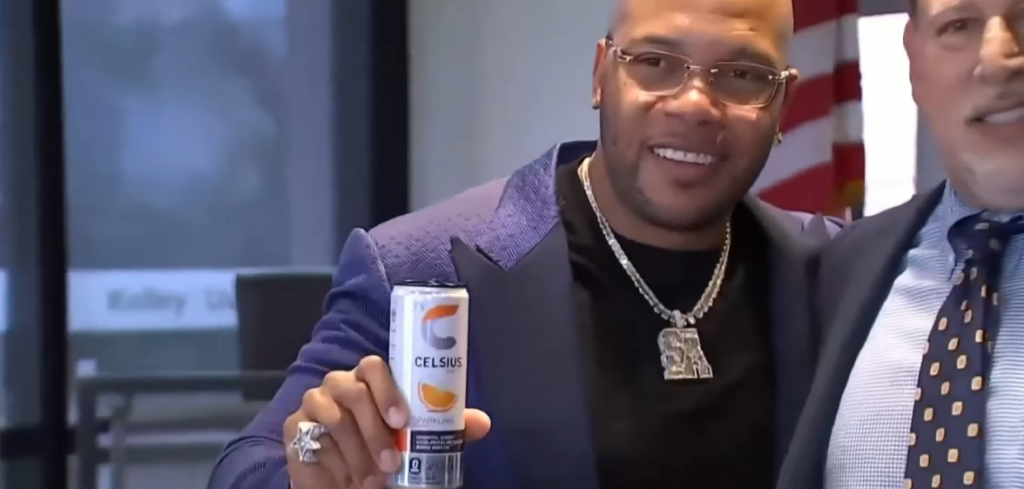
It’s difficult to ignore how acute the irony is in this instance. Celsius was built with Flo Rida’s assistance. When the brand was fighting for shelf space in gyms and gas stations in the mid-2010s, he was out there lending his name and his reach to a product that needed exposure. Celsius increased. Huge. In a market dominated by Red Bull and Monster, the company grew to become one of the fastest-growing energy drink brands in the US, eventually competing with the major players. Additionally, the lawsuit claims that the company’s accounting practices during that expansion prevented Flo Rida from getting what the agreement stated he was entitled to.
The January 2023 verdict was not the end of the legal battle. After Celsius filed an appeal, the Fourth District Court of Appeal in Florida rendered a nuanced decision in December 2024, upholding the breach of contract finding on all three claims while concurring with Celsius on one technical but crucial financial issue. On January 13, 2023, the last day of evidence, the jury determined Flo Rida’s stock damages based on the price of Celsius shares. That was the incorrect date, according to the appeals court. The stock price at the time of the actual breach, which was either April 30, 2021, or November 1, 2021, when the shares could have been sold, should have been used by the jury. The disparity in valuation is significant given how sharply Celsius stock increased and then fluctuated during that time. According to Bloomberg Law, the decrease might be as high as 50%.
The Florida Supreme Court then declined to review the appeals court’s ruling in November 2025, thereby solidifying Celsius’s liability while leaving the precise payout amount to be decided at a retrial on the valuation issue. In order to determine the appropriate date and, subsequently, the final number, the case now goes back to the trial court. Depending on the date the jury chooses, Flo Rida’s lawyers at Kelley Uustal predict the judgment with interest will range from roughly $55 million to almost $100 million.
Following this case gives the impression that it is important for reasons other than the specific people involved. Celebrity endorsement agreements have developed into incredibly intricate financial instruments, frequently involving equity stakes, royalty structures, and milestone-linked incentives that, when fulfilled, should generate real wealth. According to Flo Rida, he wasn’t attempting to profit from the lawsuit. He claimed to still own company stock and to be drinking Celsius products. Simply put, he expressed his desire for what had been agreed upon and what he had worked for. That demand is not out of the ordinary. He had the means and the determination to spend years in court to make it stick, which was what made it unique.
This is the last phase of the case. It is established that Celsius is liable. The question is the amount, and regardless of that amount, the tale of how a contractual obligation worth about $30,000 in 2014 developed into one of the decade’s most talked-about legal disputes in the music industry is already finished.
