

A teacher is working on a reading intervention with a student in a Columbus-area school district. The student’s individualized education plan, which is legally required and outlines the precise support that the child is entitled to, has taken months to perfect. The plan is in place because it is mandated by federal law. It receives some of its funding from Washington. And a budget proposal currently on Capitol Hill raises concerns about what would happen to all of that in the event that the underlying architecture is reorganized.
Cuts to federal education support programs are included in the Trump administration’s proposed FY2027 budget, which was released in early April for the second time in a row. The plan would cut K–12 public education spending by about $8.5 million for Ohio schools in particular, focusing on programs for English language learners, rural schools, student support services, and professional development for teachers. These cuts have been presented by the administration as doing away with initiatives that support DEI and encourage illegal immigration. More and more parents in Ohio are portraying them as something completely different.
Within days of the budget’s release, the statewide advocacy group Parents United for Public Schools started a petition, collected hundreds of signatures, and sent them to Ohio’s congressional delegation. “Federal funding must be protected at a time when many school districts are already facing budget uncertainty,” the group said in a measured but firm statement. Instead of fewer opportunities, our students require more resources, protections, and opportunities. In the meantime, the Pickerington school district warned that cuts would be required if a May levy fails. This local pressure is independent of the federal budget drama, but it exacerbates parents’ perception of a funding system under simultaneous stress from several sources.
The Trump Administration’s 2027 Budget Proposal: What $8.5 Million in Ohio School Cuts Actually Looks Like on the Ground
| Category | Details |
|---|---|
| Budget | Trump Administration Proposed FY2027 Federal Budget |
| Proposed Education Reduction (Ohio) | Approximately $8.5 million in K-12 public school spending |
| Programs Targeted | Educator professional development; English learner support; rural school programs; student support services |
| Administration’s Stated Rationale | Targeting programs promoting DEI and illegal immigration; reducing bureaucracy |
| New Program Introduced | Make Education Great Again (MEGA) grants — $2 billion to replace most existing K-12 grant programs |
| MEGA Grant Structure | Consolidates Department of Education K-12 programs into block grants distributed to states |
| DOE Dismantlement | Budget is part of broader effort to close the federal Department of Education |
| IDEA Proposal | Increased funding proposed for IDEA grants — but structured as block grants to states, removing federal oversight |
| IDEA = Individuals with Disabilities Education Act | Federal law guaranteeing services for students with disabilities and individualized education plans (IEPs) |
| Key Ohio Advocacy Group | Parents United for Public Schools — launched petition with hundreds of signatures |
| Central Ohio Parent/Advocate | Amanda Fontana — mother of children with disabilities, legal advocate, local school board member |
| Olentangy Parent Quoted | Tia Underwood — mother of child with IEP; described IDEA as “a federal guarantee” |
| School District Warning | Pickerington schools warning cuts necessary if May levy fails |
| Budget Status | Proposal submitted to Congress for review — final version subject to significant congressional changes |
| Broader Education Cuts | National proposal reduces higher education programs by $2.7 billion |
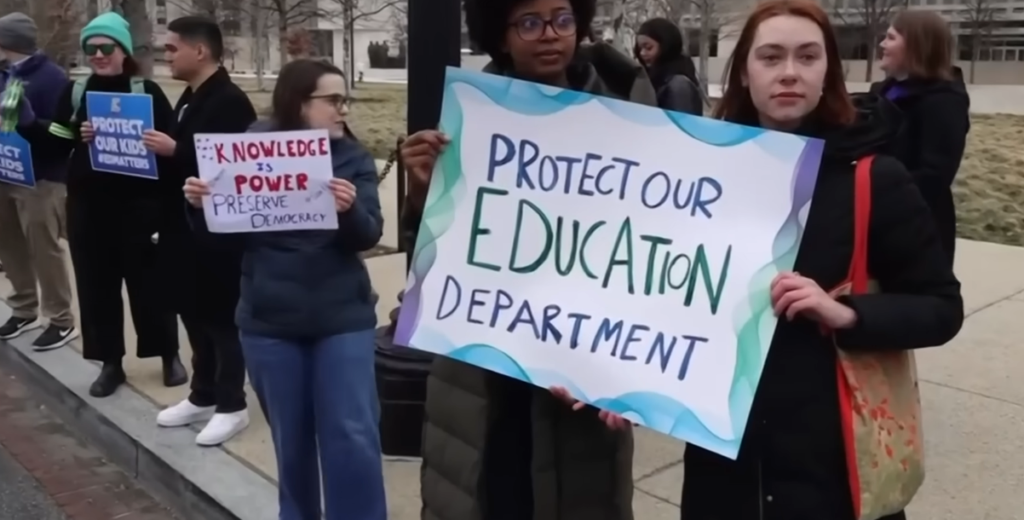
What happens to the Individuals with Disabilities Education Act is the more intricate portion of the budget and the one causing the most ongoing concern among Ohio’s disability advocacy community. Individualized education plans, which many Ohio families have spent years navigating, negotiating, and occasionally suing to obtain for their children, are among the specific services and educational accommodations that are guaranteed for students with disabilities under IDEA, a federal law. Increased nominal funding for IDEA is proposed in the Trump budget, but it is presented as a block grant, which means that states would receive a lump sum to distribute however they see fit rather than funding linked to the current federal framework that establishes enforceable guarantees.
Tia Underwood, a parent in the Olentangy district whose daughter has an IEP, explained the difference in terms that are understandable without prior knowledge of policy. “The moment you turn it into a block grant, you hand states permission to decide which children are worth the investment,” she replied. “A budget cut is not what that is. That’s abandonment disguised as policy. Underwood stated that the federal guarantee is what gives the current system its teeth and that she is aware of its emotional, financial, and logistical costs. She contended that in the absence of federal supervision, the pledge to her daughter and other kids like her turns into a suggestion rather than a right.
For months, Amanda Fontana—a mother of disabled children in central Ohio, a member of the local school board, and a lawyer who represents families in disability cases—has made a similar claim. The current system provides parents with a way to dispute, appeal, and, if necessary, escalate to federal oversight bodies that hold states accountable when they believe a school is failing to meet their child’s needs. Reducing the federal department’s authority and consolidating grants affect more than just the money flow. The leverage is altered. According to Fontana, parents lose the mechanism that makes state and local compliance more than optional in the absence of the federal backstop.
The administration’s stated reasoning goes the other way, claiming that cutting back on bureaucracy and giving states more authority will improve the efficiency of funding distribution to students by eliminating layers of compliance overhead that slow down funding and take resources away from classrooms. As a general proposition, that argument is not obviously incorrect. There are real instances of bureaucracy in federal education programs, and staff time that could be spent on students is actually consumed by compliance requirements. The question is whether the state discretion created by block grants is better or worse for the particular populations protected by categorical federal programs, such as children with disabilities, English language learners, and students in rural districts that have trouble attracting teachers.
How much of the original proposal will make it through congressional review is still unknown. By the time they come out of the legislative process, budget proposals frequently look very different, and Republican members of Congress who represent districts with sizable rural school populations or special education needs have their own incentives to oppose specific cuts. Some members of Ohio’s congressional delegation will listen to the families who signed those petitions.
Observing Ohio parents mobilize around these issues in real time gives me the impression that what is being contested here is not only a funding line but also an assumption about whether the federal government’s role in education is primarily a structural guarantee for the children most likely to fall through gaps when states are left to their own priorities, or if it is primarily bureaucratic overhead to be eliminated. In American politics, that is a genuinely contentious issue with no clear solution. Parents in Ohio who have children on IEPs often claim that they have already witnessed the consequences of not having the guarantee. They refuse to learn the truth once more.
