

Watching a three-year-old decide, for real, that a wooden spoon is a microphone is quietly amazing. They didn’t get that order from anyone. No app told me to do it. All they did was look at what they had and start making something new. In early childhood, that’s what creative development looks like at its core. It’s much more important than most parents realize until someone points it out.
Being creative as a child isn’t just about going to art class. It’s about how little kids learn to make sense of the world, play with cause and effect, and be okay with not knowing what will happen for long enough to try again. In a small but real way, a toddler who presses down on a crayon and watches a line appear is testing a hypothesis. Between the ages of one and three, the scribble stage helps kids improve their fine motor skills and learn that what they do has an effect. That feedback loop becomes very important.
When kids are three or four, something cool starts to happen. When they start drawing, they mean it. There is now a door on the house. That person has eyes. They aren’t just making marks; they are building meaning. When kids are five or six, they start putting things in order in their drawings. For example, the sky goes at the top, the ground goes at the bottom, and the people stand on something. It seems small. But that sense of spatial logic follows you as you read, do math, and eventually think about things in a more general way.
It seems like imaginative play is shrugged off as “just fun” when it’s really helping kids learn. When a kid pretends to run a bakery, they work on their vocabulary, ability to set priorities, and ability to control their emotions—sometimes all in the same ten minutes. When there is a fight over who will be the chef, they have to settle it. There is no adult script. There is no right answer. Just kids figuring out how to get along, which is also one of the hardest things to do as an adult.
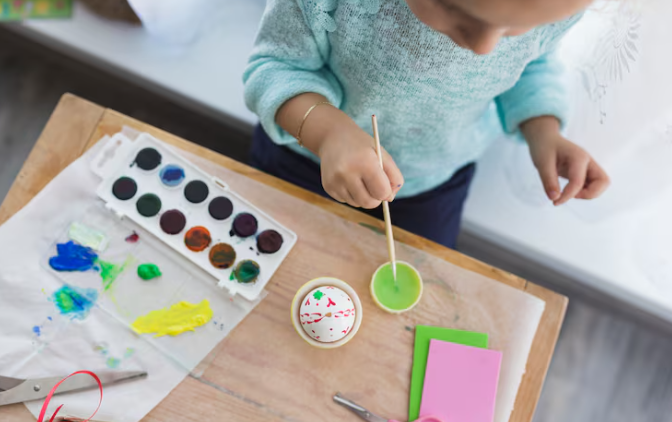
It’s important to think about how much the environment affects all of this. Kids don’t need complicated kits or lessons that are broken down by color. A large bowl and a wooden spoon. Scraps of fabric. Sand and water. Open-ended materials, which don’t come with instructions, make you think of more creative ideas than toys that are made for a specific purpose. For the child to practice flexible thinking in its purest form, they have to choose what the thing is.
Moments that happen every day have more weight than we think. As a child walks outside and knelts down to look at a beetle, their curiosity is being fed. Composition is when they arrange crackers into a face for snack time. They sway without knowing why while music plays in the background. That’s the start of an aesthetic sense. It doesn’t need a lesson plan for any of it.
Many researchers who study child development have noticed that kids’ creativity seems to peak around age six. But no one knows for sure why this happens. What’s less debated is the idea that kids who are allowed to make mistakes and are encouraged to try new things early on tend to be able to handle uncertainty well into adulthood. You don’t have to be successful to feel confident. That’s because they know that failing isn’t the end of the world.
Adults who help kids develop their creativity don’t have to be artists themselves. They mostly need to slow down, notice what a child is doing, and resist the urge to redirect it toward something neater or more obviously useful. Most of the time, the mess is what’s important.
Disclaimer
Nothing published on Creative Learning Guild — including news articles, legal news, lawsuit summaries, settlement guides, legal analysis, financial commentary, expert opinion, educational content, or any other material — constitutes legal advice, financial advice, investment advice, or professional counsel of any kind. All content on this website is provided strictly for informational, educational, and news reporting purposes only. Consult your legal or financial advisor before taking any step.
