

Even before the movie started, the theater seemed abnormally noisy. Kids were fidgeting in their seats, kicking chair backs, and gripping big buckets of popcorn. Goat didn’t introduce the story slowly when it did start. It exploded onto the screen, plunging viewers into a roarball arena brimming with neon lights and unfathomable speed. One gets the impression from watching those first few minutes that the movie doesn’t want viewers to be patient. It seeks out adrenaline.
The story is fundamentally quite straightforward. Will, a tiny goat with a lot of energy and a lot of ambition, gets drafted into a professional roarball league where bigger, more formidable animals rule. Although the idea is reminiscent of decades of sports narrative, there is something about the way it is presented that gives it a fresh sense of urgency. Familiarity may be purposeful, providing young viewers with something familiar while encasing it in contemporary spectacle.
Seldom does the animation itself remain motionless. As though reality itself is having trouble keeping up, courts beneath the players’ feet change throughout the game, going from frozen tundra to thick jungle. As you watch those changes take place in a dimly lit theater, you get the impression that the filmmakers were more concerned with sensation than realism. It can occasionally be very effective. It seems excessive at times.
| Item | Details |
|---|---|
| Film Title | GOAT |
| Release Date | February 13, 2026 |
| Directors | Tyree Dillihay, Adam Rosette |
| Studio | Sony Pictures Animation |
| Main Voice Cast | Caleb McLaughlin, Gabrielle Union, Stephen Curry |
| Genre | Animation, Sports, Comedy |
| Runtime | 1 hour 40 minutes |
| Worldwide Box Office | Approx. $61 million |
| Reference | IMDb Listing, Rotten Tomatoes Page |
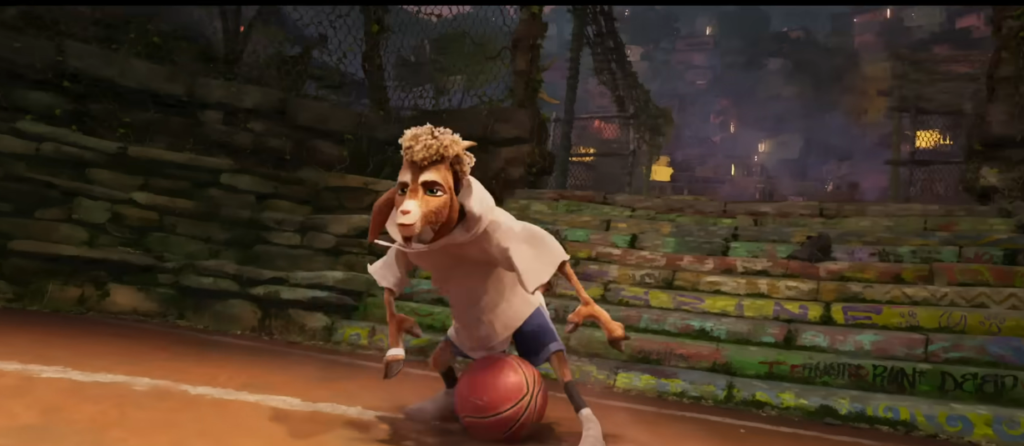
Will has a convincingly brittle resolve thanks to Caleb McLaughlin’s voice acting. He lacks confidence in himself. He pauses, falters, and questions himself. When the script heavily relies on cliched emotional beats, that vulnerability keeps the movie moving. Younger audiences appear to react naturally to his perseverance, though it’s still unclear if they pick up on those subtleties.
In more subdued ways, Stephen Curry’s involvement remains throughout the movie. Will’s fictional struggle is reflected in his own career, which has been shaped by doubts about his size. Even though the plot takes predictable turns, that parallel lends the story a sense of authenticity. This seems to be more than just entertainment. It is an animated retelling of personal mythology.
However, there are issues with the pacing. Emotional moments can occasionally feel incomplete because conflicts arise and end quickly. Within minutes, relationships change, as though the movie is worried about losing steam. As you watch this develop, you get the impression that contemporary animation has grown a little impatient with itself, prioritizing stimulation over introspection.
Some scenes, however, slow down just enough to be significant.
Will and his reluctant teammate Jett are having a conversation in the locker room in low light, with the faint echo of a cheering crowd in the background. No music. No tricks of the eye. Only two characters face their uncertainties. These slower scenes seem almost unintentional, as though they were overlooked by the film’s continuous movement.
Jett, played by Gabrielle Union, conveys a quiet fatigue that betrays a character unsure of her own legacy. It doesn’t feel cruel that she won’t accept Will. It has a human feel. Even though their connection comes sooner than anticipated, that hesitancy lends it a tenuous credibility.
Children were imitating roarball moves in the lobby outside the theater after the screening, their sneakers squeaking on the shiny tile floors. While some parents looked thoughtful, others checked their phones, parents watched with smiles. It’s difficult to ignore how the movie lands differently for different audiences.
Continuing to build on the creative momentum of its previous successes, Sony Pictures Animation appears to be pushing the boundaries of visual storytelling. Goat seems to be involved in that experiment. Not completely polished. Not completely bound. However, it is definitely energetic.
It also reveals something about the movie’s fixation on perfection. In a culture that continuously gauges success, the title itself carries weight, conjuring the idea of greatness. It’s possible that in this day and age, when comparison seems inevitable and constant, this message has a different resonance.
In a haze of sound and movement, the conclusion delivers precisely what viewers anticipate—possibly nothing more. Kids applauded. Adults gave courteous nods. Depending on what each audience member brought to the theater, the emotional impact persisted in different ways.
Goat doesn’t seem to be attempting to be flawless. It’s attempting to be perceived.
