

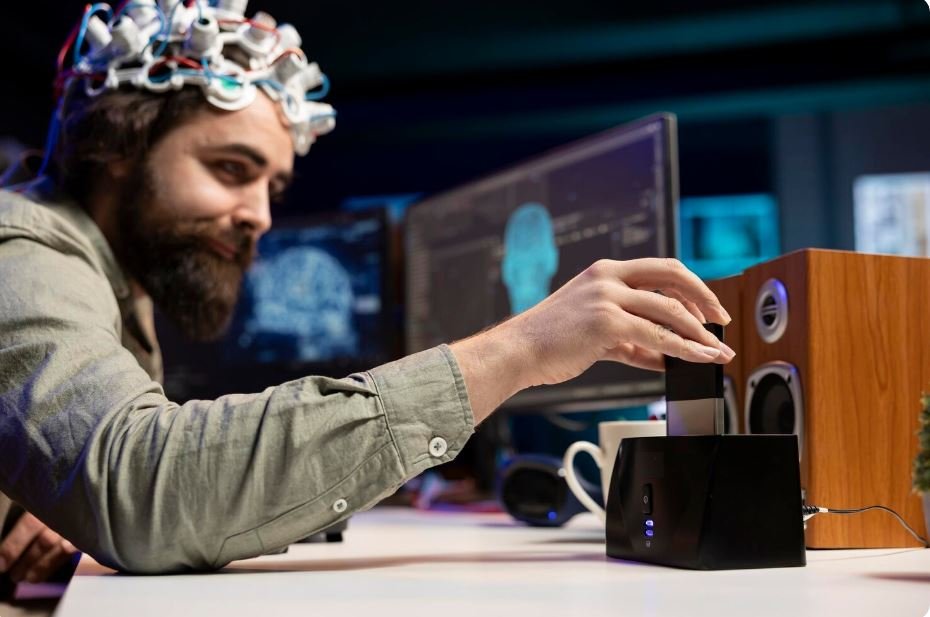
A cursor moves across a laptop screen in a small room with the soft hum of computer fans. The mouse is nowhere to be seen. No trackpad with a hand hovering over it. Rather, a man in a wheelchair is sitting quietly and focusing on his thoughts without moving or talking.
The cursor complies. It didn’t appear to be a cinematic breakthrough when Noland Arbaugh first showed that he could browse the web with just his thoughts. Dramatic orchestral swells were absent. A digital world reacting to unseen intention, a chessboard opening on-screen, a browser tab changing. However, as you watch it happen, you get the impression that something small but significant has changed.
| Company | Neuralink |
|---|---|
| Founder | Elon Musk |
| Founded | 2016 |
| Device Name | N1 Implant (“The Link”) |
| First Human Implant | January 2024 |
| First Patient | Noland Arbaugh |
| FDA Human Trial Clearance | May 2023 |
| Current Human Patients (as of 2025) | 12 |
| Official Website | https://neuralink.com |
Since its founding by Elon Musk in 2016, Neuralink has promised to create a brain-computer interface that can convert ideas into action.
Following a diving accident that left him paralyzed below the shoulders, Arbaugh was given the company’s N1 implant in January 2024. Neural threads inserted into areas of the brain responsible for movement intention are connected to the device, which is flush with the skull. The electrical spikes are translated into cursor motion by the system when he thinks about moving his fingers.
It sounds easy. It isn’t. According to his account, the actual surgery went surprisingly well, and he was discharged from the hospital in less than a day. Later, when software teams and engineers sat in front of screens, watching neuron spikes emerge in real time, the real drama began. The tension in that room is difficult to imagine: decades of scholarly research, billions of dollars in investor interest, and Musk’s divisive reputation all coming together on a blinking cursor.
Arbaugh was initially able to move it hesitantly, as though he were relearning how to walk in digital form. The motions grew more fluid with time. He engaged in chess play. He looked at websites. He even played Civilization VI for hours on end, even though he once believed he had lost the game forever.
That picture of a man reclaiming leisure rather than just function has a subtly potent quality.
Interfaces between the brain and computers are not new. Implanted electrodes have been the subject of years of research, frequently in strictly regulated academic environments. The scale and ambition of Neuralink’s breakthrough are what set it apart. In addition to openly discussing the restoration of speech, mobility, and even vision, the company has implanted devices in an increasing number of patients.
Skepticism persists, though.
While encouraging, early demonstrations are far from revolutionary, according to some neuroscientists. The 80 billion neurons in the brain dwarf the 10,000 neurons that are currently being observed. As complexity increases, it’s possible that progress will slow. Furthermore, the long-term performance of these devices in living tissue is still unknown.
Already, there were indications of weakness. The signal strength was once diminished when a few of the implant’s threads slightly retracted. As a reminder that this technology is still in its experimental stage, Arbaugh momentarily lost control of the cursor. Software was modified by engineers, who recalculated signal interpretation and restored functionality. However, the incident brought home a more significant reality: this is not plug-and-play magic.
As you watch this develop, it seems like the story frequently takes precedence over the science.
Musk, who isn’t afraid to use lofty language when describing technological advancements, has called Neuralink a bridge between digital systems and human cognition and has even hinted at the possibility of improving memory or cognition in the future. It appears that investors think the potential goes well beyond treating paralysis. However, the breakthrough seems more grounded to Arbaugh.
It has to do with freedom. He said he had little control over even basic interactions prior to the implant. It took help to browse the internet. Through other people, communication was mediated. He now controls a cursor on screens by himself, regaining a tiny but significant amount of independence.
And there are complex ramifications to that autonomy.
Anil Seth and other neuroscientists have cautioned that privacy becomes vulnerable once brain activity is converted to data. Is it possible to interpret emotional states or intentions tomorrow if signals can be decoded into motor commands today? Where ethical concerns start and technical limitations end is still up for debate.
Another layer is added by the regulatory context. The FDA approved Neuralink’s human trials in 2023, but the company’s growth is overshadowed by safety concerns and scrutiny of its earlier animal testing. Instead of performing open brain surgery, competitors like Synchron and Precision Neuroscience are using less invasive techniques by inserting devices through blood vessels. The race is picking up speed.
The cursor continues to move inside that silent room.
Arbaugh fails to present himself as a trailblazer. He acknowledges the dangers and speaks with cautious optimism. “It’s not flawless,” he has stated. “A lot of work remains to be done.” In a narrative that is frequently exaggerated by headlines, that humility feels grounded.
This moment might appear archaic in twenty years, akin to early dial-up modems in contrast to fiber optics. Or maybe it will be remembered by historians as the first real step toward combining digital and biological intelligence.
The image of a person thinking, a screen reacting, and a small group of engineers closely observing is still more human than futuristic for the time being. The web, which was previously accessed by voice and hands, is now bending to pure intention, albeit imperfectly and cautiously. And it’s difficult to overlook that, even in its early stages.
