

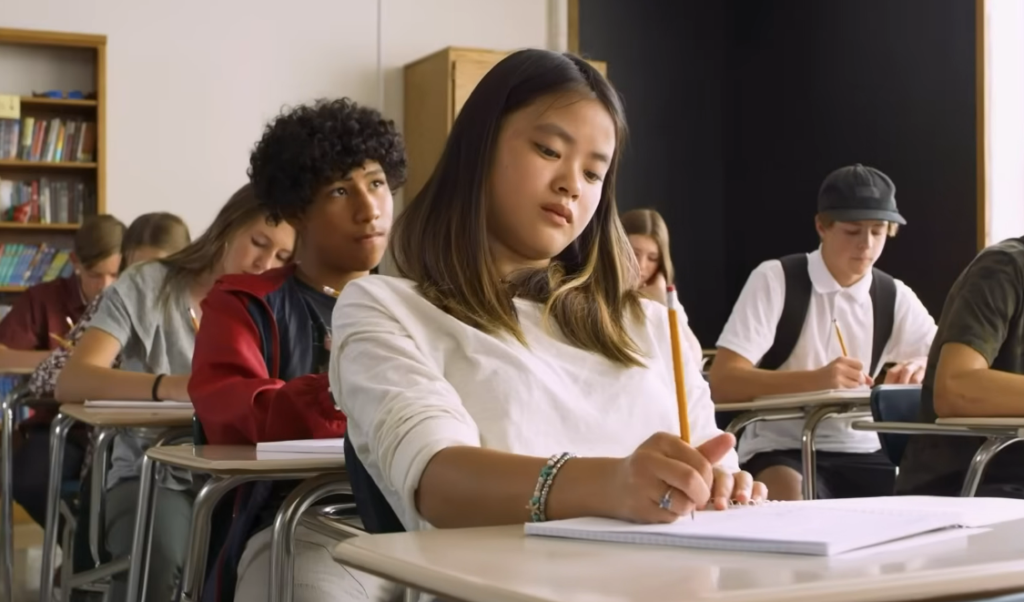
A fifteen-year-old is currently asking ChatGPT to clarify a topic their teacher covered yesterday in a secondary school classroom. not to be dishonest. At eleven o’clock at night, when no one else is around to ask, just to better understand it in a less formal language at a pace they can manage. They are among the 93% of secondary school students who already regularly use artificial intelligence (AI) in their studies, according to a Save My Exams survey of over 1,500 students in the UK earlier this year. Not in an experiment. Frequently. 74% at least once a week. The school system is running roughly two years behind the students it should be serving because it is still debating policies and holding awareness campaigns.
The fundamental reality of education in 2026 is that gap. And over the past year, an impressive amount of research has been published that has attempted, with differing degrees of urgency, to close it, or at the very least, describe it honestly. In a Forbes article, Dan Fitzpatrick listed eight 2025 papers that he believed all teachers ought to read. When combined, they don’t provide comfort. They provide something more beneficial: a realistic depiction of the situation, which turns out to be far more complex than either the optimists or the pessimists have been willing to admit.
| Topic | AI in Education 2026 — Research Landscape and Student Adoption |
|---|---|
| Key Survey | Save My Exams, 1,533 UK students (GCSE, A-Level, IGCSE, IB), March 2026 |
| AI Adoption Rate | 93% of UK students have used AI for schoolwork; 74% use it at least weekly |
| Dominant Tool | ChatGPT — used by 87% of students surveyed |
| Key Finding on Learning | 82% say AI helps them understand topics better; 55% find it more useful than textbooks |
| Academic Integrity Risk | 94% of AI-written university submissions went undetected in one study (PLoS One) |
| Equity Gap | Private school teachers 2x more likely to have formal AI training than state school teachers (Sutton Trust) |
| Notable Research | 8 key 2025 papers identified by Dan Fitzpatrick for Forbes covering cognition, collaboration, equity and mental health |
| Global Market | AI in education projected to exceed $32 billion; North America leads at 39% market share |
| Early Intervention Trial | Czech State University dropout rates fell from 37% to 19% using AI detection tools |
| Policy Gap | 11% of UK students receive no guidance at all on acceptable AI use |
Consider the paper on human-AI cooperation by Ben Weidmann and Christoph Riedl. Their conclusion was not that AI is making students more intelligent or lazy, but rather that using AI effectively is a unique skill that is unrelated to subject knowledge. Even if a student understands chemistry, they might still struggle to formulate questions, decipher AI answers, and modify their way of thinking when interacting with a system. No current curriculum specifically addresses this capability gap, and the more students use these tools without structured guidance, the more likely it is that the gap will widen.
The picture of academic integrity is also more complicated than most institutions would like to admit. 94% of the AI-written work that was submitted to a university examination system was found to be undetected. The startling figure is accompanied by a more illuminating discovery: between 2024 and 2025, the percentage of college students who believe it is appropriate to use edited AI text in their assignments increased from 17% to 25%. Students are not engaging in covert cheating. Students are altering their perception of what constitutes their own work, and they are doing so more quickly than the organizations establishing the regulations can monitor. Whether that change is a true ethical recalibration or just a reaction to systems that are unable to uphold their own standards is still up for debate.
It is difficult to ignore how the equity dimension cuts through all of this. According to the Sutton Trust, teachers in private schools are more than twice as likely as those in state schools to have received formal AI training (45% versus 21%). Seventy-five percent of teachers in well-funded schools have enough digital devices for each student. That number falls to 25% in underprivileged schools. AI does not automatically reduce achievement gaps. It expands them when the infrastructure, training, and tools are dispersed unevenly. The Tony Blair Institute for Global Change has advocated for the inclusion of mandatory AI literacy in the primary curriculum, claiming that the achievement gap will merely take on a new technological form if everyone does not have access to a core AI curriculum.
Reading this research together gives me the impression that education is at one of those times when staffrooms and policy offices are not keeping up with the rate of change occurring in classrooms. By their actions, the students have already cast their votes. Ninety-three percent is a baseline, not a trend. Whether the educational institutions in charge of this generation can quickly reorient themselves to teach them how to use these tools effectively instead of just catching them using them improperly is the question that is still genuinely open. According to research from 2025 and 2026, the window is getting smaller. It also implies—perhaps more crucially—that educators who actively participate in what is already taking place in front of them are in a far better position than those who continue to wait for the issue to be settled elsewhere.
Disclaimer
Nothing published on Creative Learning Guild — including news articles, legal news, lawsuit summaries, settlement guides, legal analysis, financial commentary, expert opinion, educational content, or any other material — constitutes legal advice, financial advice, investment advice, or professional counsel of any kind. All content on this website is provided strictly for informational, educational, and news reporting purposes only. Consult your legal or financial advisor before taking any step.
