

On a calm morning, the scene at the edge of the Mekong Delta appears as it always has: water birds making slow arcs across a sky the color of old tin, farmers hunched over paddies, and canals winding through a verdant maze. Observing all that stillness makes it easy to forget that the ground is moving beneath it. Not in a big way. Not all at once. Just quietly, steadily, downward.
Over half of Vietnam’s rice production and about 90% of its rice exports come from the Mekong Delta. That figure felt almost geological for decades, steady, dependable, and as unchanging as the river. However, that permanence was never quite real. The delta is declining. The ocean is rising. Additionally, saltwater is gradually destroying what took generations to construct by seeping inland through irrigation channels and canals.
This crisis cannot be traced back to a single incident. It’s pressure coming in all at once. Sea levels are rising at a rate of about three millimeters per year due to global warming, which may seem insignificant until you consider that the delta’s land is also sinking by up to three centimeters per year in some places. This is mostly due to groundwater extraction and the loss of sediment that used to replenish the soil every flood season. The math is not difficult. The sea isn’t just engulfing the delta. It’s coming down to meet it.
IMPORTANT INFORMATION TABLE — VIETNAM’S MEKONG DELTA
| Category | Details |
|---|---|
| Location | Mekong Delta, Southern Vietnam |
| Total Area | ~40,000 sq km |
| Rice Contribution | Over 50% of Vietnam’s total rice production |
| Export Share | ~90% of Vietnam’s rice exports |
| GDP Contribution | ~12% of Vietnam’s national GDP |
| Population Affected | ~17–18 million people |
| Salinity Intrusion Reach | Up to 50 km inland through canal networks |
| Land Subsidence Rate | Up to 3 cm/year in affected areas |
| Sea Level Rise Rate | ~3 mm/year globally; faster locally |
| Rice Paddies Damaged | Over 159,000 hectares destroyed in recent droughts |
| Projection by 2100 | Up to 85% of the delta could be permanently submerged |
| Key Threat Factors | Rising seas, land sinking, upstream dams, salinity, prolonged drought |
| Global Rice Rank | Vietnam is the world’s 3rd largest rice exporter |
| Key Research Body | International Rice Research Institute (IRRI), Philippines-based |
Once you understand the sediment problem, it is difficult to ignore it. Every year, sediment that used to flow south is trapped by hydropower dams constructed upstream in China and other Mekong River countries, creating new layers of earth that keep the land above sea level. The delta has lost its geological floor in the absence of that yearly renewal. The river is still flowing. The water continues to come in. However, the land-building material no longer does, and each year the delta repays that debt by quietly sinking more paddies, more soil, and more coastline.
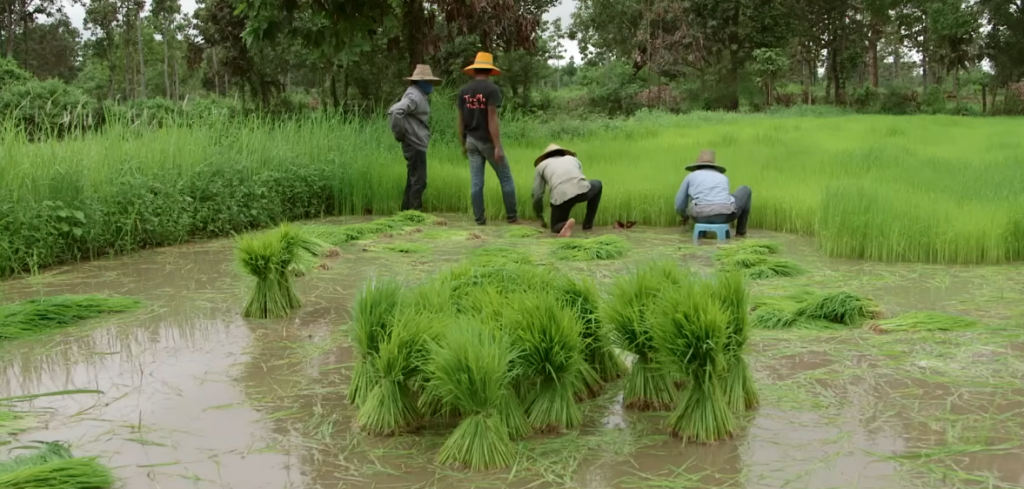
Farmers perceive salinity intrusion in their crops and feel it in their hands. In provinces like Ben Tre, salt water has been pushing through the canal networks up to fifty kilometers inland, contaminating the freshwater that rice paddies rely on. The saltwater arrived two months ahead of schedule and traveled farther inland than at any other time in a century of recorded data during a severe drought caused by El Niño. Rice just died in some fields. In others, it became thin and pale and produced very little when harvested. In just that season, more than 159,000 hectares of paddies were destroyed.
Researchers believe those drought seasons weren’t unusual. They were sneak peeks. Researchers at the International Rice Research Institute have been creating fast-maturing, salt-tolerant rice varieties tailored to the declining conditions of the delta. It’s practical, serious work that could help individual farmers deal with the coming years. However, it’s also a subtle acknowledgement that the shift has already begun—breeding a better rice plant doesn’t make the salt go away. It purchases time.
The magnitude of what is being lost is hard to quantify when observing this from the outside. This is not merely a declining agricultural area. The delta contributes around twelve percent of Vietnam’s national GDP, and the country only reached the top three global rice exporters after doubling production over two decades — a transformation built on policy, infrastructure, and the sustained labor of millions of farming families. Younger generations are already departing for factory jobs in Ho Chi Minh City and other places, sensing something that their parents may not yet express verbally. As a result, everything is currently on shaky ground.
There is some adaptation taking place. Over 200,000 hectares in the province of An Giang have implemented a water management strategy known as Alternate Wetting and Drying, which involves stopping the standing water in paddies to lessen methane-producing bacteria and reduce water use. Where there used to be only waste, farmers like Dong Van Canh, who grew up witnessing his parents burn rice straw and blacken the sky with smoke, are making money by turning that straw into mushrooms and organic fertilizer. Real adjustments, under real pressure. Whether they will be sufficient is still up in the air.
In the end, crop science and farming practices are insufficient to address the delta’s issue. River politics between China, Laos, Thailand, Cambodia, and Vietnam are involved. It involves seas rising over land that the emitters have never seen due to carbon emissions generated thousands of miles away. Additionally, it has to do with groundwater policy in Vietnam, where extraction has gone well beyond the point of sustainable return. According to some estimates, up to 85% of the Vietnamese Mekong Delta will be permanently underwater by the year 2100. It hardly matters anymore whether or not that precise number holds. It’s obvious where to go. There are still paddies. Rice is still planted, harvested, and transported. However, something is literally changing beneath all that routine activity, and the workers on that land sense it in ways that are difficult to measure from a distance.
Disclaimer
Nothing published on Creative Learning Guild — including news articles, legal news, lawsuit summaries, settlement guides, legal analysis, financial commentary, expert opinion, educational content, or any other material — constitutes legal advice, financial advice, investment advice, or professional counsel of any kind. All content on this website is provided strictly for informational, educational, and news reporting purposes only. Consult your legal or financial advisor before taking any step.
