

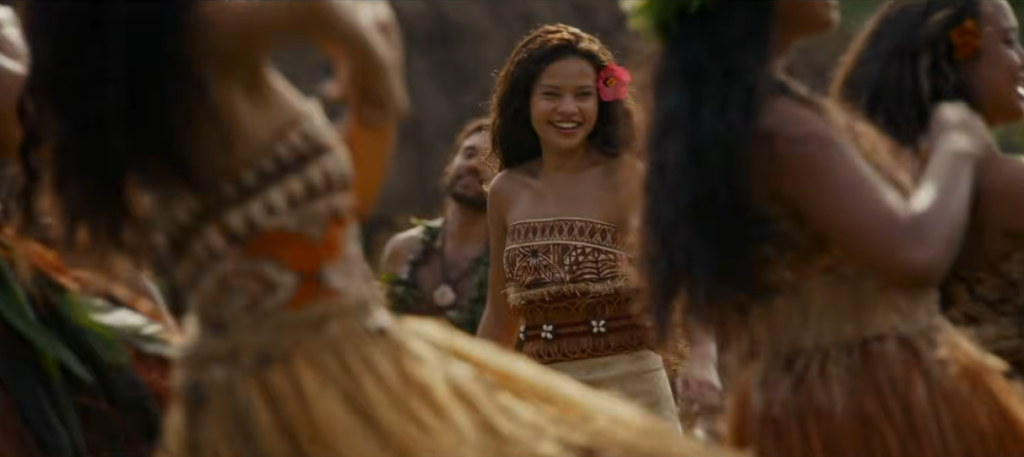
The Moana live-action trailer’s first view of the ocean seems almost too real. Water no longer shimmers as it did in 2016. It stretches across the screen with a weight that animation never quite managed, moving heavier now and darker in some places. The sand is less forgiving, and the shoreline appears sharper. A new Moana, portrayed by Catherine Lagaʻaia, is standing at the edge of it, observing the horizon as though unsure of what lies beyond.
It’s possible that audiences’ emotions are reflected in this uncertainty.
Disney decided to make a live-action version of Moana less than ten years after the first movie, which is surprisingly quick. That’s hardly enough time for nostalgia to settle in Hollywood terms. The animated version is still available on streaming services, feels new, and is still relevant today. This begs the silent question, “Why revisit it now?”
There’s a feeling that momentum is more important to the solution than narrative.
Not only did the first movie do well, but it also endured. Songs like “How Far I’ll Go” started to play in classrooms, cars, and homes. After watching it once, kids seemed to keep watching it. The idea that Moana is more than just a movie—rather, it’s a franchise with enduring power—was reinforced when the sequel hit the billion-dollar mark worldwide.
It appears that investors think this level of loyalty can translate into live action. However, the translation is difficult.
The shapeshifting demigod Maui was made to feel larger than life through animation in a way that required no explanation. That scale gets more difficult in the live-action version, which Dwayne Johnson plays once more. It’s difficult to ignore the details that people are already arguing about when watching the trailer: the wig, the tattoos, and the somewhat exaggerated yet restrained physical presence. Some viewers chuckle. Others support it. Most seem uncertain.
| Category | Details |
|---|---|
| Film Title | Moana (Live-Action) |
| Release Date | July 10, 2026 |
| Director | Thomas Kail |
| Lead Actress | Catherine Lagaʻaia |
| Maui Actor | Dwayne Johnson |
| Genre | Musical / Adventure / Fantasy |
| Original Film | Moana (2016, Disney Animation) |
| Setting | Polynesian islands / oceanic voyage |
| Production | Disney, Seven Bucks Productions |
| Reference | IMDb Listing |
| Reference | Disney Official Page |
That response seems familiar. Disney has previously visited this location with Aladdin, The Lion King, and The Little Mermaid. Every time, the same pattern occurs: skepticism, internet discussion, and frequently enormous box office profits. These days, it seems almost like a pattern that suggests what happens in theaters may not be predicted by online reactions.
However, Moana feels unique in some way.
It’s partly cultural. The original movie combined mythology with contemporary storytelling in a way that felt thoughtful, even cautious, with a careful regard for Polynesian ancestry. Dwayne Johnson has been transparent about his ties to that culture, and the new movie makes a clear attempt to preserve that authenticity.
But controlling authenticity in live action is more difficult.
Unpredictability is introduced when filming on water and working with real light, weather, and textures. After spending hours in the ocean, a wig that appears convincing in a controlled setting may act differently. When recreated physically, a scene that seemed magical in animation may feel constrained and grounded.
Whether that grounding will strengthen the narrative or subtly weaken it is still up for debate.
However, Catherine Lagaʻaia’s casting as Moana adds a different kind of energy. She exudes a seriousness in brief scenes from the trailer that seems a little more contemplative than the animated version. Her eyes stay there longer. Her motions seem deliberate, almost cautious. As this plays out, it seems like this Moana may be less impetuous and more conscious of the consequences. It might have an impact.
Because Moana has always been fundamentally about going beyond what is known—leaving the reef, defying convention, and taking a chance on failure. That trip felt exciting and occasionally even lighthearted in animation. It could feel heavier in live action. more actual. The stakes are more direct and less symbolic. And perhaps that’s the goal.
Disney is testing whether those stories can change with their audience rather than merely reenacting its history. The kids who watched Moana for the first time in 2016 are now older. Their standards have changed. They have become more realistic. The outcome of a softer, more optimistic version of the story may change.
That involves a silent risk.
Because nostalgia can attract people, but it can also lead to uncomfortable expectations. Each scene turns into a comparison. Each character is a memory that is evaluated in light of a fresh interpretation. And occasionally, the original version—the one that people remember—wins. However, this project’s scope indicates confidence.
The scenes of the ocean appear vast, extending well beyond the frame. Glimpsed briefly, the creatures have a distinct presence that is more textured and less stylized. Additionally, the music seems to echo the original while holding back just enough to feel fresh, despite only being hinted at. It’s difficult not to wonder how everything will fit together.
Because there’s a more straightforward question that lurks beneath the spectacle and the controversy surrounding wigs and graphics. Is it necessary to retell this story? Or does this version focus more on possibility than necessity?
Disclaimer
Nothing published on Creative Learning Guild — including news articles, legal news, lawsuit summaries, settlement guides, legal analysis, financial commentary, expert opinion, educational content, or any other material — constitutes legal advice, financial advice, investment advice, or professional counsel of any kind. All content on this website is provided strictly for informational, educational, and news reporting purposes only. Consult your legal or financial advisor before taking any step.
