

The dramatic flair of Tesla and the algorithmic intensity of Nvidia are not reflected in the movement of Amazon’s stock. It moves in a unique way. heavier. more intentional. With a market valuation of over $2.2 trillion and a share price of about $209, Amazon is more like infrastructure than a trade—something that is ingrained in both portfolios and everyday life.
Delivery vans, each filled to the brim with cardboard boxes bearing that recognizable curved arrow, rolled out of an industrial center just south of downtown Seattle on a recent weekday morning. Conveyor belts hummed, scanners beeped, and employees walked briskly under fluorescent lights inside fulfillment centers. It’s difficult not to view Amazon as a logistics behemoth first and a stock ticker second after watching that choreography.
But at the moment, artificial intelligence is the focus of Wall Street’s attention.
| Bio / Key Information | Details |
|---|---|
| Company | Amazon.com, Inc. |
| Ticker | AMZN |
| Exchange | NASDAQ |
| Current Price | ~$209 |
| Market Cap | ~$2.24 Trillion |
| 52-Week Range | $161.38 – $258.60 |
| P/E Ratio (TTM) | ~29 |
| CEO | Andy Jassy |
| Headquarters | Seattle, Washington |
| Employees | ~1.57 Million |
| Revenue (TTM) | ~$717 Billion |
| Official Sources | Amazon Official Website · NASDAQ – Amazon Stock Profile |
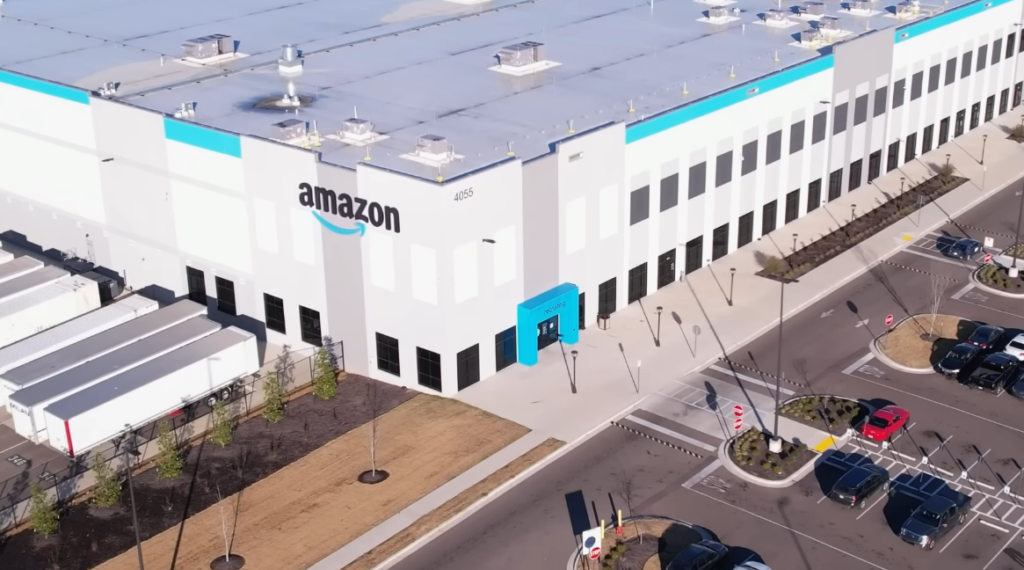
Recently, Amazon pledged $12 billion to build new data center campuses in Louisiana as part of a much bigger capital spending plan that may eventually reach $200 billion. The funds will support the next stage of AI computing and expand the infrastructure for Amazon Web Services, its cloud division. At first, investors recoiled. That’s what big numbers tend to do.
The market might be more concerned with timing than ambition. When margins are stabilizing, spending aggressively can appear audacious—or reckless. Amazon’s earnings exceeded forecasts, and the company’s fourth-quarter revenue increased by more than 13% year over year to over $213 billion. In any case, those are good numbers. However, some investors seem concerned about the amount of money that will be reinvested in power grids, cooling systems, and servers.
It seems like Amazon is attempting a long-term strategy that most businesses cannot afford.
Compared to Jeff Bezos’s visionary tenure, the company feels more operationally focused under CEO Andy Jassy, who formerly oversaw AWS. Expenses have been reduced. Layers of corporations shrank. Efficiency is prioritized. Nevertheless, Amazon writes massive checks to increase cloud capacity while preaching discipline.
The area where Amazon intends to construct those data centers, Caddo Parish in northwest Louisiana, is primarily made up of utility poles and level fields. Racks of servers blinking in climate-controlled darkness will soon be housed in enormous warehouse-like structures. According to the company, the project will generate thousands of construction jobs in addition to hundreds of direct jobs. However, whether those servers will produce enough high-margin AI revenue to cover the investment is the more crucial question for investors.
It appears that investors still consider AWS to be Amazon’s greatest asset. It stabilizes the business’s profitability and has larger margins than retail. Cloud competition, however, is getting more fierce. In an effort to attract business clients who are in need of processing power, Google and Microsoft are investing heavily in their own AI capabilities. Whether the AI boom will benefit all cloud providers equally or just the most productive ones is still up in the air.
The original engine, the retail industry, is still chugging along. North American revenue is still strong thanks to the expansion of advertising and Prime memberships. Often disregarded, Amazon’s ad business has quietly grown into a multibillion-dollar profit center by precisely monetizing sponsored listings and search results.
Retail is mature, though. Growth is gradual rather than rapid. There is a sense of consolidation rather than frenzied activity when examining Amazon’s stock chart over the last year. While trading below their 52-week high of $258, shares are up slightly. Perhaps that restraint is good for you.
By tech standards, the valuation is far from extreme, coming in at about 29 times trailing earnings. Amazon appears almost conservative when compared to well-known AI companies. Fantasy-level multiples are not being used by investors for pricing. They are factoring in long-term growth.
Durability does not equate to invincibility, though.
Both the US and Europe are still under regulatory scrutiny, especially with regard to employee data usage and marketplace practices. The political winds change. Customer attitude varies. Managing the company’s global workforce of over 1.5 million employees is no easy task.
Nevertheless, Amazon stock has a certain quiet resilience. Rarely does it fall apart completely. It ignores the news—job losses, capital expenditure increases, and regulatory inquiries—and continues on. With price targets ranging from $280 and higher, analysts overwhelmingly recommend it as a buy, which may be explained by its stability.
As we watch this develop, it seems like Amazon has evolved from a startup to something more akin to a utility. Not dazzling. Not easily broken. simply growing steadily.
Nevertheless, the AI wager introduces uncertainty. In retrospect, today’s price might seem reasonable if the spending binge results in longer-term cloud growth and deeper enterprise integration. Investors might wonder if Amazon overbuilt if demand declines or margins are eroded by competition.
