

The Rhine does not appear to be Europe’s commercial route in the town of Bingen, where vineyards slope down toward the water. It appears worn out. While moored barges sit awkwardly beneath quays that once hovered just above the surface, ferries cautiously pass exposed rocks. The amount of riverbed that is suddenly visible is difficult to ignore.
The Rhine River levels in Germany have once again fallen to historic lows, endangering trade in ways that are both familiar and unnerving. Levels have dropped significantly below what is required for regular navigation at the chokepoint of Kaub, where the depth of the water determines whether fully loaded vessels can pass. Barges are now negotiating sections with less than half a meter to spare, whereas previously they would sail with more than two meters beneath them.
There are instant repercussions. In order to prevent running aground, cargo vessels are reducing loads and operating at about 30% to 50% of capacity. Once able to transport fuel or chemicals in a single trip, a single tanker now needs two or three. In recent low-water episodes, freight rates have increased by multiple times. Although it appears that investors think these spikes are only temporary, the word “temporary” keeps coming up.
| Category | Details |
|---|---|
| River | Rhine River |
| Country Most Affected | Germany |
| Critical Chokepoint | Kaub (Rhineland-Palatinate) |
| Key Industries Dependent | Coal, chemicals, steel, fuel transport |
| Major Company Exposed | BASF |
| Annual Inland Cargo (Germany) | ~200 million tonnes |
| Monitoring Authority | Federal Waterways and Shipping Administration |
| Official River Data | https://www.elwis.de |
| Climate & Environment Data | https://www.umweltbundesamt.de |
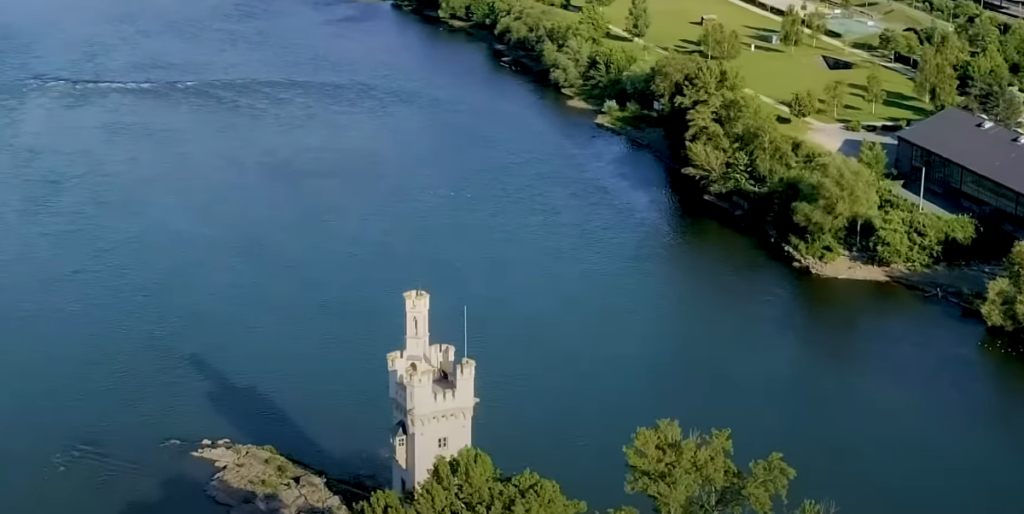
Every year, the Rhine transports almost 200 million tonnes of goods across Germany, including grain heading north toward Rotterdam, chemicals to factories, iron ore to steelmakers in Duisburg, and coal to power plants. It is easy to see how narrow the margin has become when one observes a 135-meter barge hugging the deepest channel along the groynes. Because the safe passage zones have gotten smaller, captains talk about steering in convoy, moving almost like trains.
When its river runs low, Germany’s economic resilience might be more brittle than it seems. According to earlier estimates, persistently low water levels can reduce GDP by as much as half a percentage point. That might sound modest. However, half a point feels significant in an economy already struggling with high energy costs and a slowdown in industry.
During previous droughts, chemical giant BASF, which has significant operations along the upper Rhine, has publicly discussed contingency planning. In the past, production cuts were unimaginable. They are now included in risk management for businesses. Particularly at risk are coal shipments, which rose following the energy crisis brought on by Russia’s invasion of Ukraine. Transporting coal to power plants requires lighter barges, which tightens supply chains.
A combination of prolonged drought, heat waves, and less snowmelt from the Alps is causing the low water. For years, climate scientists have warned that summer droughts would become more common in central Europe. Even though the Rhine has already dipped dangerously in 2018, 2022, and 2023, there seems to be a little more urgency in each instance. One gets the impression that adaptation is not keeping up with reality.
A cargo ship in Düsseldorf, its hull unusually high above the waterline, glides slowly past apartment balconies. Locals stop to observe, possibly feeling that something is strange. Awkwardly, signs that once alerted people to dangerously high waters now loom over dry gravel. The irony in the image is striking.
Logistical flaws are also revealed by shallow water. Redirected cargo cannot be readily absorbed by rail and road networks, which are already nearly full. The cost of a truck is high. Trains are reserved. Additionally, just-in-time delivery is still a major component of Germany’s industrial base. Everything downstream is strained when the river falters.
Whether these low-water episodes will get worse every year is still up in the air. Some meteorologists advise against extrapolating long-term decline from isolated droughts. However, it is hard to overlook the trend toward hotter, drier summers throughout Europe. The continent is warming more quickly than the rest of the world. Rivers answers.
Additionally, there is a political component. By making investments in electrification and renewable energy, Germany has established itself as a leader in the climate transition. However, heavy industry still depends heavily on inland waterways. It would take decades, not seasons, to upgrade the infrastructure necessary to switch freight completely to rail. River engineering and dredging projects are discussed by policymakers, but they are complicated by permitting requirements and environmental resistance.
It’s difficult not to consider the Rhine to be more than a trade route as you watch this happen. For centuries, it has influenced European history by acting as a border, a route, and a symbol. It now has the feel of a barometer. Trade flows as it swells. Confidence falters when it gets smaller.
Measuring markers in Kaub rise sharply above the water’s edge, their numbers visible like a silent warning. In the hopes of rain upstream in Switzerland, barge operators check forecasts every day. The difference between a ship waiting or sailing is only a few centimeters.
Hope and realism are subtly at odds with one another. Rainfall can restore capacity by momentarily raising levels. However, the reprieve might only last a short while if there is no sustained precipitation and no snowpack recovery. Once-stable assumptions are being recalculated by industrial planners, shipping companies, and investors.
The Rhine has never been stable. Droughts and floods are nothing new. The frequency of disruptions, which come as Europe is navigating an energy transition and economic uncertainty, feels different. The river doesn’t make a big show of its decline. It slowly becomes apparent in the form of stranded stones, partially empty barges, and freight surcharges that are subtly added to invoices.
Disclaimer
Nothing published on Creative Learning Guild — including news articles, legal news, lawsuit summaries, settlement guides, legal analysis, financial commentary, expert opinion, educational content, or any other material — constitutes legal advice, financial advice, investment advice, or professional counsel of any kind. All content on this website is provided strictly for informational, educational, and news reporting purposes only. Consult your legal or financial advisor before taking any step.
