

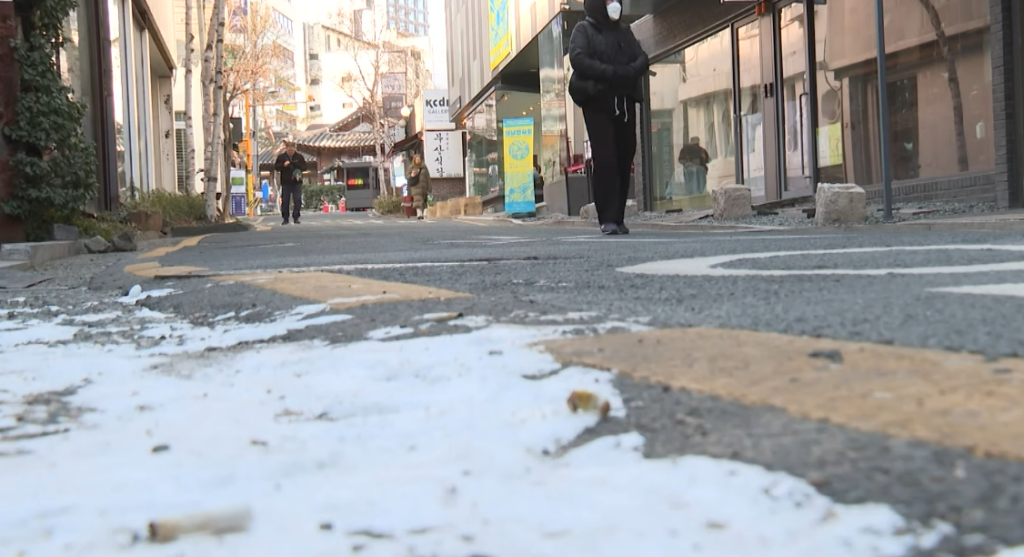
Commuters hurried across Sejong-daero in central Seoul on the first working Monday of January, their shoulders bent and their scarves drawn high across their faces. The chill was more intense than usual; it wasn’t dramatic or dramatic, just persistent. The kind that gets into your bones and seeps through gloves.
The coldest January in South Korea’s history has sparked both scientific and psychological concerns about the climate. In January 2026, the national average temperature was -1.6°C, which was unusual in a decade that has generally been warm and below the seasonal norm. But it was the volatility, not just the cold, that most unnerved meteorologists.
In some southern regions, mid-month daytime highs flirted with 20°C, which is warm enough for light jackets and springlike temperatures. After a few days, Arctic air rushed downward, causing temperatures to drop precipitously below freezing for over ten days in a row. There was a 13.5°C difference between the warmest and coldest daily averages. Perhaps this seesaw, this whiplash, is the true story.
Precipitation was even more concerning, according to the Korea Meteorological Administration. January was the second driest January on record, with only 4.3 millimeters of national rainfall, or about 19.6% of average levels. A record low for relative humidity was reached. There was virtually no detectable precipitation at all in areas like Daegu and Yeosu. It was brittle air. Static held onto clothes. In the pale winter light, even the Han River appeared oddly muted.
| Category | Details |
|---|---|
| Country | South Korea |
| Capital City | Seoul |
| National Weather Authority | Korea Meteorological Administration |
| January 2026 Avg. Temp | -1.6°C (below normal) |
| Precipitation | 4.3 mm (19.6% of normal, 2nd lowest on record) |
| Humidity | Lowest since records began (53%) |
| Energy Context | Winter peak power demand rising during cold waves |
| Official Climate Data | https://www.kma.go.kr |
| Government Climate Policy Portal | https://www.korea.kr |
Extreme cold seems to go against the idea of global warming. That is the natural response. However, climate scientists contend that the opposite might be true. Sea ice loss can cause the polar vortex to weaken and become unstable, allowing cold air to spill southward in erratic bursts due to Arctic warming. Although it’s still unclear if this specific cold snap fits neatly into that framework, the Northern Hemisphere has seen a general pattern of warmer averages interspersed with severe cold spells.
Over the past century, South Korea’s climate has unquestionably warmed, rising by about 1.8°C, or nearly twice the global average. The length and humidity of the summers have increased. The intensity of heat waves has increased. But winter won’t go away without a fight. Rather, it appears to be changing, showing up less frequently but more suddenly at times, surprising cities.
A delivery man recently told of his van’s difficulty starting during the coldest week outside a Mapo residential tower. The batteries quickly ran out. Overnight, the roads iced over. At the same time, the amount of electricity used increased. In Korea, almost 70% of the energy used in homes is for heating. Peak power loads moved from summer to winter during extreme cold waves in previous years, a small but significant change in how climate variability affects infrastructure planning.
Energy planners are keeping a close eye on things. According to investors, Korea’s decarbonization timeline may be complicated by winter volatility, especially as the use of electrified heating increases. The grid must handle both summer cooling peaks and winter heating surges if cold waves get stronger even as averages rise. It feels costly to have that dual pressure.
An additional layer of unease is added by the dryness. In the Yeongdong area of Gangwon, which is already vulnerable to forest fires, wildfire advisories persisted. Siberian dry winds drained the fields and slopes of their moisture. According to reports, farmers in Gyeongsang Province were concerned about what might happen in the spring if soil moisture levels continued to drop, in addition to the potential damage from frost.
It’s difficult to avoid feeling a subtle tension between perception and data as you watch this play out. Climate change skepticism can be stoked by a single harsh winter. However, decades, not days, are used to measure climate. In a warming world, the paradox of colder extremes defies common sense. It makes public messaging more difficult as well.
South Korea seems to be situated at the meeting point of conflicting atmospheric forces. The peninsula’s climate is a choreography rather than a straight line because it is surrounded by warming seas, shaped by East Asian monsoon patterns, and impacted by Arctic dynamics. Northward, warm air pushes. The air gets colder. Over eastern Siberia, blocking highs form, trapping cold masses. The atmosphere acts more like a pendulum than a trend line.
One unusually warm afternoon in mid-January illuminated the stone surfaces of Gwanghwamun Plaza, where fountains are usually turned off in winter. A few days later, the same plaza was covered in ice, and the wind was tearing through the hallways of skyscrapers. The trend of warmth flirting with April and then retreating into Arctic severity could be the new normal.
The scientific controversy is still going strong. Even though there are still sporadic, severe outbreaks, some studies indicate that the number of extreme cold days has decreased overall. Some contend that mid-latitude weather patterns may still be disturbed by Arctic amplification. It is evident that there is a rise in variability. And there are expenses associated with variability.
Another layer is cultural. Korea has always had a cold winter, characterized by snow-covered palace roofs and the season for making kimchi. However, customs adapt when January alternates between a deep freeze and near spring. Plans for travel change. Energy costs are increasing. Advisories for public health proliferate.
Global warming is not negated by South Korea’s coldest January. It reveals its complexity, if anything. A march toward uniform warmth is not the only aspect of climate change. It adds instability, intensifies swings, and rearranges patterns.
Disclaimer
Nothing published on Creative Learning Guild — including news articles, legal news, lawsuit summaries, settlement guides, legal analysis, financial commentary, expert opinion, educational content, or any other material — constitutes legal advice, financial advice, investment advice, or professional counsel of any kind. All content on this website is provided strictly for informational, educational, and news reporting purposes only. Consult your legal or financial advisor before taking any step.
