

She initially appeared almost shocked to be there.
Ami Nakai held herself with the deliberate stillness of someone attempting to avoid waking from a dream on the Olympic ice in Milan, surrounded by camera flashes and the distant chatter of thousands of spectators. At just 17, her shoulders were small under the weight of a bronze medal that briefly appeared to be a bit too large for her. She might not have completely processed what had just transpired. It’s likely that the majority of viewers hadn’t either.
Instead of the loud inevitable climax of a favorite, her performance had developed in silence. She wasn’t meant to be the center of attention. Older, more recognizable names were better suited for that role. But there was a steadiness that seemed older than her years as she stepped into her jumps, knees bending, blades whispering against the ice. From the seats in the arena, it seemed as though she had nothing in mind. She was just skating.
There has always been a certain pressure on Japanese figure skating. The nation consistently produces champions by developing athletes through years of rigorous training and cultural expectations. Teenagers in Japan practice the same motions on rinks until they become automatic. Growing up in that system, Nakai watched older skaters who appeared invincible while listening to music reverberating through chilly training halls. It’s still unclear if she thought she would be joining them so quickly.
| Category | Details |
|---|---|
| Full Name | Ami Nakai |
| Date of Birth | April 27, 2008 |
| Birthplace | Niigata, Japan |
| Nationality | Japanese |
| Profession | Figure Skater |
| Olympic Achievement | Bronze Medalist, Women’s Singles – 2026 Winter Olympics |
| Other Major Titles | 2026 Four Continents Silver Medalist; Grand Prix Final Silver Medalist |
| Height | 1.50 m |
| Skating Club | MF Figure Skating Academy |
| Reference Links | Olympics Athlete Profile • ISU Official Athlete Biography |
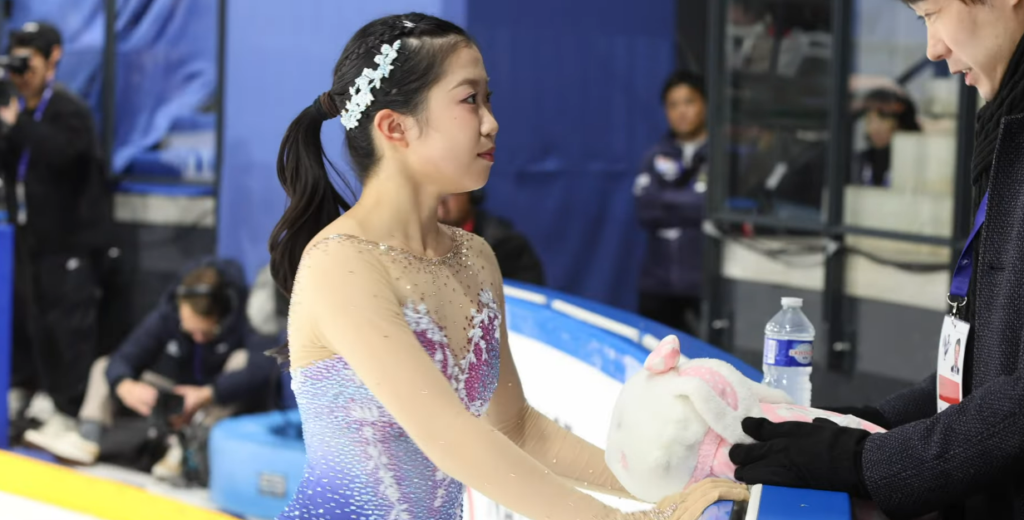
She was nervous when she made her Olympic debut. Much later, she acknowledged this, describing the tension in her body prior to taking the ice. However, once she began to move, something changed. The nerves did not completely go away. They became softer. That difference is important. Rarely do athletes develop fearlessness; instead, they learn to manage their fear without allowing it to control their performance. She was transformed from a promising junior to something more by what transpired next.
She successfully landed the challenging elements she required, causing the crowd to collectively gasp in response to her triple axel. Not flawless. Not perfect. But enough. Enough to maintain her competitiveness. Enough that people noticed her name was rising higher than they had anticipated and looked twice at the scoreboard.
She reacted almost childishly when the final placements were announced later. As if to see if someone would correct her, she jumped, laughed, and then froze for a moment. Rather, a different skater hurried over to her and embraced her, creating one of the iconic pictures of the Games. In a sport that is frequently characterized by isolation, it is difficult to ignore how uncommon those moments are.
Her bronze had a different meaning back home in Japan. The nation had historically depended on well-known skaters whose dominance influenced entire Olympic cycles. Nakai’s rise suggested another possibility: rebirth. It seemed to me as I watched her skate that she wasn’t taking anyone’s place. She was making things up. Everything is uncertain because she is young.
For some Olympic medalists, their initial success becomes a peak they never return to. Others become legendary; their initial medal is just the start. It’s still unclear what route she will take. Talent is insufficient on its own. Resilience, creativity, and occasionally good fortune are necessary for longevity.
In Milan, however, there were hints of durability. Her poise. Her readiness to smile despite not knowing the result. Her capacity to accept rather than resist the moment. While those attributes don’t ensure gold medals in the future, they do point to a deeper, more difficult-to-measure foundation.
She returned to the ice with a more subdued expression during the exhibition gala following the conclusion of the competition. She appeared lighter and more liberated in the absence of judges and rankings. Her motions were less restricted and broader. As she watched this happen, she had the impression that the medal had already transformed her—not by putting more pressure on her, but by taking away her doubts.
Disclaimer
Nothing published on Creative Learning Guild — including news articles, legal news, lawsuit summaries, settlement guides, legal analysis, financial commentary, expert opinion, educational content, or any other material — constitutes legal advice, financial advice, investment advice, or professional counsel of any kind. All content on this website is provided strictly for informational, educational, and news reporting purposes only. Consult your legal or financial advisor before taking any step.
