

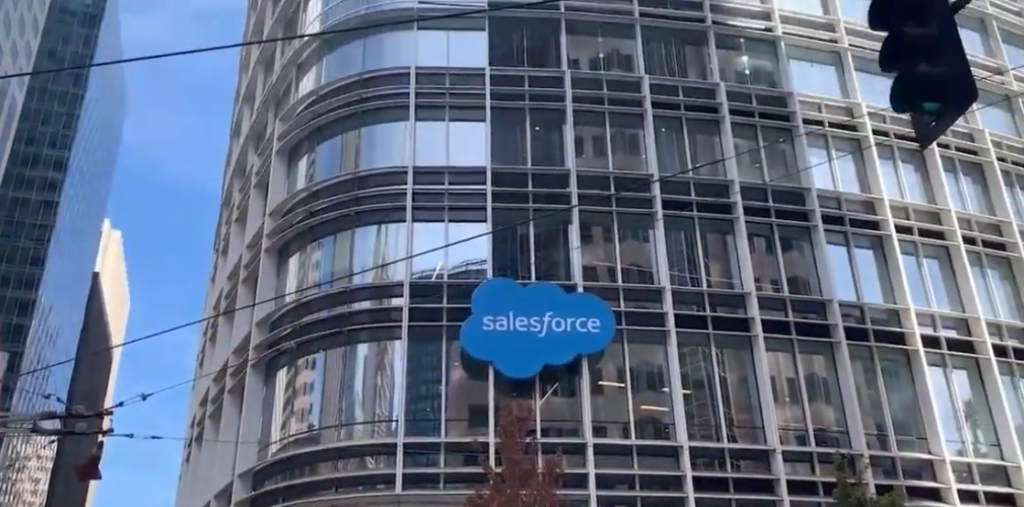
From the street beneath San Francisco’s Salesforce Tower, the structure appears to be made to last forever. Its glass exterior reflects the shifting sky, which can be gray and uncertain at times or bright and hopeful. It’s difficult not to wonder if the Salesforce stock price reflects the same blend of quiet anxiety and confidence as you watch staff members stream through the lobby doors in the morning, holding coffee cups and staring at their phones.
Salesforce’s stock is currently near its 52-week low at about $185 per share, which is odd for a business that used to seem nearly unstoppable. Because of the excitement surrounding cloud computing and digital transformation, it was trading above $300 not long ago. The figures now show a different picture of a business that is still huge and profitable but is no longer viewed as inevitable.
Expectations rather than reality seem to be responsible for a portion of the change. Salesforce’s free cash flow is still impressive, and it continues to generate over $40 billion in revenue annually. Investors, however, appear to want more. Being successful seems to be insufficient these days. Businesses like Microsoft and Nvidia have raised the standard for what constitutes “growth” to a point where even Salesforce finds it difficult to meet.
Executives at Salesforce have been discussing artificial intelligence nonstop and portraying it as the next big thing. Hundreds of deals have already been closed using their Agentforce platform, which was created to incorporate AI into customer relationships. The optimism may eventually be justified by this technology. However, as the stock price declines, there is still uncertainty about how soon that promise will materialize into quantifiable outcomes.
| Field | Details |
|---|---|
| Company | Salesforce, Inc. |
| Founded | 1999 |
| Headquarters | San Francisco, California, USA |
| CEO | Marc Benioff |
| Stock Symbol | CRM (NYSE) |
| Market Cap | Approx. $173 billion |
| Recent Stock Price | Around $185 per share |
| Employees | Approx. 76,000 |
| Reference | https://www.salesforce.com |
| Reference | https://finance.yahoo.com/quote/CRM |
Rarely does the market wait calmly.
In an industry where relevance is determined by speed, Salesforce’s slower revenue growth—which is still in the single digits—has begun to seem like a warning sign. Investors appear to be adjusting their expectations, viewing Salesforce more as an incumbent protecting its market share than as a disruptor. More may be explained by that small change in perception than by any earnings report.
The psychological component is another. In the past, Salesforce seemed like the future. It seems to be a part of the present now.
There is a feeling that something has changed in the larger culture as you stroll through downtown San Francisco and past office buildings where tech companies used to grow endlessly. The optimism has grown, but it hasn’t vanished. Investors are posing more challenging queries. They want more than just vision; they want proof.
Salesforce’s co-founder and longtime CEO, Marc Benioff, continues to speak with the assurance of someone who firmly believes in the company’s course. Instead of selling or backing off, he has persisted in making investments in new goods and acquisitions. There is a sense of resolve when observing his public appearances, but there is also a recognition that the stakes are now higher.
The business has even bought back billions of dollars’ worth of its own stock, indicating that it believes the shares are cheap. Investors may feel reassured by that action, but it also begs the question: why hasn’t the market reacted more strongly if management sees opportunity?
Another silent pressure is competition. Microsoft has incorporated AI in ways that appear quicker and more obvious thanks to its extensive cloud infrastructure. Meanwhile, smaller software companies are developing specialized tools that pose a threat to Salesforce. Salesforce might still be robust enough to resist these pressures. However, technological dominance tends to erode gradually and almost imperceptibly before anyone fully realizes it.
Salesforce isn’t going away, though. Not at all.
All across the world, its products are still firmly ingrained in business systems. Salesforce is used by businesses to track sales, manage customers, and plan operations. Though it doesn’t ensure growth, that dependence produces stability. As this develops, it seems as though Salesforce has moved into a new stage of its existence, one that is more complex and less explosive.
That ambiguity is reflected in the stock price.
Disclaimer
Nothing published on Creative Learning Guild — including news articles, legal news, lawsuit summaries, settlement guides, legal analysis, financial commentary, expert opinion, educational content, or any other material — constitutes legal advice, financial advice, investment advice, or professional counsel of any kind. All content on this website is provided strictly for informational, educational, and news reporting purposes only. Consult your legal or financial advisor before taking any step.
