

At first glance, the fossil itself appears unimpressive. It looks like a dark, cylindrical stone with a dull, cracked surface that has been there for a long time, sitting behind glass in a softly lit museum collection in Scotland. Instead, they are drawn to dinosaurs or early fish with distinguishable eyes and teeth, so visitors pass it without pausing. There is a subtle tension surrounding this object, though, as scientists now think it may be a remnant of a long-extinct branch of life.
It’s difficult to ignore how unnerving that thought is.
More than 400 million years ago, the organism known as Prototaxites would have stood erect like a lone tower rising from arid land. Trees had not yet been created at that time. Even the tallest plants were only knee-high. But whatever it was, it dominated landscapes that would appear strange today, growing as tall as a contemporary streetlight.
You could picture it standing there, creating a shadow on the bare earth.
Scientists debated the true nature of prototaxites for over 165 years. Because of its familiar shape, early researchers mistakenly believed it to be a tree trunk. Others later claimed it was a fungus, citing its internal tube-like structure as evidence. The simplicity of that explanation was reassuring for decades. However, the more scientists investigated, the less credible it became.
| Category | Details |
|---|---|
| Fossil Name | Prototaxites taiti |
| Age | Approximately 407 million years |
| Location Found | Rhynie chert, Aberdeenshire, Scotland |
| Size | Up to 26 feet tall (some species) |
| Classification | Unknown, possibly extinct lineage of complex life |
| Key Scientific Debate | Not plant, fungus, or lichen |
| Research Institutions | University of Edinburgh, National Museums Scotland |
| Geological Period | Early Devonian |
| Reference Link 1 | https://www.smithsonianmag.com |
| Reference Link 2 | https://www.scientificamerican.com |
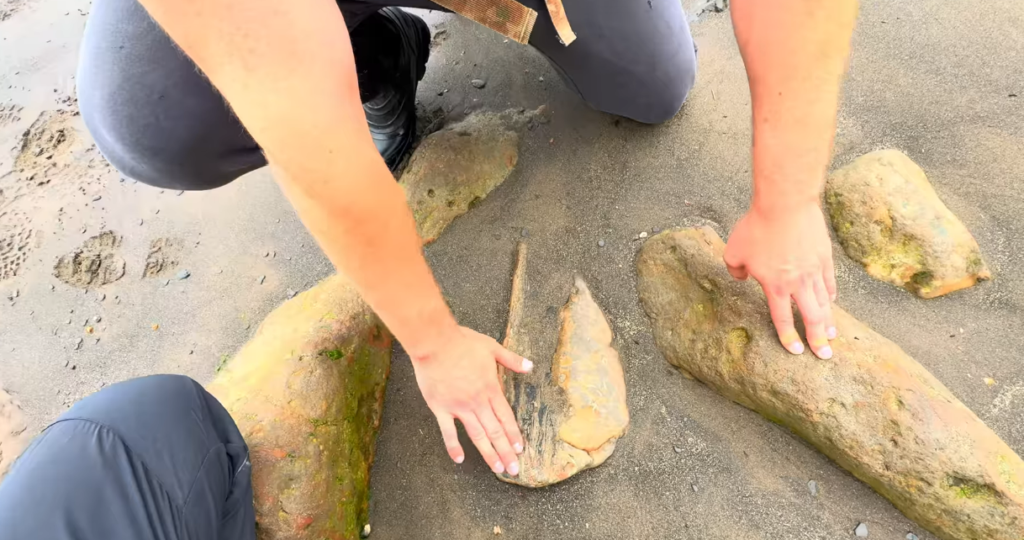
When examined under a microscope, its internal structure showed an oddity: tubes that connected and branched in ways that no other fungus currently in existence could. They appeared haphazard, almost improvised, as though they were constructed using guidelines that are no longer applicable in contemporary life. Suspicion was aroused by that alone, but its chemistry was the true surprise.
Chitin, a structural molecule present in fungal cell walls, was absent from it. Although that absence may seem like a minor detail, it has a profound impact. The fungus theory starts to fall apart in the absence of chitin.
It seems as though scientists quietly realized they were out of well-known explanations.
The fossil was discovered in the Rhynie Chert, a rocky formation in northeastern Scotland that contains remarkably detailed remnants of ancient life. The area is chilly and windswept today, with low grass and moss growing everywhere you look. It’s hard to imagine tall pillars of unidentified creatures rising there and consuming whatever rudimentary ecosystems were present.
However, they did.
According to some scientists, prototaxites were part of a completely different branch of complex life that evolved on its own before going extinct. Not a plant. Not a fungus. Nothing is alive anymore.
Another thing.
Whether that lineage had relatives or existed alone—a short-lived evolutionary experiment that eventually vanished—is still unknown. That possibility seems oddly intimate, as though Earth itself had once dared something and then subtly wiped it out.
The disturbing extent of its disappearance is another factor.
entire life forms that have vanished without progeny.
Today, there is a mixture of excitement and trepidation as scientists discuss prototaxites. The concept of a continuous tree, in which all species are connected in some way, has long been a foundational element of evolutionary biology. However, this fossil implies that the tree might have lost entire limbs, cutting them off completely rather than gradually pruning them.
That alters the perception of evolution. less organized. less robust.
Some researchers question how Prototaxites were able to get so big. It might have had more room to grow if there were no trees vying for sunlight. It most likely consumed decomposing matter while gradually absorbing nutrients from undeveloped soil. However, given how thin, sparse, and barely developed the ecosystems were at the time, even that explanation begs the question.
How was it possible for something so big to live there?
Nobody is positive.
Additionally, this discovery suggests a deeper cultural shift. For many years, people thought that the biological history of Earth was largely known and that new information would only fill in the blanks rather than completely alter existing chapters. Prototaxites, however, has a distinct feel. It implies that the past of life was more bizarre than anticipated and full of experiments that only left stone behind.
There might have been more of these organisms, living in peace for millions of years before going extinct and leaving no descendants. Since their survival depends solely on the preservation of rare fossils, their absence today renders them invisible.
That vulnerability seems significant.
There are no answers from the fossil. They are produced by it.
In an effort to locate it on the map of life, scientists are still examining its chemical signatures and looking for hints. However, the more they examine it, the more it appears to defy categorization and fall outside of well-known groups.
Disclaimer
Nothing published on Creative Learning Guild — including news articles, legal news, lawsuit summaries, settlement guides, legal analysis, financial commentary, expert opinion, educational content, or any other material — constitutes legal advice, financial advice, investment advice, or professional counsel of any kind. All content on this website is provided strictly for informational, educational, and news reporting purposes only. Consult your legal or financial advisor before taking any step.
