

The Android 17 beta program is more akin to an early handshake with the mobile software of the future than a casual preview. It streamlines operations and subtly redefines expectations for both developers and regular Pixel owners by inviting users into a testing lane where policy changes and performance improvements take place in real time.
For many years, there was a sense of excitement and getting behind the scenes when you joined a beta. But, especially for users who depend on their gadgets for work, travel, and payments, this cycle feels remarkably more like a contract than an interest. The enrolling process’s simplicity makes it incredibly effective, but its dedication merits careful consideration.
Eligible Pixel users can enroll through Google’s official beta page to receive over-the-air upgrades, which install similarly to a standard system patch. Although the method is incredibly effective and surprisingly low-effort, the exit door may not be as forgiving. Depending on when you leave the beta, you might have to reset your device completely. This is a little-known fact that has serious repercussions.
Android 17 presents criteria for developers that are very novel in their approach. The prior orientation and resizability opt-outs must be successfully eliminated from apps aiming for the new SDK level in order to properly support larger displays. Practically speaking, this indicates a markedly stronger dedication to tablets and foldables, turning adaptability from a suggestion into a duty.
| Key factual context | Details |
|---|---|
| What it is | A public test channel for pre-release Android builds on supported Pixel devices via Google’s Android Beta Program (Android Developers Blog) |
| How updates arrive | Enroll a device, then receive over-the-air beta updates; updates continue during the beta cycle (Android Developers Blog) |
| The trade-off | Leaving the beta can require wiping the device, depending on timing and build path (Android Developers Blog) |
| What Beta 1 signals | Android 17 removes certain “developer opt-out” behavior for app orientation/resizability on large screens (sw ≥ 600dp) when targeting the new SDK level (Android Developers Blog) |
| Notable technical themes | Efficiency and stability work, including generational garbage collection in ART and a lock-free MessageQueue implementation (for apps targeting the new SDK) (Android Developers Blog) |
| Media/camera and security direction | Camera session updates, VVC support (where hardware allows), plus tightened defaults around cleartext traffic when apps target the new Android level (Android Developers Blog) |
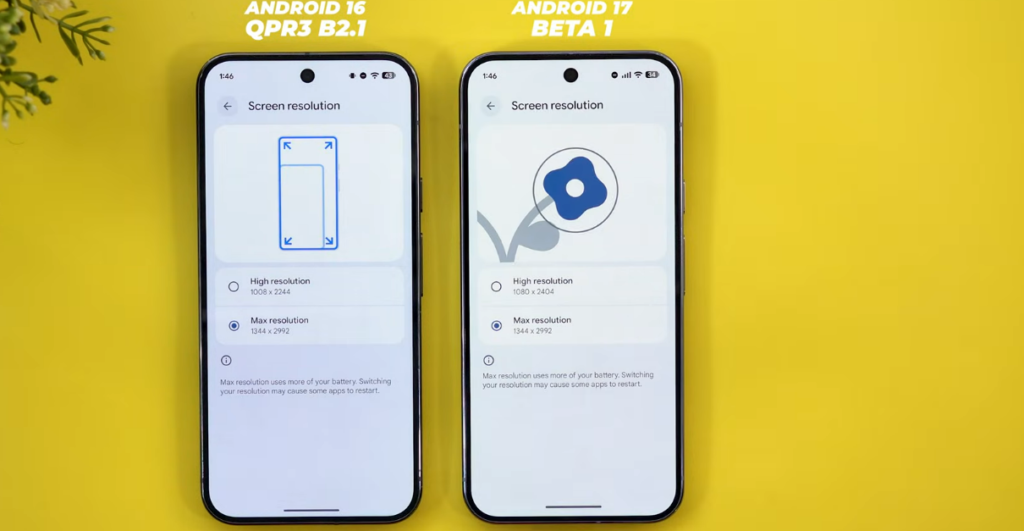
Last year, I had a conversation with a tiny app developer who, almost sheepishly, acknowledged that tablet optimization was not always at the top of his list of priorities. It gets harder and harder to defend that kind of delay under Android 17. The platform is developing in the direction of a time when layout flexibility will be essential rather than discretionary.
Improvements in performance are just as persuasive. The Android Runtime’s generational garbage collection attempts to lower CPU overhead, which will greatly speed up and improve the predictability of memory management. Apps aiming for the new SDK can take use of a lock-free MessageQueue implementation, which further improves responsiveness and makes the experience feel incredibly dependable even when multitasking is demanding.
Even while these enhancements might not result in noticeable visual changes, they are very helpful for everyday use. Heavy workflows, such as editing media, playing games, and balancing productivity tools, can function more smoothly, and switching between programs feels noticeably better. Without requiring praise, the improvements alter system behavior in the background.
A forward-thinking mindset is also reflected in security changes. For apps aiming for the new platform level, Android 17 tightens defaults around cleartext traffic, lowering the possibility that unsafe setups may go undetected. It sends a very obvious message: protection shouldn’t be sacrificed for convenience.
Updates from cameras and media show yet another level of ambition. Developers may now dynamically update camera session outputs, which minimizes noticeable interruptions during mode changes. When hardware permits, support for sophisticated codecs broadens the creative toolkit accessible to app developers, providing an extraordinarily flexible basis for next-generation video experiences.
Hesitancy makes sense for people who prefer stability to exploration. Bugs in beta software have the potential to interfere with corporate tools, banking apps, and authentication systems. Even if the underlying engineering work is incredibly robust and well-built, that uncertainty still exists.
However, taking part in the beta provides a unique perspective. Priorities for the platform are seen before they make headlines. You see how legislative choices, such requiring flexible layouts, progressively change the ecosystem, impacting industry standards and elevating expectations.
As I read through the technical notes, I was struck by how purposefully the corporation is pushing developers to meet higher standards.
The beta might be a very useful testing area for enthusiasts who have a backup device. It provides early access to performance enhancements that are frequently subtle but far faster to implement. The experience is both instructive and useful, showing how operating systems change over time as a result of deliberate yet little actions.
Android upgrades have increased gradually over the last ten years, which is indicative of a larger trend toward constant improvement. Google welcomes early feedback while keeping a controlled development pace by substituting a more efficient public beta strategy for traditional preview cycles. For developers that require months of preparation prior to a stable release, this approach is especially advantageous.
Context is important for professionals thinking about enrolling. You should exercise caution if your Pixel serves as a mission-critical device. However, it may be a really fulfilling experience if you approach the beta as a collaborative exercise—testing features, reporting problems, and seeing progress.
Disclaimer
Nothing published on Creative Learning Guild — including news articles, legal news, lawsuit summaries, settlement guides, legal analysis, financial commentary, expert opinion, educational content, or any other material — constitutes legal advice, financial advice, investment advice, or professional counsel of any kind. All content on this website is provided strictly for informational, educational, and news reporting purposes only. Consult your legal or financial advisor before taking any step.
