

No knock is made by UNC3886. It sneaks in silently, gaining access, integrating itself into infrastructure, and staying hidden long enough to pose a threat. Because they curate persistence like an art form, this organization flourishes in the shadows, unlike ransomware crews that are attention-hungry.
In recent months, a campaign that had quietly developed across all four of Singapore’s major telecom operators was made public by the country’s cybersecurity agency. The Chinese state’s cyberespionage unit, UNC3886, compromised SIMBA Telecom, StarHub, M1, and Singtel. The sophistication of the intrusion prompted an unprecedented response, despite the fact that there were no service interruptions or leaks of customer data.
With the activation of “Cyber Guardian,” Singapore launched its most extensive cyber defense effort to date, deploying more than 100 highly qualified experts from multiple state agencies. A thorough diagnostic sweep was intended in addition to containment, in order to determine the extent of the attackers’ nesting and the precise items they had impacted. The public was only made aware of these measures, surprisingly, after authorities were certain that the immediate threat had been eliminated.
| Category | Details |
|---|---|
| Name | UNC3886 |
| Alias | CAULDRON PANDA (by CrowdStrike) |
| First Publicly Identified | Mid-2023 |
| Affiliation | China-nexus, state-backed cyber espionage group |
| Notable Targets | Telecoms, defense, and tech sectors in Singapore, U.S., and Europe |
| Key Incident (2025–2026) | Infiltration of Singapore’s four major telcos: Singtel, StarHub, M1, SIMBA |
| Attack Methods | Zero-day exploits, advanced backdoors, persistent network access |
| Response Effort | Singapore’s largest cyber defense operation, “Cyber Guardian,” involving 100+ defenders |
| Credible Source | MITRE ATT&CK – UNC3886 |
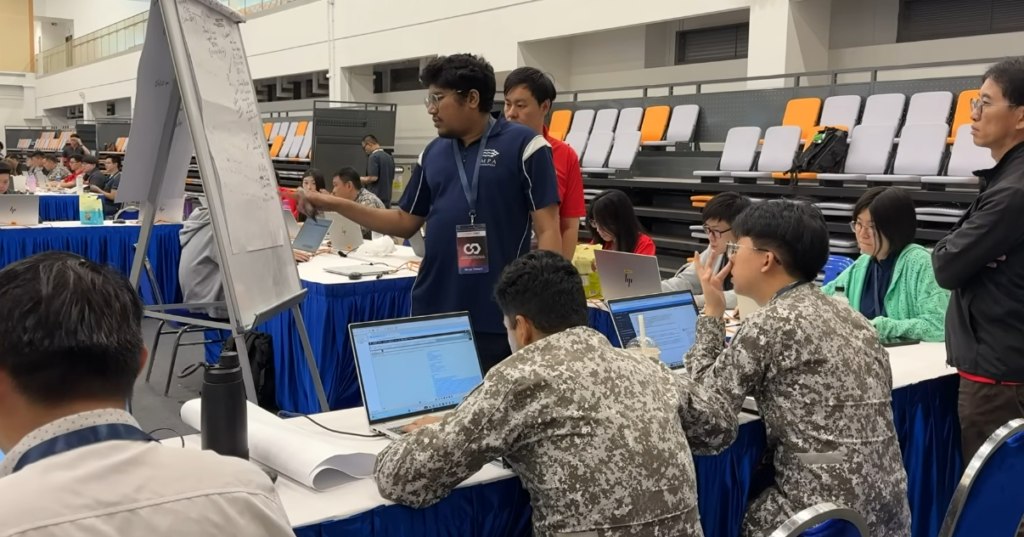
For everyday users, the effects were invisible. The services remained up and running. Bills arrived on schedule. But UNC3886 had mapped out network layouts and extracted what officials called “technical data” from the infrastructure, which was hidden beneath blinking routers and well-known apps. Although that might appear uninteresting, such information is invaluable to a gang that is known to take use of router-level attacks and virtualization backdoors.
Tracking this actor under the alias “CAULDRON PANDA,” CrowdStrike has continuously emphasized their sophisticated tradecraft. Operationally, UNC3886 is more patient than opportunistic hackers, preferring stealth over speed and strategic placement over chaotic damage. Their exploits have previously been used on Juniper, VMware, and Fortinet systems, frequently utilizing flaws that the public was unaware of.
The restraint of UNC3886’s approach is what makes it really novel. In order to get attention, it doesn’t crash services or inundate systems with malware. It waits instead, installing silent backdoors that are custom-built and frequently polymorphic. Instead of being a break-in, this type of digital espionage is a residency.
When the operation was at its height, I recall remarking in private how the panic was lacking. No dramatic headlines or urgent warnings were present. Rather, the government of Singapore presented the matter with a composed professionalism, as though the tactic included keeping quiet. And it was, sort of. Only after containment did transparency emerge.
Investigators think no private client data was taken. It is possible that the repeated emphasis on that particular detail highlights the efficacy of the nation’s response mechanisms. Nonetheless, the network schematics, configuration logs, and vendor links that were extracted might prove particularly helpful for upcoming campaigns or more intricate targeting in other locations. Beyond telecom billing records, the ramifications are extensive.
Long-term access to vital systems was made possible by UNC3886 by using zero-day exploits and preserving covert access. An actor looking to obtain intelligence covertly can be very effective with this type of presence. Modern cybersecurity teams are working feverishly to defend against this very threat, which silently leaves its mark in technical echoes.
Not surprisingly, the Chinese government has denied any involvement. Global threat intelligence organizations and independent analysts, however, note that the region-specific targeting patterns, common tactics, and shared toolkits are remarkably similar to previous campaigns with ties to China. Although the brushstrokes are familiar, the fingerprints are obscured.
Due to this incident, Singapore’s approach to cyber readiness has changed. These days, the Cyber Security Agency publicly cautions that highly resourced adversaries still find telecom infrastructure to be a desirable and vulnerable target. Its proactive and well-coordinated defensive strategy has significantly enhanced the nation’s reputation as a role model for other nations negotiating this silent war.
The last year has seen a rise in conversations around enhanced endpoint detection and zero-trust architectures. These are now national priorities rather than IT department-specific interests. In the case of medium-sized countries, safeguarding digital borders has become as crucial as safeguarding airspace or shoreline. UNC3886 made that point very clear and unsettling.
This case illustrates how contemporary cyberthreats develop gradually, which makes it especially instructive. Both a dramatic alarm and a singular moment of breach are absent. Instead, the threat develops gradually, only those who are trained to recognize its subtle signs can see it.
Scholars have hailed Singapore’s response as prompt and well-thought-out since the initial discovery. Instead of responding on the spur of the moment, authorities methodically closed entry points, isolated systems, and examined behavior patterns in order to develop a long-term plan. It was a reset, not just a reaction.
This whole story provides a cybersecurity roadmap for early-stage startups. Tools that can recognize lateral movement, flag low-signal signs, and locate dormant access points are obviously needed. The current threat landscape includes these issues, so they are not merely hypothetical.
Singapore exemplified how collaboration between the public and private sectors may result in extremely effective solutions. To maintain public trust, system integrity, and digital sovereignty, they handled the intrusion as a national security issue, even with little disruption.
The future is viewed with guarded optimism. Though its strategies are now better recognized, UNC3886 is still in operation. Several nations have taken note. In Asia, Europe, and North America, policy changes are already being influenced by Singapore’s experience.
Disclaimer
Nothing published on Creative Learning Guild — including news articles, legal news, lawsuit summaries, settlement guides, legal analysis, financial commentary, expert opinion, educational content, or any other material — constitutes legal advice, financial advice, investment advice, or professional counsel of any kind. All content on this website is provided strictly for informational, educational, and news reporting purposes only. Consult your legal or financial advisor before taking any step.
