

Each year on February 2, long before most alarms go off, throngs gather at the edge of a wooded hill in Punxsutawney, Pennsylvania. They arrive wrapped in scarves, sipping steaming drinks, looking up toward a little stage with a huge stump. And they wait—just to see a groundhog.
Phil, as he’s lovingly called, is not your average burrow-dweller. According to mythology, he emerges at sunrise—roughly between 7:07 and 7:25 a.m. Eastern Time—to ascertain if winter will persist or spring will arrive sooner. It’s an odd show, but it does a remarkable job of bringing a sleepy rural community in the middle of winter to the attention of the country.
The ceremony begins well before the sun rises. At 3:30 a.m., the gates at Gobbler’s Knob swing open, and by 5:00 a.m., there is already dancing, music, and a gathering that resembles both a festival and a pilgrimage. Fireworks, stage acts, and emcees in black coats and top hats—the “Inner Circle”—fill the air with expectation and theatrical bravado.
The crucial moment then arrives. At the peak of daybreak, a few members of the Inner Circle ceremoniously bang on Phil’s tree stump. They converse in a language they claim only Phil knows. The groundhog is hauled up, blinking into the cold, and a “decision” is declared—usually in rhyme.
| Date | February 2, 2026 (Groundhog Day – Always Feb. 2) |
|---|---|
| Groundhog | Punxsutawney Phil |
| Location | Gobbler’s Knob, Punxsutawney, Pennsylvania |
| Official Prediction Time | Approximately 7:07 a.m. to 7:25 a.m. ET (sunrise) |
| Gates Open | 3:30 a.m. ET – festivities begin with live entertainment |
| Prediction Tradition | Shadow = 6 more weeks of winter; No shadow = early spring |
| Viewing Options | Live stream via USA Today and VisitPA.com |
| Accuracy Rate | Roughly 30% accurate based on NOAA data |
| Reference Source | Punxsutawney Groundhog Club, USA Today, Florida Today |
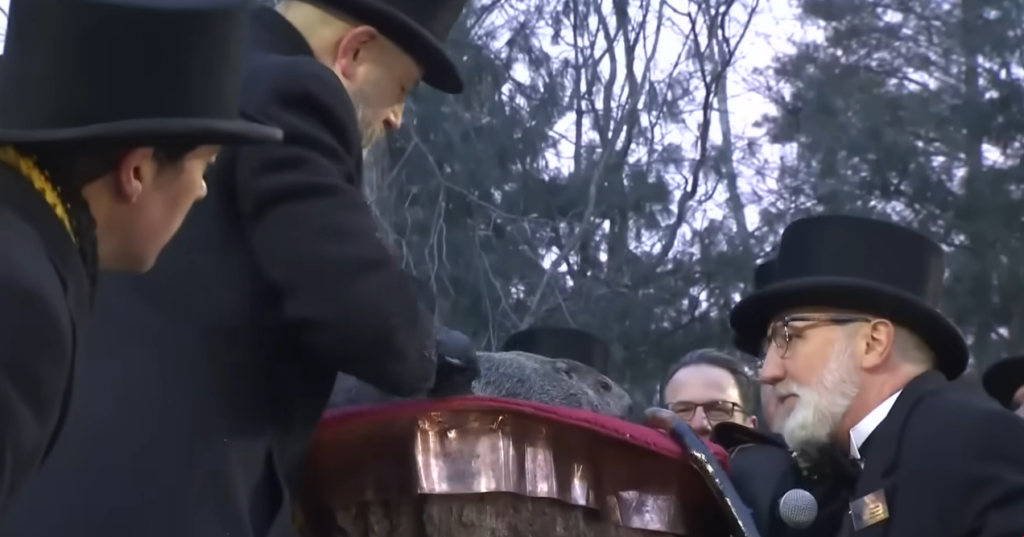
If he “sees” his shadow, folklore says winter will linger six more weeks. If not, spring is on the horizon. It’s deliciously ludicrous and extraordinarily resilient as a ritual. The idea of relying on a sleeping marmot to foretell the weather is, admittedly, not scientifically rigorous. But perhaps that’s part of the appeal. It doesn’t pretend to be a forecast—it delivers something else entirely.
What Phil actually gives folks is a time to pause. I’ve been watching the livestream in silence for the past few years, sipping coffee and taking in the subtle absurdity of it all. There’s something soothing about watching an entire town gather around a shared moment of pageantry, even if it’s anchored in folklore rather than science.
Phil’s forecast track record is notably disappointing. According to the National Oceanic and Atmospheric Administration, his projections coincide with actual weather events just about 30% of the time. In many respects, he’s a better mascot than meteorologist. Yet his cultural power is intact.
German colonists introduced European Candlemas Day traditions, which the Pennsylvania Dutch later modified. By 1887, the first “official” Groundhog Day was held in Punxsutawney. Since then, the event has expanded in grandeur and spectacle, becoming a reliable winter marker—a type of seasonal checkpoint where we collectively ponder, if only for a time, what comes next.
Today, spectators don’t need to travel through the snow to take part. Livestreams begin as early as 4:00 a.m., hosted by USA Today and VisitPA.com. Themed banquets, entertainment shows, and a playful sense of civic pride are all part of the whole experience for attendees in person.
The ceremony is presented at daybreak in order to preserve the appearance of a custom closely linked to the natural world. And while it doesn’t matter precisely when Phil appears—just that he does—it’s the predictability of the routine that people cling to.
While half of the nation was covered in snow, I recall watching the event from my living room last year. The wooden stump seemed to hold answers that no algorithm could provide as the camera panned over bundled-up kids sitting on their parents’ shoulders. I found it strangely moving.
Despite the spectacle, Groundhog Day never feels overtly commercial. No showy sponsors. No trademarked hashtags. Just a rodent, some poetry, and a weather guess that no one takes too seriously. And that’s part of what keeps it alive. It’s a vacation from intricacy. A straightforward prediction from a made-up prophet.
In the context of lengthy winters and digital overload, rituals like this serve a particularly beneficial purpose. They serve as our anchor. They offer texture to time. And even if the answer is random, the question—how much longer?—is genuine at all times.
The fact that the event starts so early is not by chance. The organizers deftly connect spectacle to a natural cycle by connecting Phil’s moment to sunrise. It provides the ceremony an air of sincerity, despite its theatrical trappings. It’s no longer just a groundhog standing on wood—it’s a sign of emergence, of transition, of the calm potential that maybe, just maybe, the harshest part of the season is behind us.
For those watching this year, expect Phil’s debut between 7:07 and 7:25 a.m. Eastern Time. He won’t be hurried. And neither should you. Ultimately, whether or not he perceives a shadow is not the magic. It can be found in the assembly, the observation, and the waiting.
Through that shared moment—brief, frigid, and pleasantly strange—we are reminded that even the smallest creature can make a crowd pause. That’s what makes Groundhog Day feel, against all odds, very efficient at relieving the melancholy of February.
Disclaimer
Nothing published on Creative Learning Guild — including news articles, legal news, lawsuit summaries, settlement guides, legal analysis, financial commentary, expert opinion, educational content, or any other material — constitutes legal advice, financial advice, investment advice, or professional counsel of any kind. All content on this website is provided strictly for informational, educational, and news reporting purposes only. Consult your legal or financial advisor before taking any step.
