

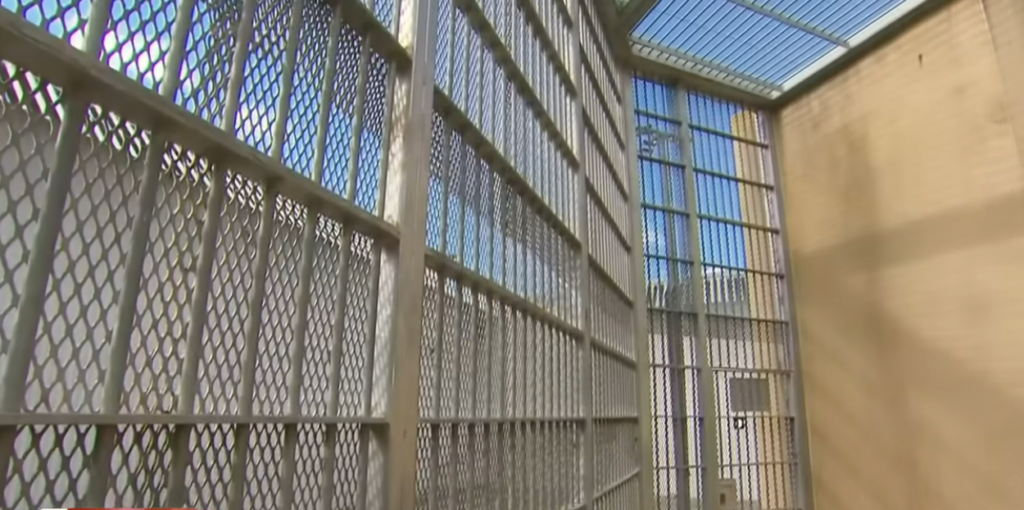
Certain prisons are designed to mechanically neutralize disruption, functioning as self-contained machines. Ebongweni, located just outside Kokstad, is startlingly comparable in this regard—designed with layers of technology, routine, and architectural force to contain South Africa’s most problematic offenders. Since its inception in 2002, it has come to symbolize what the state believes necessary when all other correctional choices begin to fray.
By keeping the jail purposefully under capacity, the Department of Correctional Services maintains a carefully regulated atmosphere. Unlike overloaded metropolitan institutions, Ebongweni doesn’t work under stress—it absorbs it. A control-oriented philosophy is reflected in the structure itself. Everything is designed to restrict movement, both physically and mentally, from the digital surveillance systems to the reinforced concrete.
The jail has lately regained national notoriety due to the transfer of Thabo Bester—whose previous escape from another penal facility captured headlines. According to officials, his move was guided by standard risk assessment procedures. Yet, his legal team regarded the action as unexpected and ambiguous. These contrasting viewpoints generate a classic tension between institutional power and individual rights, particularly when decisions occur in locations where supervision is limited and openness often delayed.
Ebongweni contains inmates like Radovan Krejcir, tied to organized crime, and Ananias Mathe, formerly considered South Africa’s most slick escapee. Each was brought here when their presence elsewhere became too disruptive. The logic is administrative—but the human effect is isolation. The Judicial Inspectorate’s recent study slammed the use of 23-hour lockdowns, classifying them as bordering on unlawful solitary confinement. Inmates are shackled during mobility and housed in isolated cells, producing a living environment that’s incredibly predictable for management—but increasingly antagonistic to mental well-being.
| Detail | Information |
|---|---|
| Facility Name | Ebongweni Super Maximum Correctional Centre |
| Location | Kokstad, KwaZulu-Natal, South Africa |
| Operational Since | 2002 |
| Capacity | Designed for over 1,500 inmates, deliberately kept under capacity |
| Security Level | Super-Maximum (highest security classification in South Africa) |
| Notable Inmates | Ananias Mathe, Radovan Krejcir, Thabo Bester, Henry Okah |
| Controversial Practices | 23-hour cell confinement, shackling during movement, accused of unlawful solitary confinement |
| External Reference | https://www.dcs.gov.za |
What struck me most while reading the report wasn’t the operational information, but a phrase hidden inside the commentary: “structured invisibility.” The concept that someone could be regulated so precisely that they almost vanish—seen only by monitoring and paper trails—left me quietly concerned.
Nigerian national Henry Okah, who was formerly incarcerated here, called it the worst experience of his life. His sentiments were echoed by numerous convicts over the years, frequently during court appeals or rare interviews. These testimonies, albeit emotionally intense, are rarely contested in public. Ebongweni functions silently. That, for many officials, is its strongest asset.
Even Parliament’s Portfolio Committee lauded the institution lately for its strong adherence to operational procedures. From a legislative standpoint, it is incredibly efficient. There are no riots. No jailbreaks. Very few incidents. The gates hold. The cameras are operational. The numbers behave. But beyond those statistics are instances of psychological drift—minds trapped in silence so extended that communication begins to weaken. It presents a significant ethical question: at what point does a secure environment become something else entirely?
The Department guarantees convicts receive appropriate care and preserve access to legal services, family communication, and court proceedings. Singabakho Nxumalo, a spokesperson, stressed that logistical arrangements are still in place to guarantee the protection of rights. Yet, the emotional reality of solitary housing cannot be totally handled with legislative compliance alone. On paper, systems might be incredibly efficient, but individuals are not designed for constant confinement.
The state has built a facility that seems impervious to disorder by utilizing rigid scheduling and maximum-security architecture. But its strength rests on silence—and silence, while useful for order, does not always serve justice. Rehabilitation, one of the department’s declared goals, becomes considerably tougher in areas where connection is minimal and psychological resilience is worn thin.
Ebongweni is not a failure of the correctional system—it is its chosen extreme. It exists because other institutions occasionally cannot absorb the risk. In the midst of increased public pressure, political scrutiny, and headline-driven indignation, super-max facilities offer governments a type of settlement that feels both final and conclusive.
Still, one has to worry what happens to individuals confined there long-term. Not just their bodies, but their capacity to return—if ever—to anything like effective involvement in society. That is a cultural concern as well as a legal one. The fundamental idea of justice evolves with how we treat people we cannot understand or control. And every day, Ebongweni pushes those limits.
Years ago, I had a conversation with a retired officer who had spent three months rotating around the prison. The hallways are “too quiet to trust,” he said. Unnervingly still, but neither violent nor dangerous. His uneasiness didn’t originate from terror, but from the absence of human rhythm. That hush lingered with me.
Human rights, infrastructure requirements, and correctional policies will all be major topics of discussion in South Africa in the years to come. Ebongweni will likely remain a tool in the legal system’s arsenal—but whether it will evolve or ossify depends largely on how its usage is examined, questioned, and regulated. The institution does what it was built to do. Now we must evaluate if that mission still aligns with the ideals we claim to promote.
Through better sentencing reforms, more focus on mental health support, and more nuanced security policies, there is a chance to rebalance. Not to reduce accountability—but to strengthen outcomes. Because while confinement may separate someone from society, it should never remove them from humanity.
Disclaimer
Nothing published on Creative Learning Guild — including news articles, legal news, lawsuit summaries, settlement guides, legal analysis, financial commentary, expert opinion, educational content, or any other material — constitutes legal advice, financial advice, investment advice, or professional counsel of any kind. All content on this website is provided strictly for informational, educational, and news reporting purposes only. Consult your legal or financial advisor before taking any step.
