

Mark Carney didn’t yell at Davos, but it had a profound impact. He urged middle countries to find strength in cooperation, particularly when larger nations try to change trade norms through coercion, in a tone that was clearly sharp but also balanced.
Even while the message was abstract to some, it had a clear impact in Washington. The president was on the phone within hours. The topics of conversation included trade policy, Arctic security, Venezuela, and Ukraine. However, it was obvious that Carney had offended someone.
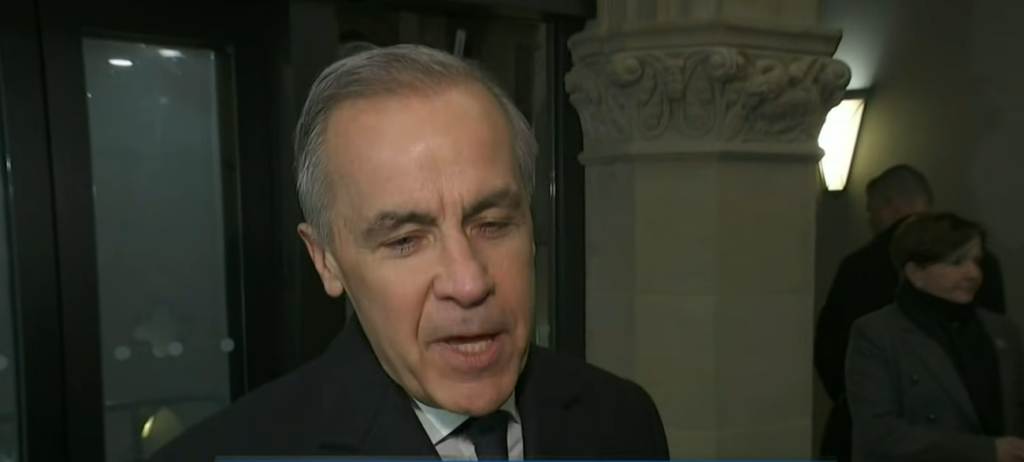
Carney has steadfastly defended his statements in recent days. He denied any backtracking when he spoke to reporters back home. “I meant what I said in Davos,” he remarked bluntly, seemingly to dispel the rumors before they could spread.
Carney “aggressively” retracted his statements, according to U.S. Treasury Secretary Scott Bessent, who spoke to Fox News. However, Carney just shook his head and replied, “No,” when asked directly. It was especially symbolic to have a prime minister coolly dismiss a misrepresentation.
There was more to the argument than just tone. It soon became a policy. The U.S. would put 100% tariffs on Canadian products if Canada sought a closer trade partnership with China, Trump threatened. The danger was widespread but not new.
| Item | Details |
|---|---|
| Leaders | Donald Trump (U.S. President), Mark Carney (Prime Minister of Canada) |
| Trigger | Carney’s World Economic Forum speech in Davos |
| Core Issue | Trade power, tariffs, and economic coercion |
| Flashpoint | Phone call following Davos remarks |
| U.S. Position | Threat of 100% tariffs; emphasis on dependency |
| Canada’s Response | Trade diversification; refusal to retract remarks |
| Broader Stakes | USMCA review, global alliances, middle‑power coordination |
Carney did not become angry. Rather, he clarified that Canada’s recent deal with China was limited to particular tariff relief, which is especially advantageous for exporters like canola growers. According to him, Ottawa has “never” pursued a full free-trade agreement with Beijing.
Canada has been discreetly increasing its trading reach during the last six months. There was no ceremony involved in the signing of twelve new agreements covering four continents. The tactic is subtle yet incredibly successful; it is meant to lessen dependency rather than incite retaliation.
Canada is preparing for economic disruption without drama by strengthening its global resilience.
I kept watching that Davos speech to observe how Carney described risk without mentioning specific individuals.
Trump’s reaction followed a now-familiar pattern: show power, challenge allegiance, and then exert financial pressure. “Canada lives because of the United States” was not merely rhetorical; it was a calculated move. His intention was to remind Ottawa of its dependence on geography.
Carney responded, however, with hope rather than acquiescence. In a later national speech, he declared, “Canada thrives because we are Canadian.” With a clarity that doesn’t require amplification, the sentence exuded a quiet resolve.
Carney’s strategy is a significant improvement over previous Canadian diplomacy, which frequently depended on goodwill and closeness. Self-reliance may now be the best indicator of respect, and his administration seems to recognize that the playing field has changed.
For Carney, the topic of discussion is flexibility rather than nationalism or provocation. In a shifting global economy, Canada is establishing itself as a more effective, more independent partner by utilizing a variety of agreements and bolstering domestic capabilities.
Additionally, Trump’s stance exhibits consistency. His main perspective on trade is one of a zero-sum game, in which the winner is the one who takes most. For him, tariffs continue to be very effective instruments—leverage, not punishment.
Cross-border connections are now characterized by these opposing tendencies.
This contrast is captivating because it’s layered rather than loud. A leader who prioritizes strong statements and quick results is on one side. Conversely, one that prioritizes spread risk, extended deadlines, and structural resilience.
In the next review of the Canada-United States-Mexico Agreement (CUSMA), both approaches will be put to the test. The assessment, which is set for later this year, will compel both parties to present their goals and red lines in ways that go beyond public declarations.
Trump’s current tariff threat is a negotiation ploy, as Carney has already stated. “The president is a strong negotiator,” he said, adding that Canada is ready to react constructively through discussion and strategy rather than panic.
The lesson is relevant to economies of moderate size. Resilience needs to be developed proactively, tactically, and without fear in a time of shifting leadership philosophies and unstable partnerships. Carney’s concept, which is still in its infancy, might provide a particularly creative road map.
Meanwhile, the United States is making it clear that it is prepared to deal with allies who don’t align with its strategic objectives. Bessent’s remarks, which are scathingly critical of Canada’s “globalist agenda,” reveal a larger misgiving about decentralization. Though intended to frighten, that rhetoric might be losing its effect.
The Canadian public’s response has been more centered on Carney’s response than on Trump’s remarks. Maintaining his composure allowed him to demonstrate something quite evident: a diplomatic approach based on constant recalibration rather than defensiveness.
Carney is establishing a framework that prioritizes dependability over spectacle through strategic alliances and more subdued trade diplomacy.
Not in opposition to the United States, but in tandem with it, Canada has been adjusting its trade strategy since the start of this administration. This distinction is important. It conveys assurance without being hostile.
There might not be a significant confrontation between Carney and Trump in this chapter. No summit was canceled, and there was no walkout. Canada did, however, make a silent, clear, and deliberate signal that it would no longer wait to be led. Instead, it is making the decision to travel at its own speed and with a purpose.
Disclaimer
Nothing published on Creative Learning Guild — including news articles, legal news, lawsuit summaries, settlement guides, legal analysis, financial commentary, expert opinion, educational content, or any other material — constitutes legal advice, financial advice, investment advice, or professional counsel of any kind. All content on this website is provided strictly for informational, educational, and news reporting purposes only. Consult your legal or financial advisor before taking any step.
