

In some parts of Prayagraj, the mention of Atiq Ahmed still causes people to lower their voices. It was habit rather than loyalty or even fear. This type of reflex persists long after the man has passed away. There’s a feeling that his story didn’t simply unfold here—rather, it settled into the walls—as he stands close to the old neighborhoods of Allahabad West, where he once held political ground for years.
On the surface, Atiq Ahmed’s beginnings were unremarkable. His early life did not foreshadow the scope of what was to come. He was born into a modest family, the son of a horse-cart driver. However, minor offenses like coal theft and neighborhood conflicts started to influence a different course by the late 1970s. Those early actions might not have been solely survival-oriented. They seemed to be testing power and figuring out how far it could go before resistance emerged.
Something out of the ordinary had already begun to take shape by the time he entered politics in 1989 and won an assembly seat as an independent. This man was bringing criminal accusations into a democratic system and succeeding. Not just once, but several times. It’s difficult to ignore how this pattern reflected a more general reality in some regions of India, where mandate and muscle occasionally overlap in awkward ways. Voters were aware of his identity. Nevertheless, they selected him.
His influence grew steadily throughout the 1990s and the first part of the 2000s. Five MLA terms. A seat in Parliament after that. The transition from local strongman to national politician didn’t seem sudden; rather, it was almost anticipated. As one passes Prayagraj’s government buildings, one can envision the quiet discussions and unwritten agreements that made these changes possible. Where the system drew the line—or whether it ever did—remains a mystery.
| Category | Details |
|---|---|
| Full Name | Atique Ahmed |
| Date of Birth | August 10, 1962 |
| Birthplace | Prayagraj (Allahabad), Uttar Pradesh, India |
| Date of Death | April 15, 2023 |
| Age at Death | 60 |
| Occupation | Gangster, Politician |
| Political Roles | MLA (5 terms), MP (Lok Sabha 2004–2009) |
| Political Affiliations | Samajwadi Party, Apna Dal, AIMIM |
| Spouse | Shaista Parveen |
| Criminal Cases | 160+ cases including murder, kidnapping, extortion |
| Notable Incident | Assassinated live on camera in police custody |
Reference Links:
Atiq Ahmed – Wikipedia
BBC Report on Atiq Ahmed Killing
Criminal cases kept piling up at the same time. Over 160, from murder to extortion. Names like Raju Pal and later Umesh Pal were included in a story that was as much about rivalry as it was about violence. The courts proceeded cautiously and slowly at times. Even judges occasionally declined to hear cases involving him. Observing that from the outside, a question remains: was this fear, influence, or something more elusive?
Nevertheless, his presence persisted despite being incarcerated. Elections were held while incarcerated. Statements were released. Networks seemed to work. It produced a strange paradox: a man who was socially and politically engaged but physically confined. His ability to remain relevant despite being deprived of freedom may have been his most remarkable accomplishment.
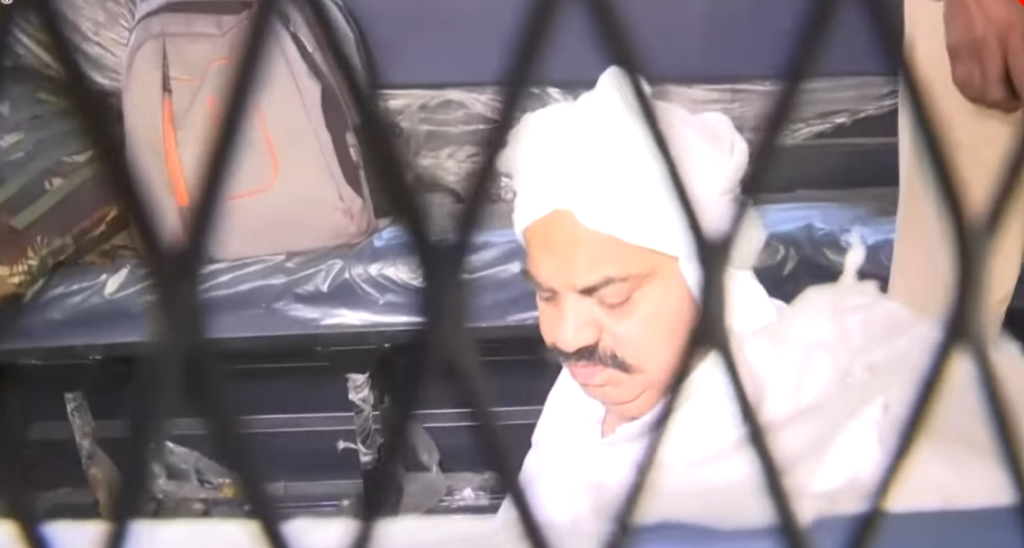
The last chapter arrived suddenly and in a manner that seemed almost unreal. 15 April 2023. At night. Media cameras are in motion. There is a police escort in place. Walking toward a medical examination are Atiq Ahmed and his brother Ashraf. Then there were gunshots in a matter of seconds. Anarchy. Instantaneously, the video was shared and replayed on phones, screens, and conversations. The silence that ensued—the kind that follows something too abrupt to comprehend—is difficult to forget.
The setting was just as unsettling to many as the killing. This was neither a remote incident nor a covert encounter. It took place under state supervision, in police custody, and in front of cameras. There’s a feeling that more questions than answers were raised by the incident. Even now, there are still some unanswered questions about security flaws, potential collusion, and the attackers’ motivations.
Reactions diverged dramatically in the days that followed. It was framed by some as the delayed arrival of justice. Others perceived it as a risky precedent, an indication that due process could be circumvented at any time. The gap felt intimate as I heard people talking in tea shops and on city corners. Emotional rather than ideological. In addition to discussing the law, people were reacting to years of pent-up anger, anxiety, and memories.
Reinterpretation is something else that has surfaced more recently. His story has started to be woven into fiction by movies like Dhurandhar: The Revenge, which alter details and add layers of intrigue and geopolitics. The speed at which reality turns into narrative is difficult to ignore. A life that used to unfold in courtrooms and police files now appears on movie screens, slightly changed, more dramatic, and possibly easier to understand.
But when you step back from the commotion, a more subdued question remains. What does the narrative of Atiq Ahmed truly reveal about the system that gave rise to him? Concerning the electorate that chose him? What about the establishments that found it difficult to restrain him?
It is tempting to present it as a full arc with a rise and fall. However, that seems too tidy. Too settled.
