

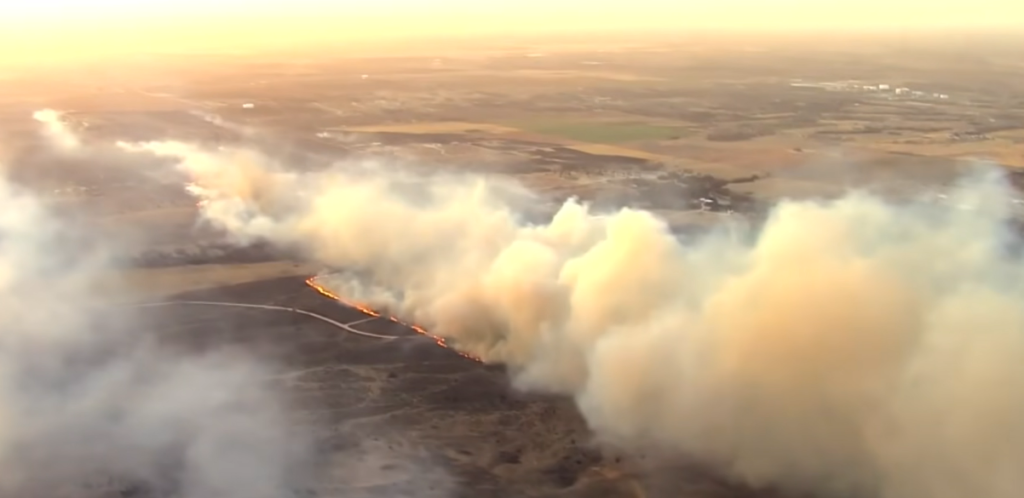
Galicia’s hills took on an unwelcome shade last summer, turning from ashy orange to gray. Days passed while entire slopes burned, helicopters hovered overhead, and the stench of burned eucalyptus lingered obstinately in the air. One of the harshest wildfire seasons in recent memory struck Spain, especially the northern region known as “Green Spain.” Then there were evacuations. Town squares were deserted. The harm seemed both unexpected and unavoidable.
Months later, a more subdued activity is taking place over those same forests.
Authorities in Spain have started testing AI-assisted wildfire prevention drones in a number of wooded areas. These drones combine thermal cameras, embedded sensors, and autonomous flight systems that are intended to identify fires in their earliest, nearly undetectable stage. The objective is surprisingly straightforward: identify a smoldering ignition before it makes the news.
In a dimly lit control center outside of Madrid, operators watch tower and drone feeds on screens. One monitor shows a faint column of heat that is barely visible to the unaided eye. The system flags it in a matter of seconds. Such a spark might have gone unnoticed until smoke billowed above the treeline a decade ago. Subtle thermal signatures can now be identified by software that compares them to past fire data and weather patterns. Spain seems to be attempting to keep up with the fire itself.
| Initiative | AI-Assisted Wildfire Prevention Drone Pilot |
|---|---|
| Country | Spain |
| Lead Agencies | Regional Fire Services & Emergency Authorities |
| Technology | AI sensors, thermal imaging, autonomous drones |
| Focus Area | Wildland-Urban Interface (WUI) |
| Key Regions | Galicia, Asturias, Madrid region, Catalonia |
| Objective | Detect and suppress fires within minutes of ignition |
| Supporting Tech | Electronic nose sensors, AI fire-behavior prediction |
| Broader Context | EU wildfire resilience & climate adaptation strategy |
Official Government Portal: https://www.lamoncloa.gob.es
European Forest Fire Information System (EFFIS): https://effis.jrc.ec.europa.eu
The technology partially depends on sensors positioned strategically throughout forests that can identify chemical traces released during the smoldering phase of combustion, which engineers refer to as “electronic noses.” These signals are analyzed by embedded AI, which can differentiate between, for example, the exhaust from a passing tractor and the smell of burning vegetation. False positive results are expensive. Fires that are missed are worse.
At the wildland-urban interface—that tense line where homes and pine forests converge—the focus is particularly acute. Although forests cover a large area, experts contend that the most catastrophic losses frequently take place in this small overlap. By focusing surveillance there, destruction could be disproportionately decreased. The battlefield is being strategically condensed.
It’s not as cinematic as you might think to watch a drone take off from a makeshift launch pad close to a telecom tower in Asturias. The roar isn’t dramatic. Just a constant hum. As it rises, the aircraft banks toward coordinates that the detection system automatically transmits. Certain prototypes can even release specific suppression payloads, like water or retardant, before ground crews arrive if the fire is small enough.
Whether such quick action can reliably stop bigger fires is still unknown. However, the goal is clear: extinguish within ten minutes of ignition.
Similar to patterns in southern Europe, Spain has seen longer and more unpredictable wildfire seasons. Scientists studying climate change caution that longer droughts and hotter summers are making fires more intense. Large tracts of EU land burned at almost twice the long-term average last year. In light of this, satellite monitoring by itself seems inadequate. Satellites have a broad field of vision. Drones can see up close.
Scalability is questioned by some skeptics. Capital, cooperation, and public trust are needed to cover every forested area with sensors and self-governing drones. There are additional regulatory layers, such as gaps in rural infrastructure, data privacy concerns, and airspace permissions. The technology might function flawlessly in pilot zones but poorly in more isolated areas.
Optimism flickers, though.
Fire service managers explain how real-time fire spread modeling using AI-assisted systems can account for changes in humidity and wind direction. Theoretically, this enables crews to more strategically pre-position resources, preventing flare-ups rather than responding to them. The drones themselves might not be as useful as that predictive component.
The human element is another. Human activity is responsible for 90% of wildfires, including unattended campfires, cigarette waste, and sparks from machinery. Carelessness cannot be eradicated by an algorithm. However, identifying its effects sooner alters the situation. It buys time.
After containment, thermal-equipped drones have already been used in Catalonia to map hotspots by looking for residual heat on blackened earth. The images are stark, with charred ground contrasted with ghostly white patches. The quieter but crucial task of reignition is prevented, according to officials, by this secondary monitoring.
Something bigger is hinted at by the project. With governments financing resilience initiatives, utilities installing AI cameras, and startups deploying nanosatellites, wildfire technology is developing into what seems like a competitive arena throughout Europe. Integration is a key component of Spain’s strategy, which links sensors, AI analytics, and autonomous response via regional command centers.
There is a sense of cautious optimism mixed with realism as you watch this play out. Fire is erratic and elemental. Lightning strikes and wind gusts are too powerful for even the most advanced model to control. But it feels reckless to do nothing.
The drones circling Spain’s woods aren’t saving the movie. They are tools, flawed, changing, and sometimes malfunctioning. However, they show a change in attitude from heroic response to proactive watchfulness. Perhaps that change is more important than any one flight.
Disclaimer
Nothing published on Creative Learning Guild — including news articles, legal news, lawsuit summaries, settlement guides, legal analysis, financial commentary, expert opinion, educational content, or any other material — constitutes legal advice, financial advice, investment advice, or professional counsel of any kind. All content on this website is provided strictly for informational, educational, and news reporting purposes only. Consult your legal or financial advisor before taking any step.
