

Fluxer feels almost unnervingly quiet in the middle of the night, when most messaging apps are glowing with unread notifications and subliminal pressure to reply. A few servers and conversations are displayed on its silent, dark interface, but none of them are vying for the user’s attention. Perhaps part of its allure is its tranquility. After years of platforms fighting to maintain user engagement at all costs, Fluxer doesn’t seem to be making as much of an effort.
Unbelievably, Fluxer started out as a stand-alone project created in Sweden by a programmer named Hampus, who developed it publicly on GitHub. His notes in the code repository, which acknowledged that the platform was expanding more quickly than anticipated, read less like corporate updates and more like someone taking a breather in the middle of a run. Honesty like that seems uncommon these days. It seems as though Fluxer wasn’t intended to become well-known; rather, it just happened to become relevant as people began searching for alternatives.
Growing mistrust of big communication platforms appears to be a contributing factor in that change. Once viewed as a resourceful outsider, Discord has evolved into something completely different, imposing verification requirements and policies that have caused discomfort for some users. Discussions started to shift within private chat groups and gaming communities. Games were no longer the only topic of conversation. They were discussing their departure.
At the precise moment, Fluxer showed up.
| Category | Details |
|---|---|
| Platform Name | Fluxer |
| Founded | 2025 |
| Headquarters | Sweden |
| Type | Open-source instant messaging and VoIP platform |
| Founder / Lead Developer | Hampus (independent developer) |
| License | AGPL-3.0 open-source license |
| Key Feature | Self-hosted messaging and community communication |
| Official Website | https://fluxer.app |
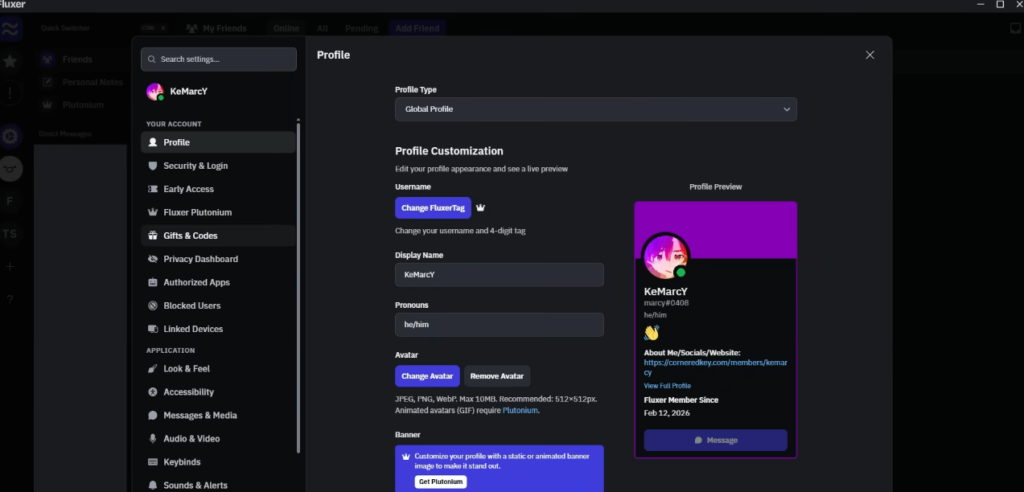
Its promise seems straightforward. It is self-hosted, open source, and free. That final detail is more important than you might think. By running Fluxer on their own hardware, users can take control of their conversations rather than depending on a company’s servers thanks to self-hosting. That concept has a lot of appeal, particularly at a time when digital privacy is perceived more as a subscription feature than a right.
Early adopters talk about installing Fluxer on outdated desktop computers and configuring their own servers while listening to the soft hum of cooling fans in small online forums. It’s not always a straightforward process. The documentation is still being developed. There are bugs. However, that roughness almost makes it more credible. That’s why it feels incomplete.
Fluxer is more than just an experiment, though. The majority of the features that people anticipate are already present. Messaging is dependable. Voice calls have a startlingly clear sound. Screen sharing functions well enough for teamwork. Although it’s still unclear if this advantage will hold as Fluxer expands, some users assert that the audio quality is even better than Discord’s.
After all, growth presents both opportunities and risks.
The strain on Fluxer’s infrastructure is already evident. Verification loops and server errors are minor reminders that software scaling can be challenging for new users. There are moments of frustration mixed in with the excitement when strolling through Fluxer’s public communities. Everyone wants Fluxer to be successful. Pressure is created by that expectation.
The issue of money is another.
Plutonium, a curiously industrial-sounding name for a chat subscription, is how Fluxer provides optional premium features. However, its core functionality is still free, unlike many other platforms. Paywalls are completely removed in self-hosted versions. Its roadmap is not being driven by investors. Not yet, anyway.
Fluxer has freedom because of that independence. It also breeds doubt.
It costs money to run a global communication platform. Servers are expensive. Security demands ongoing focus. As communities expand, moderation becomes more difficult. How Fluxer will deal with those realities in the long run is still unknown, particularly in the absence of the financial support of significant tech companies.
Nevertheless, belief appears to be sustaining it.
There is a tone that differs from the usual tech hype when scrolling through Fluxer discussions. People discuss more than just features. They discuss ownership. Command. Have faith. Words that are rarely used when discussing messaging apps.
It’s difficult to ignore the platform’s emotional resonance.
Skepticism is also present, and it is warranted. In the past, open-source initiatives have grown rapidly before dying out due to funding shortages or developer burnout. It is openly questioned by some users if Fluxer can escape the same fate. Some are concerned that it might eventually turn into the very thing it is attempting to replace.
Both outcomes are possible, according to history.
Fluxer is currently in a precarious middle stage—too big to ignore, but too little to feel safe. Its communities are gradually growing, its servers are still operational, and its code is still changing.
As you follow its development, you get the impression that Fluxer is more than just a chat program. It is indicative of users’ increasing desire to recover areas of the internet that used to feel intimate.
Disclaimer
Nothing published on Creative Learning Guild — including news articles, legal news, lawsuit summaries, settlement guides, legal analysis, financial commentary, expert opinion, educational content, or any other material — constitutes legal advice, financial advice, investment advice, or professional counsel of any kind. All content on this website is provided strictly for informational, educational, and news reporting purposes only. Consult your legal or financial advisor before taking any step.
