

Whether it’s a World Cup match or a bilateral match played on a sweltering afternoon, Quinton de Kock’s attitude to each innings is very identical. Without making any dramatic gestures, he enters the room, calmly adjusts his gloves, and looks around the field as if mentally calculating angles.
The first boundary then comes, frequently much sooner than the bowler anticipates.
De Kock, who was born in Johannesburg in 1992, gained recognition for his daring hitting and especially creative shot selection as he advanced through South Africa’s domestic system. He immediately proved that he was more than simply a bright teenager by using his innate timing and deft glovework. He developed into a player that rivals had to account for.
His white-ball record has significantly improved over the last ten years, but it has been consistent rather than noisy. A batter who combines control and aggression is demonstrated by his more than 7,000 ODI runs, more than 3,000 T20I runs, and strike rates that are noticeably faster than those of many of his peers. He does more than just strike; he makes calculations.
| Category | Details |
|---|---|
| Full Name | Quinton de Kock |
| Born | 17 December 1992, Johannesburg, South Africa |
| Role | Wicketkeeper-batter |
| Batting Style | Left-handed |
| International Debut | T20I (2012), ODI (2013), Test (2014) |
| Former Role | Captain of South Africa (all formats) |
| Notable Milestone | First South African to 3000 T20I runs |
| Career Reference | ESPNcricinfo Player Profile |
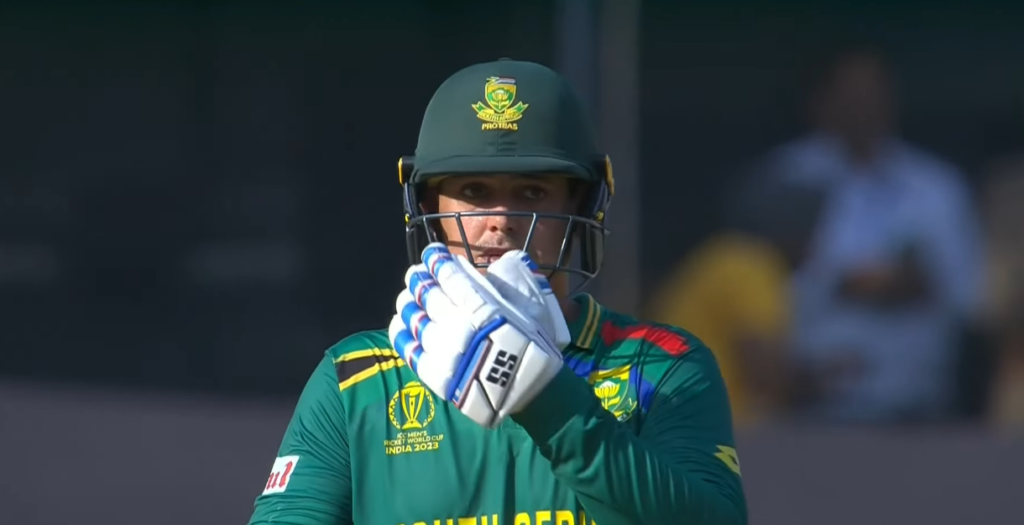
De Kock has done a remarkable job of setting the tempo in the shortest format, where margins are quite thin. His T20 international strike rate of over 140 highlights a highly effective and flexible strategy. With a movement that feels natural yet practiced, he clears his front leg early to create space and turns deliveries into scoring possibilities.
For him, milestones are hardly celebrated.
He became the first South African to reach 3,000 runs in Twenty20 Internationals at the 2026 T20 World Cup. With a clean cover drive—the kind that appears almost automatic when he performs it—the benchmark was reached. Commentators noted the accomplishment, the cheers reverberated, and de Kock only shifted positions.
As I watched that moment, I noticed how little he acknowledged it, as if the immediate chase was more important than statistics.
His career has also included leadership roles. As South Africa’s captain in all forms, he had to maintain composure and clarity during a time of change. More than just tactical knowledge is needed to lead an international team; mental fortitude is also needed to handle public criticism while simplifying on-field choices and allowing teammates to focus.
The weight of the responsibilities seemed heavy at times.
Some onlookers were taken aback by his decision to retire from Test cricket and step aside as captain. On closer inspection, however, it was very advantageous to his longevity. He maintained the explosive edge that characterizes his batting and greatly decreased physical strain by focusing only on white-ball formats.
His flexibility goes beyond his sense of national obligation.
He has shown remarkable versatility in franchise events, including the IPL, SA20, and other T20 leagues. He can accelerate from ball one as he opens the batting. He can anchor and rotate strike with subtle skill when batting deeper before launching late-overs attacks. He is very dependable under pressure because of such duality.
His disposition is strongly depicted in this story.
He discovered he had left his bats behind when he arrived at Centurion for a Twenty20 International. The mistake was made about half an hour before the team bus was scheduled to depart. There were phone calls; serenity gave way to urgency. It was too late for the bats to arrive.
He asked Dewald Brevis for one.
He achieved a career-high score of 115 in T20 internationals using that borrowed bat. Six-fours. Ten sixes. It was a technically competent and strikingly effective show. He later acknowledged that the bat’s balance did not especially appeal to him, characterizing it as weighted toward younger hitters.
Without hesitation, he gave it back.
A subtle reality is revealed in that episode. Equipment mythology has no bearing on De Kock’s confidence. It has its roots in instinct and preparation. Although tools are important, skill is still incredibly resilient.
His effectiveness as a wicketkeeper is frequently overlooked. Compared to his early years, his footwork has significantly improved, with crisper and more efficient motions. He looks almost reflective from behind the stumps, assessing angles, predicting deflections, and responding in a matter of seconds.
Such consistency is especially essential for a team looking to gain control in limited-overs cricket, where tempo can swiftly spin out of hand.
He keeps a somewhat quiet life off the field. He has talked on the value of family balance after he got married in 2016. Setting priorities for home life can be surprisingly difficult at times of high schedule, particularly in the shortened international calendar. That recalibration was mirrored in his decisions to withdraw from specific forms.
Recalibration can be mistaken for retreat by athletes. It seems more like strategic alignment in de Kock’s instance.
Since adolescence, he has been compared to previous greats. The parallels to Adam Gilchrist were especially enduring. wicketkeeper with a left hand. aggressive attitude. revolutionary. De Kock’s identity, however, has grown remarkably obvious over time.
He doesn’t strive for aesthetic excellence.
Impact is what he prefers.
His innings of 178 against Australia is still regarded as one of the most forceful by a South African opener in One-Day Internationals. He has hit boundaries in T20 cricket with a rhythmically assured, rather than reckless, frequency. His shot selection has significantly improved, combining situational awareness with measured risk.
There have also been periods of silence. Lean areas, times when his footwork seemed shaky, and times when his consistency was questioned by observers. But in recent seasons, those stretches have been noticeably shorter, indicating a player who has a deeper understanding of his tempo than previously.
He’s been honed by experience.
De Kock’s role might change once more in the upcoming years as South Africa’s younger hitters take on more responsibilities. His presence in the dressing room, providing subtle direction, might be especially helpful. It’s not always necessary to wear a captain’s armband to demonstrate leadership; sometimes poise and setting an example suffice.
At 33, he exudes a feeling of measured clarity when viewed. Despite his apparent lack of strain, he plays with intensity. When necessary, he speeds up. When necessary, he consolidates. It feels like a really good balance.
Disclaimer
Nothing published on Creative Learning Guild — including news articles, legal news, lawsuit summaries, settlement guides, legal analysis, financial commentary, expert opinion, educational content, or any other material — constitutes legal advice, financial advice, investment advice, or professional counsel of any kind. All content on this website is provided strictly for informational, educational, and news reporting purposes only. Consult your legal or financial advisor before taking any step.
