

Not all announcements from Antarctica are thunderclaps. Sometimes, in stillness, it just melts. The Thwaites Glacier, sometimes referred to as the “Doomsday Glacier,” is subtly coming to represent the urgency of the climate crisis. Its frozen expanse, which is as large as Florida, is majestic and vast. Today, however, what’s going on underneath it matters more than what’s on the outside.
With an ambitious plan to put real-time monitoring equipment almost 1,000 meters below the glacier’s surface, scientists have returned to West Antarctica in recent weeks. The approach is extremely effective in principle: find out how quickly this glacier might melt by studying the actions of warm ocean currents beneath it. As the ice sheet lifts off the seafloor and floats as an ice shelf, the glacier’s underside is being eroded by these currents, which are moving like cunning intruders.
A continuously moving sheet of ice must be precisely drilled through during the procedure. To create boreholes that are just broad enough to drop sensors through before the ice reseals itself, scientists are boiling water to about 90°C and inserting it under tremendous pressure. You cannot afford time. Every hole freezes in two days, thus the process is particularly harsh and demanding. However, after the devices are installed, they will provide data in almost real-time for a minimum of a year.
Temperature, salinity, and current measurements will be taken continuously from the glacier’s grounding zone for the first time. That is a particularly positive development since it may enhance models that forecast sea level rise with much more accuracy. Additionally, the team is gathering sediment samples in order to reconstruct the glacier’s history and identify any trends that might be recurring now.
| Item | Detail |
|---|---|
| Official Name | Thwaites Glacier |
| Nickname | Doomsday Glacier |
| Location | West Antarctica, Marie Byrd Land |
| Size | ~120 km wide; 800–2,000 m thick |
| Sea Level Rise Potential | Up to 65 cm (2+ feet) if it collapses |
| Current Status | Rapidly retreating; highly unstable |
| Research Focus | Ocean melting from below, grounding line erosion |
| Geoengineering Proposal | 50-mile curtain to block warm water |
| Official Source | https://thwaitesglacier.org |
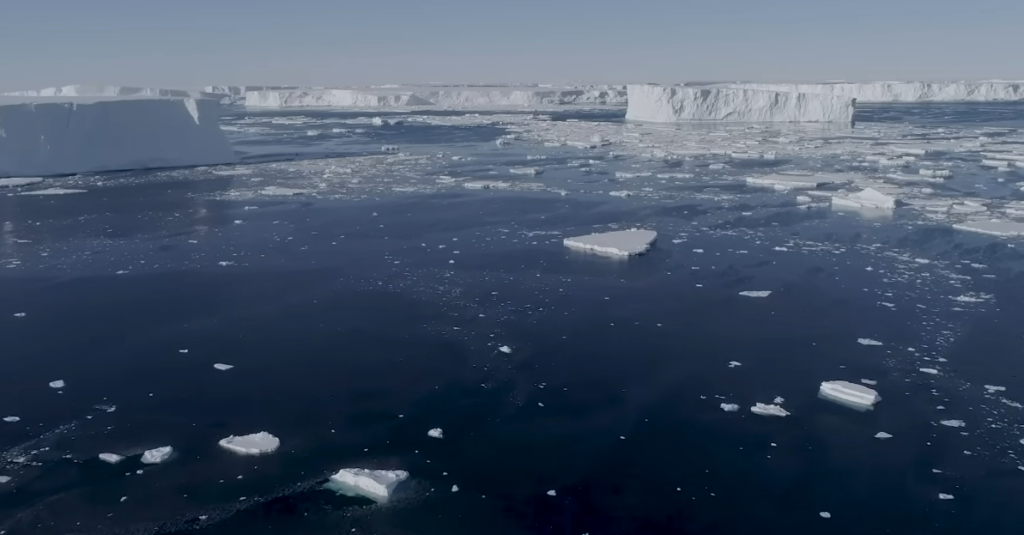
Thwaites is more than just a slab of ice. It serves as the West Antarctic Ice Sheet’s structural support. A chain reaction could occur if it falls and destabilizes nearby glaciers. The region contains enough frozen water overall to cause a more than 5-meter rise in sea levels worldwide. In ways we have ever seen simulated in digital climate models, that scenario would redraw coastlines, force governments to rethink national infrastructure, and displace millions of people.
Through the utilization of new satellite observations and the integration of on-site data, scientists are improving the scope and urgency of mitigation activities. A 50-mile-long, 500-foot-tall, flexible, debris-tethered underwater barrier is one concept that has unexpectedly garnered traction. The aim? either stop the warm water that is currently speeding up the glacier’s retreat or reroute it. Once written off as a sci-fi abstraction, this concept is currently being seriously considered for financing and simulations.
A few years back, I listened to a speaker introduce the curtain project to a panel of skeptics in a Toronto conference room. The atmosphere was one of disinterested laughter. These same researchers are now advocating for trials, arguing that the strategy might be the most practical of a limited number of imperative fixes.
These recommendations mark a shift in the direction of climate action from reactive policies to proactive design. Now, instead of just absorbing the effects of climate change, we are starting to investigate ways to direct them. Although it is still debatable, geoengineering is gaining favor among some who view it as a temporary levee or barrier that could buy crucial time rather than a panacea.
Depending on how accurate the models are, that buffer could be very dependable in controlling heat transport. However, environmental issues continue to exist. Scientists have legitimate concerns, but what if the curtain disturbs marine life? What if additional dangers are introduced during construction? These are important inquiries. However, for many coastal nations currently confronting existential dangers from sea level rise, the urgency is greater than the time to hesitate.
Another team is investigating an alternative approach: refreezing the glacier from the inside out by draining lubricating water beneath the ice cover and removing heat with passive cooling equipment. Now viewed as highly adaptable strategies within a larger suite of climate stabilization instruments, these concepts were originally thought to be unconventional.
There is a financial argument as well. The sea curtain’s construction is expected to cost between $40 and $80 billion, and upkeep would likely cost between $1 and $2 billion annually. It appears remarkably inexpensive in comparison to the billions required to move coastal people or construct sea walls. The funding discussion is gradually moving away from governments alone, with philanthropic organizations, private-sector investors, and even former IT executives supporting early research.
Since the Paris Agreement, glaciers like Thwaites have receded more quickly than expected, while the rate of emissions reductions has been slower than expected. The rhetoric surrounding climate change is undergoing a subtle yet significant shift due to this mismatch: action is no longer binary. It is tactical at times, flexible, and multi-layered.
Any intervention on the continent is complicated by the Antarctic Treaty, which regulates activity there. However, a lot of people contend that permitting Thwaites to fall would violate environmental preservation duties. It turns out that the question of how, when, and to what extent to intervene is more important than whether to do so.
Scientists today have to negotiate between ideology and ice. Aggressive decarbonization, according to some, is still the only moral way to go. Some, led by front-line polar experts, see a hybrid approach that includes both temporary stopgaps to prevent vulnerable countries from losing entire coastlines and further emissions reduction.
Attempting to use technology to stop an old glacier has a curiously human quality. It is comparable to putting a net over a sleeping giant’s mouth in an attempt to postpone its awakening. Nevertheless, that hope seems rooted—not in fantasy, but in logical, fact-based potential.
Heroism and headlines won’t be used if we are successful in slowing down Thwaites. Powered by sensors shining through the darkness of seawater and ideas that were once too daring to finance, it will take place subtly, beneath the ice.
The story of loss is being rewritten by treating the cryosphere as a resource worth protecting rather than as an unavoidable victim. While accepting danger, we are also making the decision to take action—slowly, cooperatively, and purposefully.
Whether we can construct resilience or if we waited too long to try will be the question of the future.
Disclaimer
Nothing published on Creative Learning Guild — including news articles, legal news, lawsuit summaries, settlement guides, legal analysis, financial commentary, expert opinion, educational content, or any other material — constitutes legal advice, financial advice, investment advice, or professional counsel of any kind. All content on this website is provided strictly for informational, educational, and news reporting purposes only. Consult your legal or financial advisor before taking any step.
